
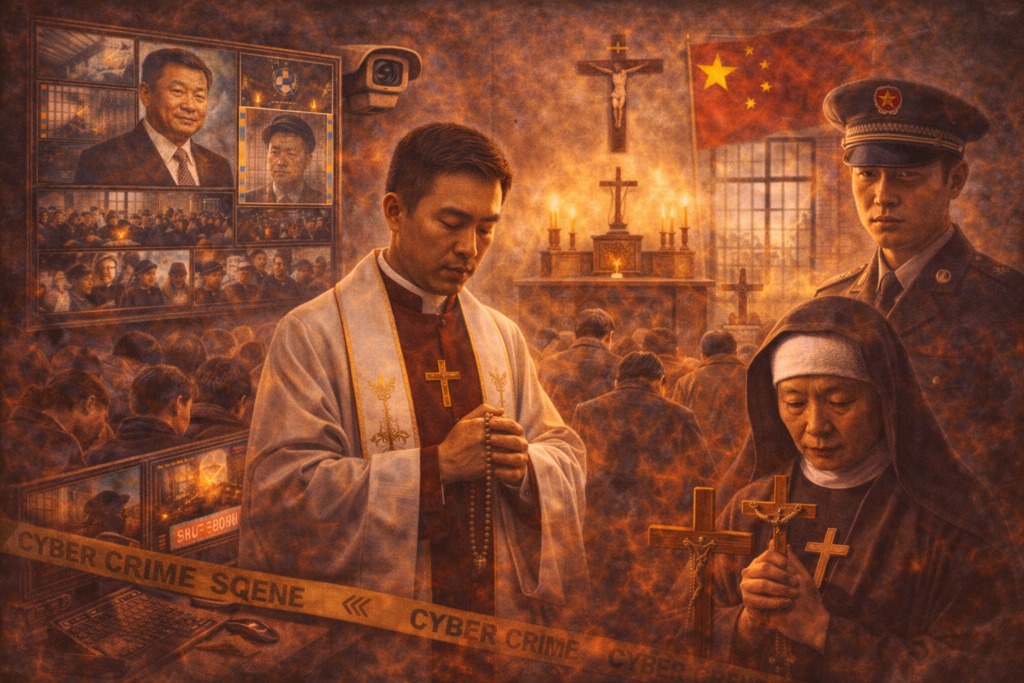
Image Credentials: Image Title: Pressure Mounts on Underground Catholics in China as Government Rejects Crackdown Claims Source: (chatgpt.com) Date: April 2026. Attribution: This image was created using AI-generated imagery (chatgpt.com) and does not depict a real-world scene.
Open Chronicle | With Agencies
Beijing — A new report has raised concerns over increasing pressure on underground Catholic communities in China, alleging tighter surveillance and restrictions as part of a broader state campaign to align religious practice with political ideology.
The findings, published by Human Rights Watch, claim that authorities are intensifying efforts to push Catholics into the state-controlled church, while limiting independent religious activity.
Chinese officials have strongly rejected the allegations, describing the report as biased and lacking credibility.
Longstanding Divide Within Chinese Catholicism
Catholic communities in China have long been divided between the state-sanctioned church and underground congregations that remain loyal to the Vatican.
Tensions between the two structures have persisted for decades, despite efforts to bridge differences through a 2018 agreement between Beijing and the Holy See.
The deal, reached under Pope Francis, allows the Chinese government to propose candidates for bishop appointments, with final approval resting with the pope. However, the full terms of the agreement have never been publicly disclosed.
Allegations of Increased Restrictions
According to the report, pressure on underground Catholics has intensified in recent years through measures such as detentions, house arrests, and restrictions on worship.
Researchers also cite tighter controls over clergy travel, limits on religious gatherings, and increased monitoring of foreign connections.
The report links these developments to a broader policy introduced by Xi Jinping aimed at “Sinicizing” religion, a strategy designed to align religious institutions more closely with Communist Party ideology.
Beijing Denies Accusations
China’s foreign ministry dismissed the claims, stating that religious affairs are managed in accordance with national law and that citizens’ freedom of belief is protected.
Officials accused the report’s authors of fabricating information, emphasizing that recognized religions, including Catholicism, are allowed to operate within the legal framework established by the state.
Vatican Faces Ongoing Dilemma
The issue places renewed focus on the Vatican’s delicate relationship with Beijing.
Pope Leo XIV has indicated he will continue to engage with Chinese authorities while reviewing the long-term future of the 2018 agreement.
The Vatican has sought to balance diplomatic engagement with concerns over religious freedom, a challenge that has grown more complex amid reports of increased pressure on underground communities.
Broader Religious Policy
The report also highlights wider restrictions affecting other religious groups in China, including Buddhists and Muslims, as part of the same ideological campaign.
Authorities officially recognize five religions, Buddhism, Taoism, Catholicism, Protestantism, and Islam, all of which operate under state supervision.
Critics argue that the expanding scope of oversight reflects a tightening grip on religious expression, while Beijing maintains that such measures ensure stability and social cohesion.
An Ongoing Debate
With limited independent access to China, many findings rely on testimony from individuals outside the country and expert analysis, making verification challenging.
As both sides maintain sharply different narratives, the situation underscores the continuing tension between state control and religious autonomy in China.