
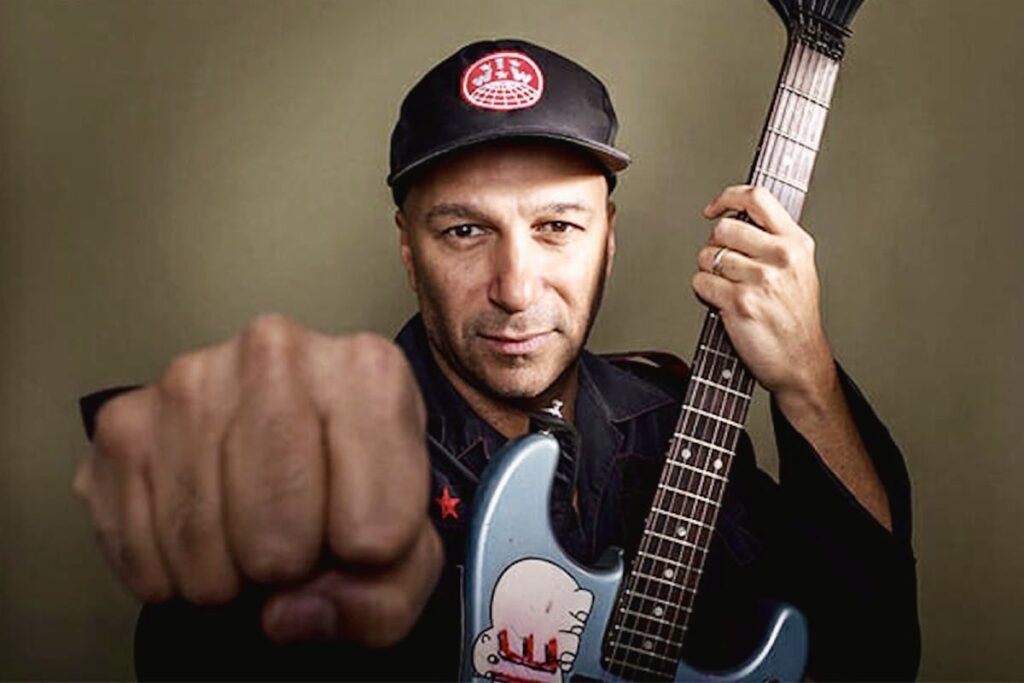
Image: from Rock History Live! X @KTrain939913
Jose Carlos Palma
For Open Chronicle | Why It Works Series | Season 1: Space, Sound, and Identity
There’s an unspoken rule most guitar players follow.
A guitar should sound like a guitar.
Clean or distorted, fast or slow, complex or simple, but still recognizably guitar.
Then there’s Tom Morello.
With Rage Against the Machine, he didn’t just push the instrument forward. He questioned what it was supposed to be in the first place.
The result wasn’t evolution.
It was a disruption.
🎧 The moment
Think of tracks like Bulls on Parade or Know Your Enemy.
What you hear isn’t just riffs or solos. It’s scratching, stuttering, mechanical bursts, textures that feel closer to turntables than traditional guitar playing.
At times, it barely sounds like strings at all.
And that’s exactly the point.
🔍 What you’re actually hearing
On the surface, it feels chaotic.
But underneath, there’s control:
- aggressive use of effects, wah, delay, pitch shifting
- toggle switch and kill-switch techniques
- rhythmic manipulation of noise
- intentional rejection of “clean” playing
Morello isn’t layering complexity.
He’s redefining function.
The guitar stops being just a melodic instrument. It becomes percussive, textural, almost electronic.
⚙️ Why it works
1. Constraint drives creativity
Morello has often spoken about working with limited gear.
Instead of endless options, he explored the extremes of what he already had.
Limitations didn’t reduce creativity. They forced it.
2. Rhythm replaces melody
Many of his most iconic parts are not about notes; they’re about timing.
The “scratching” effect works because it locks into the groove like a drum pattern.
It’s not just played. It’s performed rhythmically.
3. Identity over correctness
By traditional standards, many of these sounds would be considered wrong.
Too noisy, too unconventional, too far from the expected technique.
But that’s exactly why they stand out.
He’s not trying to fit into the instrument. He’s reshaping it around his ideas.
4. Sound as language
Most players think in terms of scales and chords.
Morello thinks in terms of sound.
Texture becomes vocabulary. Noise becomes expression.
And suddenly, the guitar isn’t limited to what it has been; it becomes what it can be.
🌍 Cultural context
This approach didn’t emerge randomly.
In the 90s, hip-hop, DJ culture, and sampling were redefining how music was created and experienced.
Morello absorbed that energy.
Instead of competing with it, he translated it into guitar.
The result is a hybrid language, part rock, part machine, part protest.
It’s not just a stylistic choice. It’s a cultural bridge.
🎯 How to apply it
You don’t need a complex rig to start thinking differently.
Try this:
1. Break the “rules”
Play something that would normally sound wrong. Then repeat it until it feels intentional.
2. Think like a drummer
Mute the strings and focus on rhythm. Treat the guitar as percussion.
3. Explore your gear fully
Before buying anything new, push your current setup to its limits.
Most players barely scratch the surface of what they already have.
🧩 What most guitarists miss
Innovation rarely comes from adding more.
It comes from using things differently.
Most players ask:
“What else do I need?”
Morello asked:
“What else can this become?”
That shift changes everything.
🎸 Conclusion
Tom Morello doesn’t sound unique because of what he plays.
He sounds unique because of how he thinks.
He didn’t just learn the language of the guitar.
He rewrote parts of it.
And that’s the real lesson:
You don’t need a new instrument to sound different.
You need a new perspective on the one you already have.
← Previous Episode | Next Episode →| Season 1 →

GuitarWorldX
Lessons, gear, techniques, artists, guitar legends and the stories shaping the world of guitar.
Return to GuitarWorldX ›