
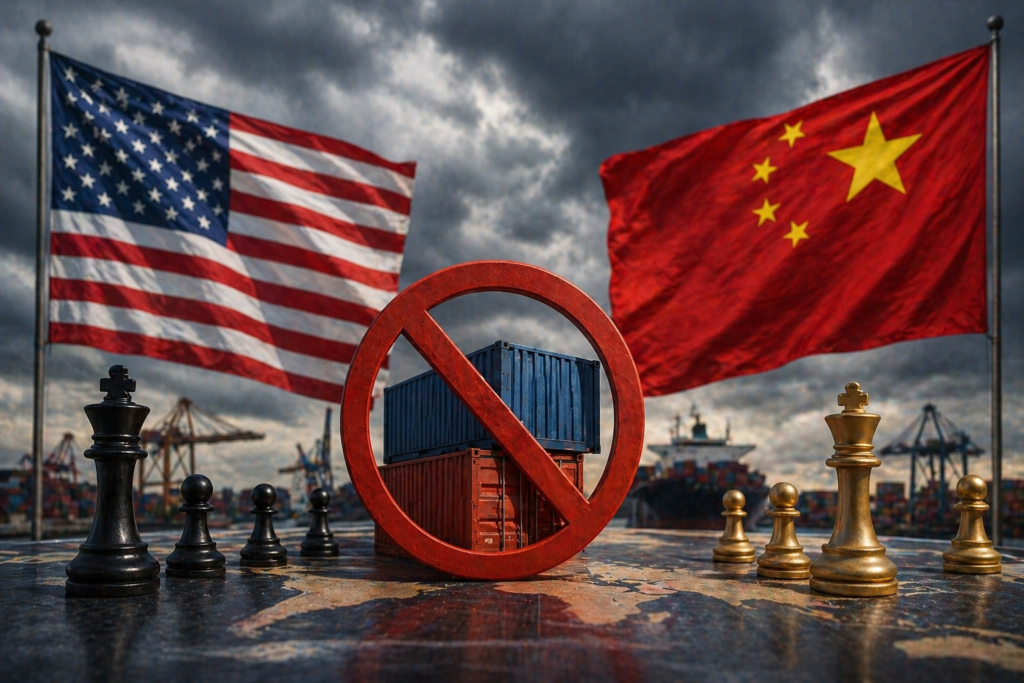
Image Credentials: Image Title: China Rejects U.S. Sanctions on Firms, Vows to Defend Corporate InterestsSource: (chatgpt.com) Date: April 2026. Attribution: This image was created using AI-generated imagery (chatgpt.com) by Open Chronicle and does not depict a real-world scene.
By Open Chronicle with Agencies
China has sharply criticized new U.S. sanctions targeting Chinese companies, describing the measures as “illicit” and pledging to protect the interests of its firms amid rising economic tensions between Washington and Beijing.
Speaking in Beijing, Foreign Ministry spokesman Lin Jian said China firmly opposes unilateral sanctions that lack a basis in international law. He urged the United States to abandon what he called “abusive” practices and warned against the use of long-arm jurisdiction affecting foreign businesses.
The remarks came after the US Department of the Treasury announced a new round of Iran-related sanctions. The measures include restrictions on a major Chinese refinery, Hengli Petrochemical, along with nearly 40 additional entities linked to what Washington describes as Iran’s illicit oil trade.
According to U.S. officials, the sanctions are part of broader efforts to disrupt financial networks supporting Tehran’s energy exports. Tommy Pigott said the actions are intended to curb activities that undermine international sanctions regimes tied to Iran.
China, however, views the measures as an overreach. Beijing argues that such sanctions interfere with legitimate commercial operations and undermine global trade norms. Officials have reiterated that Chinese companies must be allowed to operate without external political pressure, particularly when engaging in lawful international business.
The dispute reflects a broader pattern of economic friction between the world’s two largest economies. Sanctions, trade restrictions, and regulatory measures have increasingly become tools of geopolitical competition, with both sides accusing the other of destabilizing global markets.
For China, the issue also touches on energy security and supply chains. Independent refineries, often referred to as “teapot” refineries and concentrated in provinces such as Shandong, play a significant role in processing imported crude oil. Restrictions on these entities could have ripple effects across regional and global energy markets.
Beijing has signaled that it will continue to respond to such actions, though it has not yet outlined specific countermeasures. The emphasis, for now, remains on diplomatic protest and the defense of corporate interests.
As tensions persist, the episode highlights the increasingly complex intersection of geopolitics, trade, and energy, where economic decisions are closely tied to broader strategic rivalries.