
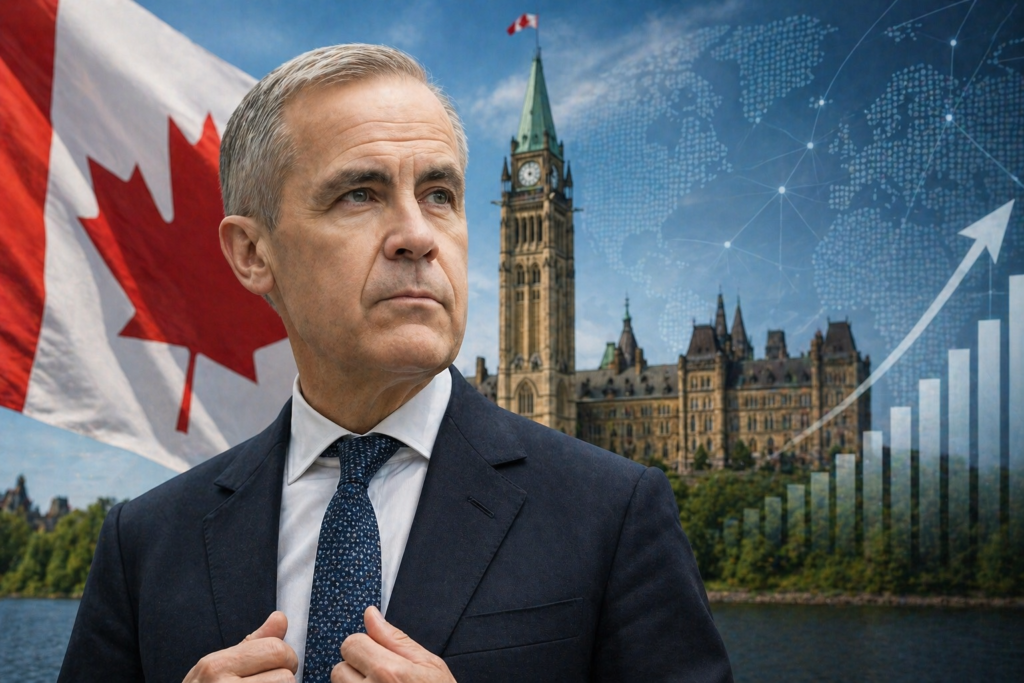
Image Credentials: Image Title: Mark Carney’s Political Honeymoon Faces Its First Real Test in Canada Source: (chatgpt.com) Date: April 2026. Attribution: This image was created using AI-generated imagery (chatgpt.com) by Open Chronicle and does not depict a real-world scene.
By Open Chronicle with Agencies
When Mark Carney entered Canadian politics, he did so with an unconventional profile, a former central banker with global credentials but no electoral experience. Within a year, he had defied expectations, leading the Liberal Party to power and consolidating a narrow majority in parliament. Today, he stands as one of the most prominent political figures on the global stage, but the real test of his leadership may only just be beginning.
Carney’s rise has been swift and, for many, surprising. With a background shaped by institutions such as the Bank of England and the Bank of Canada, he brought technocratic authority to a political system often defined by career politicians. His transition from economic policymaker to head of government was seen as a gamble, yet it has so far delivered political stability and strong public approval.
Internationally, Carney has cultivated a high-profile presence. His speech at the World Economic Forum in Davos positioned him as a leading voice among middle powers seeking to navigate what he described as a fractured global order. That message resonated in a world increasingly shaped by geopolitical rivalry, particularly during the presidency of Donald Trump.
Recognition has followed. In a profile written by Christine Lagarde, Carney was described as a “rock-star” figure in global economic and political circles, credited with anticipating the breakdown of traditional international cooperation.
At home, however, expectations are mounting. Carney has promised transformative change, from launching the most ambitious housing program since World War II to turning Canada into an energy superpower and reducing reliance on the United States, its largest trading partner. These pledges have raised hopes, but also scrutiny.
His political strength has, in part, been shaped by external dynamics. Tensions with the United States, including tariffs on Canadian industries and controversial remarks about Canada’s sovereignty, have shifted public focus outward. This has given Carney political space, allowing Canadians to view many economic challenges as externally driven.
Yet that buffer may not last. A critical test looms in the upcoming review of the North American trade agreement, known as the USMCA. Negotiations with Washington have yet to gain momentum, and industries affected by tariffs, particularly metals, automotive manufacturing, and lumber, are already feeling the strain.
Opposition leader Pierre Poilievre has seized on the issue, accusing the government of inaction and calling for greater transparency in trade negotiations. The criticism reflects a broader concern that Carney’s global focus may come at the expense of domestic priorities.
Economic pressures are also re-emerging as a central issue. Rising fuel costs, driven in part by global conflict, along with persistent housing affordability challenges and youth unemployment, are beginning to dominate public debate once again.
The government has responded with targeted measures, including temporary tax relief on fuel and a one-time grocery rebate. However, some of Carney’s more ambitious plans, particularly on housing, have faced skepticism. Analysts argue that current policies rely too heavily on reducing demand rather than significantly increasing supply.
Despite these challenges, Carney retains a key advantage, time. With a parliamentary majority, his government could remain in power until 2029, offering a long horizon to deliver on promises and shape his legacy.
For now, the question is not whether Carney has captured attention, but whether he can convert momentum into lasting results. The honeymoon phase, defined by optimism and global acclaim, is giving way to a more demanding reality, one where Canadians will increasingly judge him not by his vision but by his delivery.