
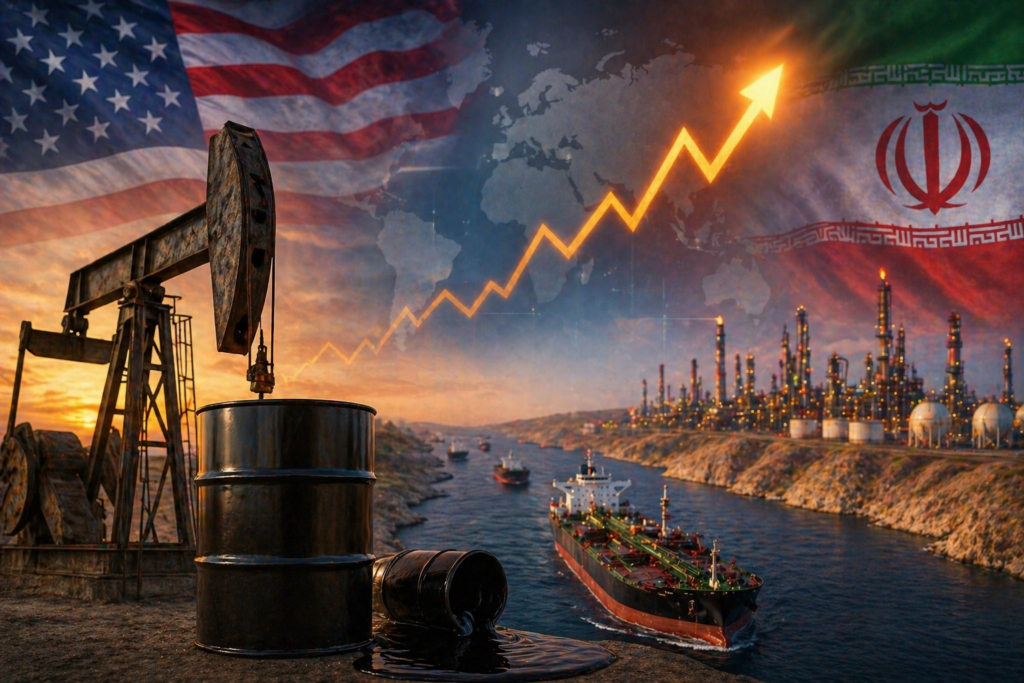
Image Credentials: Image Title: Oil Prices Rise as U.S.-Iran Peace Talks Stall and Supply Concerns Deepen Source: (chatgpt.com) Date: April 2026. Attribution: This image was created using AI-generated imagery (chatgpt.com) by Open Chronicle and does not depict a real-world scene.
By Open Chronicle with Agencies
Global oil prices have climbed sharply after a new setback in diplomatic efforts between the United States and Iran, reinforcing fears of prolonged disruption to energy supplies.
Brent crude, the international benchmark, rose by around 2% to $109.33 per barrel, while U.S. crude futures also gained 2%, reaching $96.78. The increases reflect growing uncertainty after U.S. President Donald Trump confirmed that Washington had cancelled plans to send a delegation to Pakistan for a second round of talks with Iranian officials.
The stalled negotiations come at a critical moment for global energy markets. Since the outbreak of conflict involving Iran, the Strait of Hormuz, one of the world’s most vital النفط transit routes, has been effectively closed. Roughly a fifth of global crude oil and liquefied natural gas supplies typically pass through the narrow waterway.
Iran has signaled ongoing diplomatic engagement through regional channels. Foreign Minister Abbas Araghchi said discussions with Oman were continuing, focusing on regional stability and ensuring safe transit through the strait. He later traveled to Russia for talks with Vladimir Putin, highlighting the broader geopolitical dimension of the crisis.
Despite these efforts, markets remain cautious. Brent prices have risen by more than 10% since last week, when President Trump announced an extension of a ceasefire window to allow Iran time to present a unified negotiating position. However, the lack of tangible progress has dampened expectations of a near-term resolution.
Analysts warn that the implications extend far beyond fuel prices. Sophie Huynh of BNP Paribas noted that sustained disruption could ripple through global supply chains, affecting everyday goods from basic household items to essential medical supplies.
Economists also point to a shift in market behavior. According to Goh Jing Rong of Singapore Management University, traders are increasingly reluctant to react to political signals alone, instead waiting for concrete evidence of de-escalation before adjusting positions.
Financial markets have reflected this cautious sentiment. European indices showed mixed movements in early trading, while Asian markets posted gains, with Japan’s Nikkei 225 and South Korea’s Kospi continuing their recent upward momentum despite initial volatility triggered by the conflict.
For energy-dependent economies, particularly in Asia, the stakes remain high. Japan and South Korea, both heavily reliant on Gulf energy imports, have already experienced market turbulence, underscoring the global reach of the crisis.
As diplomatic efforts stall and geopolitical tensions persist, the trajectory of oil prices will likely remain closely tied to developments in the Strait of Hormuz. For now, the market is signaling a clear message: uncertainty remains the dominant force shaping the global energy outlook.