
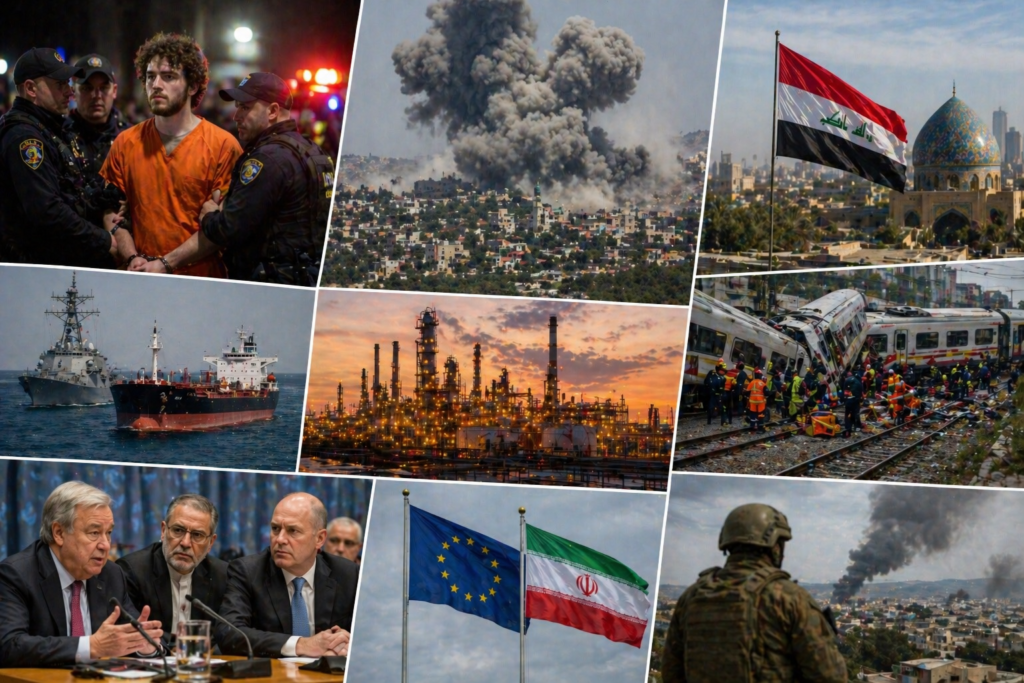
Image Credentials: Image Title: Global News Brief: Key Events and Developments for April 28, 2026 Source: (chatgpt.com) Date: April 2026. Attribution: This image was created using AI-generated imagery (chatgpt.com) by Open Chronicle and does not depict a real-world scene.
By Open Chronicle with Agencies
A series of major developments across global security, politics, and energy markets is shaping the international landscape, from escalating tensions in the Middle East to a high-profile criminal case in the United States.
Suspect Charged in Washington Shooting
The man accused of opening fire during the White House Correspondents’ Dinner has been formally charged with attempting to assassinate U.S. President Donald Trump.
Cole Allen, a 31-year-old from California, appeared in federal court on Monday facing multiple charges, including attempted assassination, transporting weapons across state lines, and discharging a firearm during a violent crime. Authorities say he rushed a Secret Service checkpoint at the Washington Hilton before being apprehended.
If convicted, Allen could face life imprisonment. He remains in custody pending a further hearing later this week.
Deadly Strikes in Southern Lebanon
At least four people have been killed and 51 injured in Israeli airstrikes on southern Lebanon, according to the country’s health authorities. Among the victims are civilians, including a woman, while children are also reported among the injured.
The strikes targeted areas such as Majdal Zoun in the Tyre district, with additional military activity reported in Hanin and Chihine. The violence comes despite an existing ceasefire and adds to a mounting humanitarian toll, with over 2,500 deaths and more than 1.6 million displaced since early March.
Iraq Names New Prime Ministerial Candidate
In Baghdad, Iraq’s largest parliamentary alliance has nominated Ali Al-Zaidi as its candidate for prime minister.
The Coordination Framework bloc announced the decision following internal discussions, praising the outgoing administration led by Mohammed Shia Al-Sudani. The move follows the withdrawal of former prime minister Nouri al-Maliki from consideration, clearing the path for a new leadership transition.
Global Developments in Brief
Tensions remain high in the Middle East as diplomatic efforts stall. Antonio Guterres has urged the reopening of the Strait of Hormuz, while Iran’s ambassador to the United Nations accused the U.S. and Israel of escalating conflict.
German Chancellor Friedrich Merz reiterated criticism of Western military strategy, calling for stronger European diplomatic engagement. Meanwhile, Mark Carney warned that the foundations of the global order are shifting.
Elsewhere, a train collision in Indonesia has left at least 14 dead and dozens injured, while tensions on the Korean Peninsula persist, with South Korea urging international action over North Korea’s nuclear ambitions.
Energy and Economic Pressures Mount
The global energy market remains under strain as shipping through the Strait of Hormuz remains limited. Only a handful of vessels have crossed the vital corridor in recent hours, reflecting ongoing uncertainty.
European Commission President Ursula von der Leyen said Europe has paid an additional $32 billion for energy imports since the conflict began, describing the situation as the continent’s second major energy crisis in recent years.
She warned that Europe’s reliance on imported fossil fuels continues to expose it to geopolitical shocks, reinforcing calls for greater energy independence.
From Washington to the Middle East and beyond, the day’s developments underline a world facing simultaneous security threats, political transitions, and economic pressures, with few signs of immediate stabilization.