
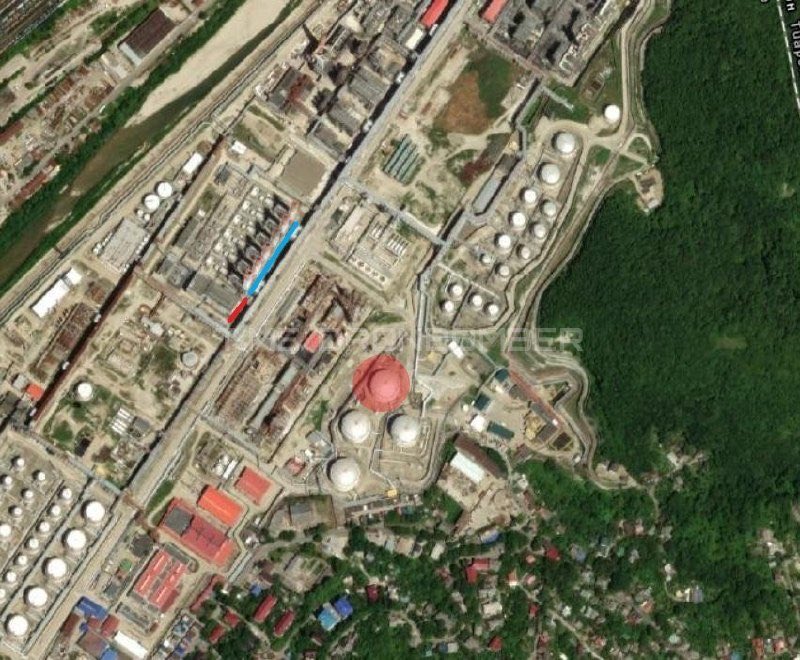
Image: from Big Ben X @alternative_war
By Open Chronicle with Agencies
Authorities in southern Russia have declared a regional state of emergency in the Black Sea port city of Tuapse after a drone attack ignited a large fire at a key oil refinery, intensifying concerns over infrastructure security and environmental risks.
The blaze, triggered by what officials described as an aerial strike, has mobilized a large-scale emergency response. According to regional authorities in Krasnodar Krai, more than 200 personnel and around 50 pieces of equipment have been deployed to contain the fire.
🇺🇦🇷🇺 BREAKING NEWS – Flaming oil is leaking from the Tuapse refinery, which was hit by Ukrainian drones overnight, causing a fire that is still out of control. pic.twitter.com/UCJPo2YjLA
— Media Express (@media_express_) April 28, 2026
Emergency services confirmed that dozens of residents have already been evacuated from nearby areas. At least 31 people, including nine children, were moved to a temporary evacuation center, with contingency plans in place to relocate additional people to hotels if conditions worsen.
The refinery, located along the strategic Black Sea coastline, has been repeatedly targeted in recent weeks. Officials previously reported an oil spill following an earlier strike in mid-April, raising environmental concerns as contamination spread into surrounding areas.
Ukraine’s military has acknowledged carrying out operations against the facility, describing the strikes as part of efforts to weaken Russia’s military and economic capacity. The latest attack is seen as a continuation of that strategy, aimed at disrupting fuel production and export logistics.
Meanwhile, Russia’s Defense Ministry said its air defense systems intercepted 186 Ukrainian drones across multiple regions, including Krasnodar, as well as over the Black Sea, the Sea of Azov, and Crimea.
The repeated targeting of energy infrastructure highlights the evolving nature of the conflict, where economic assets and supply chains are increasingly drawn into the battlefield.
As firefighting efforts continue in Tuapse, the incident underscores the growing risks faced by civilian populations living near strategic facilities, as well as the broader implications for global energy markets already under pressure from geopolitical instability.