
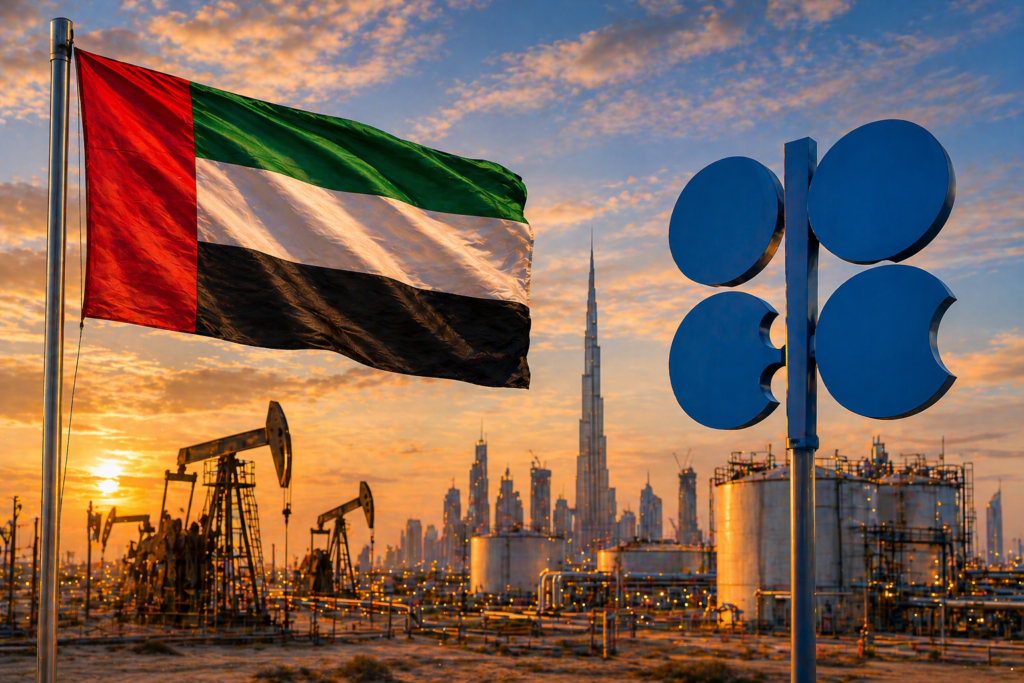
Image Credentials: Image Title: Why the UAE Withdrew from OPEC? Strategy, Tensions, and a Changing Energy Landscape Source: (chatgpt.com) Date: April 2026. Attribution: This image was created using AI-generated imagery (chatgpt.com) by Open Chronicle and does not depict a real-world scene.
By Madison Walker | The Grand Strategy Institute
The decision by the United Arab Emirates to withdraw from OPEC and the broader OPEC+ marks a significant turning point for global energy politics, raising questions about the future cohesion of the oil cartel and the balance of power within it.
Announced amid the ongoing Iran war and its disruptive impact on global energy markets, the move reflects both long-standing tensions within OPEC and a strategic recalibration by Abu Dhabi.
At the core of the UAE’s decision lies its frustration with production limits imposed by OPEC. For years, the country has pushed for higher output quotas, arguing that its growing production capacity was not adequately reflected in its assigned limits.
By leaving the organization, the UAE frees itself from these constraints, gaining greater flexibility to increase production and exports in line with its national strategy. According to energy analysts, this autonomy could become a key advantage as global demand for oil and petrochemicals continues to rise.
UAE Energy Minister Suhail bin Mohammed Al Mazrouei said the decision followed a comprehensive review of the country’s long-term energy strategy, emphasizing the need to adapt to shifting market dynamics and future demand.
While the idea of a potential exit had circulated in the past, analysts say the timing of the decision is particularly significant. The ongoing conflict involving Iran has disrupted shipping routes through the Strait of Hormuz, a critical artery for global oil flows, and intensified uncertainty across energy markets.
Ali Al-Riyami, a regional oil expert, described the move as unexpected in both timing and execution, noting that it caught markets and even OPEC members by surprise. He suggested that broader political dynamics in the Gulf may also have played a role, though definitive conclusions remain premature.
The UAE’s relationship with Saudi Arabia, OPEC’s leading power, has been a key source of friction. Disputes over production quotas have repeatedly surfaced, including a major standoff in 2021 that temporarily derailed OPEC+ negotiations.
Although compromises were eventually reached, the disagreements highlighted deeper structural tensions within the alliance. The UAE’s departure now removes one of OPEC’s most influential voices, potentially weakening its ability to present a unified front.
Energy analysts warn that Saudi Arabia may now shoulder a greater burden in maintaining market stability, as the cartel loses one of its key “shock absorbers.”
In the immediate aftermath of the announcement, oil prices rose modestly, reflecting uncertainty among traders. However, experts expect the short-term impact to remain limited, with more significant effects likely to emerge over time.
Greater production flexibility for the UAE could intensify competition in global markets, particularly if other producers follow a similar path. While competition already exists, the erosion of coordinated output controls may gradually reduce OPEC’s influence over pricing.
Political analyst Ebtesam Al-Ketbi described the move not as a simple withdrawal but as a strategic repositioning, allowing the UAE to respond more effectively to disruptions and strengthen its role in global supply chains.
The UAE’s exit does not necessarily signal an immediate breakdown of cooperation among oil producers, but it does raise important questions about the future of collective market management.
With energy markets under pressure from geopolitical tensions, supply disruptions, and shifting demand patterns, the departure of a major player like the UAE could mark the beginning of a more fragmented and competitive era.
For now, the full implications remain uncertain. What is clear, however, is that the UAE has chosen to prioritize strategic flexibility over collective discipline, a decision that could reshape the global energy landscape in the years ahead.
The Grand Strategy Institute
Continue Exploring Strategic Analysis
Return to The Grand Strategy Institute for strategic assessments, long-form analysis and research examining geopolitics, military affairs, international security, emerging technologies and the changing international order.
← Back to The Grand Strategy Institute