
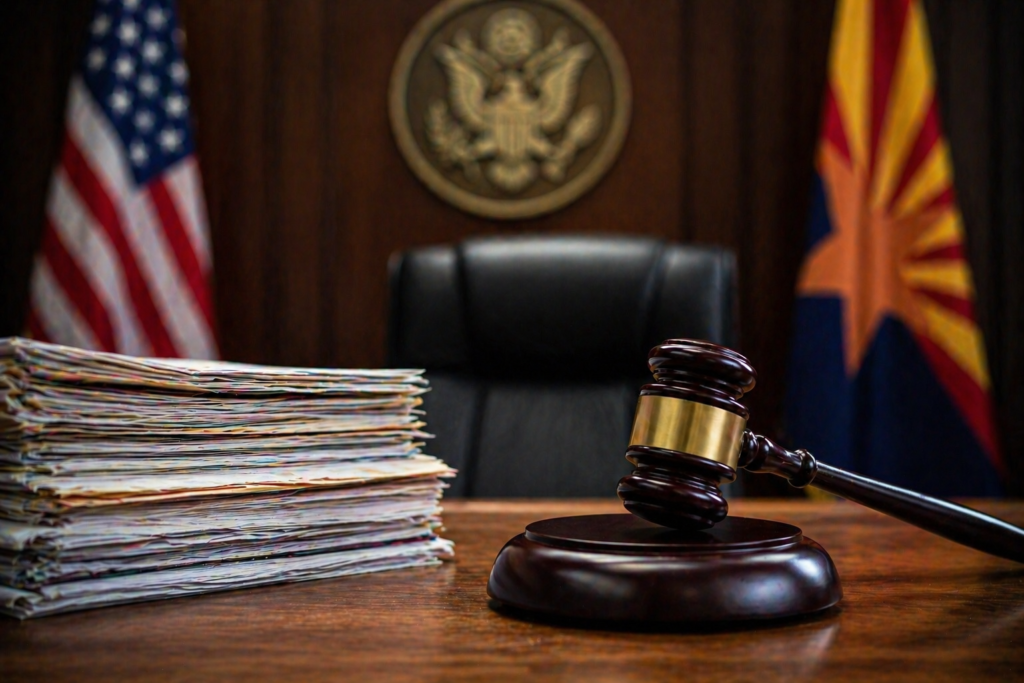
Image Credentials: Image Title: US Judge Blocks Federal Effort to Access Arizona Voter Data Source: (chatgpt.com) Date: April 2026. Attribution: This image was created using AI-generated imagery (chatgpt.com) by Open Chronicle and does not depict a real-world scene.
By Open Chronicle with Agencies
A federal judge in the United States has ruled against efforts by the Trump administration to obtain detailed voter registration data from the state of Arizona, marking another legal setback in a broader campaign targeting election records nationwide.
Susan Brnovich, serving on the U.S. District Court for the District of Arizona, determined that the state’s voter registration list is not subject to such requests under federal law. In her decision, issued Tuesday, Brnovich dismissed the case with prejudice, effectively preventing it from being refiled.
Legal Grounds for Rejection
In her ruling, Brnovich stated that any attempt to amend the complaint would be “legally futile,” indicating that the legal basis for the request lacked sufficient merit. The decision reinforces the authority of states over their own voter data and sets limits on federal intervention in election administration.
The case centered on an attempt by the U.S. Department of Justice to obtain sensitive voter information, including dates of birth, addresses, driver’s license numbers, and partial Social Security details.
Part of a Broader Effort
The Arizona case is one of many similar legal actions pursued by federal authorities. The Justice Department has filed lawsuits against at least 30 states and the District of Columbia, seeking access to voter databases as part of a wider push to review and verify electoral records.
However, courts have repeatedly pushed back on these efforts, raising concerns about privacy, federal overreach, and the legal limits of such data requests.
Implications for Election Oversight
The ruling underscores ongoing tensions between federal and state authorities over election governance in the United States. While proponents argue that access to voter data is necessary to ensure election integrity, critics warn that such moves could undermine privacy protections and public trust.
For Arizona, the decision affirms the state’s control over its voter registration system and signals judicial resistance to expansive federal data collection efforts.
Continuing Debate
The broader debate over election security and transparency remains highly politicized, particularly in the wake of recent election cycles. Legal challenges like this one highlight the complex balance between safeguarding electoral systems and protecting individual rights.
As similar cases continue to unfold across the country, the role of the courts will remain central in defining the boundaries of election oversight in the United States.