
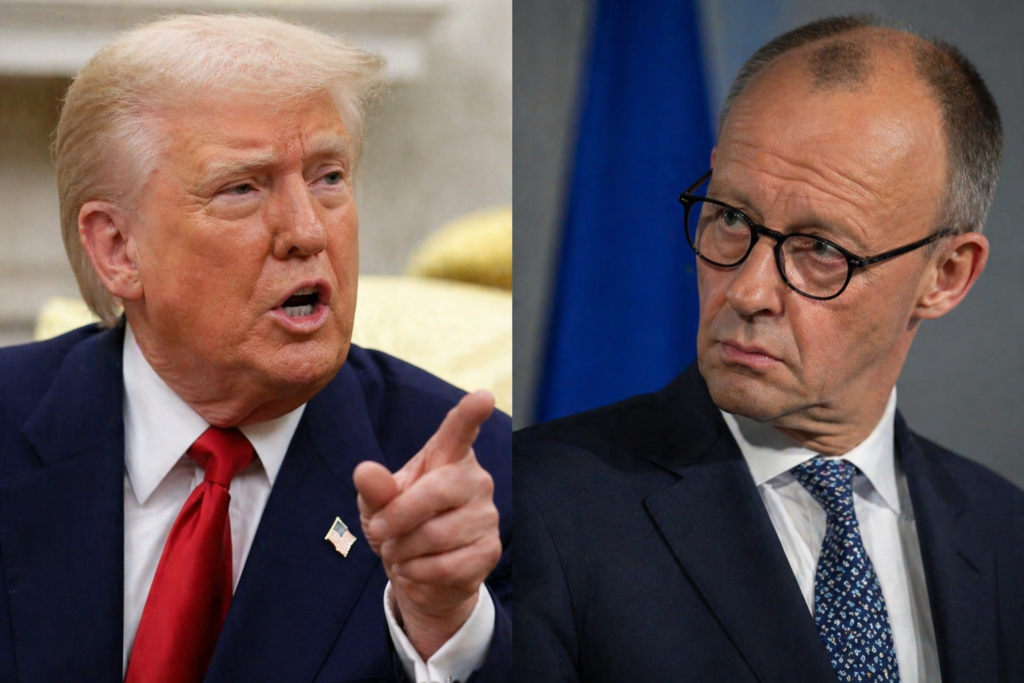
Image Credentials: Image Title: Trump Escalates Criticism of Germany’s Merz Over Iran Dispute Source: (chatgpt.com) Date: April 2026. Attribution: This image was created using AI-generated imagery (chatgpt.com) by Open Chronicle and does not depict a real-world scene.
By Open Chronicle with Agencies
U.S. President Donald Trump intensified his criticism of German Chancellor Friedrich Merz on Thursday, deepening a transatlantic rift over the ongoing conflict with Iran and broader geopolitical strategy.
In a series of remarks and a social media post, Trump accused Merz of mishandling domestic issues while interfering in U.S. efforts to confront what he described as the “Iran nuclear threat.” He urged the German leader to focus instead on challenges within Germany, including energy policy and immigration, as well as Europe’s role in the war in Ukraine.
“The Chancellor of Germany should spend more time fixing his own country and less time interfering,” Trump said, adding that Merz had been “totally ineffective” in addressing the Russia-Ukraine conflict.
The sharp comments follow several days of public exchanges between the two leaders. Earlier in the week, Trump dismissed Merz’s assessment that Iran had gained the upper hand in diplomatic efforts to end the war, saying the German chancellor “didn’t know what he was talking about.”
During a separate appearance, Trump also criticized Germany’s handling of economic and security issues, arguing that Berlin had failed to play a constructive role in resolving key international crises.
Merz, for his part, has taken a more measured tone. Speaking at a military base, he reaffirmed Germany’s commitment to cooperation with its allies and emphasized the importance of maintaining strong transatlantic ties. While he did not directly respond to Trump’s latest remarks, he confirmed that Germany remains in close coordination with its partners.
The German leader also signaled openness to participating in a potential international mission to secure the Strait of Hormuz, a critical shipping route that has been heavily disrupted since the outbreak of the Iran conflict on February 28.
The Strait’s partial blockade has had far-reaching consequences, significantly reducing oil shipments and contributing to rising global energy prices. Supply chains across multiple sectors, including agriculture and manufacturing, have also been affected.
The growing tension between Washington and Berlin comes at a sensitive moment for the Western alliance, as both countries navigate overlapping crises involving Iran, Ukraine, and global economic stability.
Despite the political friction, analysts note that both sides continue to rely on long-standing strategic cooperation. However, the increasingly public nature of the disagreement raises concerns about unity among key allies at a time of heightened global uncertainty.