
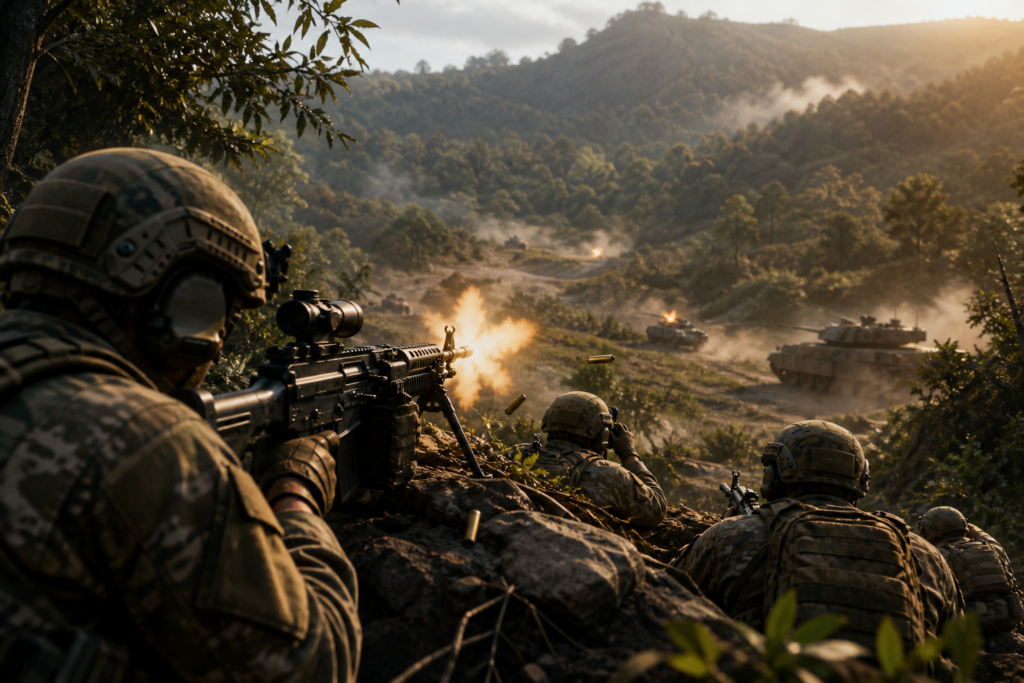
Image Credentials: Image Title: Reconnaissance by Fire Source: (chatgpt.com) Date: May 2026. Attribution: This image was created using AI-generated imagery (chatgpt.com) by Open Chronicle and does not depict a real-world scene.
Reconnaissance by fire is a method of reconnaissance in which fire is directed at a suspected enemy position to force the adversary to reveal their presence through movement or return fire. The formal definition used by NATO maintains this meaning, and the United States Army doctrine adds that the enemy’s reaction helps improve target acquisition and enables the concentration of fires on the detected element.
It is not the same concept as reconnaissance in force, which allied terminology defines as an offensive operation to discover or test enemy strength, nor does it coincide with support by fire, which means engaging the enemy with direct fire in support of another maneuvering force. In practice, reconnaissance by fire is less a standalone operation and more a tactical method that can be used by small infantry units, mounted elements, tanks, security teams, and forward artillery elements.
Concept
Infantry doctrine describes the method as engaging possible enemy locations to provoke a tactical response, such as return fire or movement. This effect turns suspicions into observable data, helping the commander confirm the position, nature, and sometimes the approximate size of the opposing force. At smaller unit levels, it is common for a commander to order a squad in overwatch to open fire on a likely position before the maneuvering squad advances by bounds.
Tactical manuals show that the technique is especially useful when time is limited, when contact is expected, or when direct observation is insufficient. Its use appears in armored forces of the United States Marine Corps, in forward artillery elements, and even in the security of motorized columns, always with the same logic: firing on likely positions to reveal ambushes, defensive positions, or concealed enemy presence.
Doctrinal Development
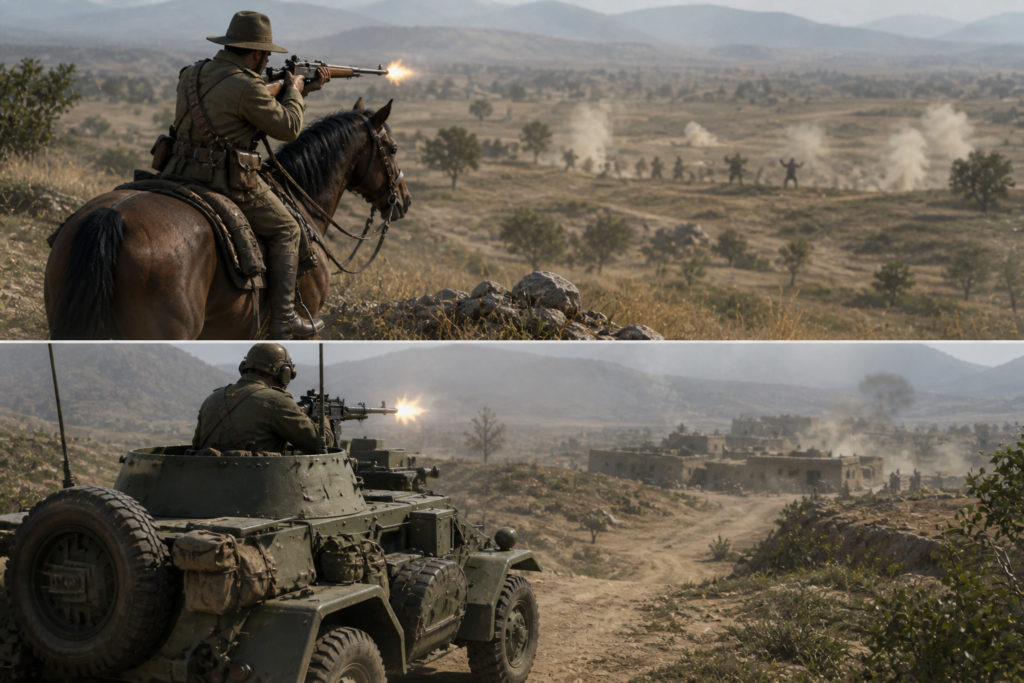
The technique predates World War II. A study of doctrinal history in the US Army shows that horse cavalry doctrine from 1938 already encouraged reconnaissance by fire when careful observation failed to reveal the enemy. In such cases, the scout would move into a visible position, fire on the suspected area, and immediately seek cover, relying on enemy reaction to confirm occupation. The same study shows that reconnaissance vehicles later adopted the method when rapid results were required.
After the war, reconnaissance by fire remained codified in infantry, armored, and artillery manuals. Technical texts emphasize their usefulness for target acquisition, clarifying likely positions, and protecting maneuver, while also making clear that it requires fire control, situational awareness, and coordination with friendly forces. The continued presence of the term in NATO glossaries and US doctrinal publications shows that the technique is not merely an improvised combat measure, but a stable part of the professional military lexicon.
World War II
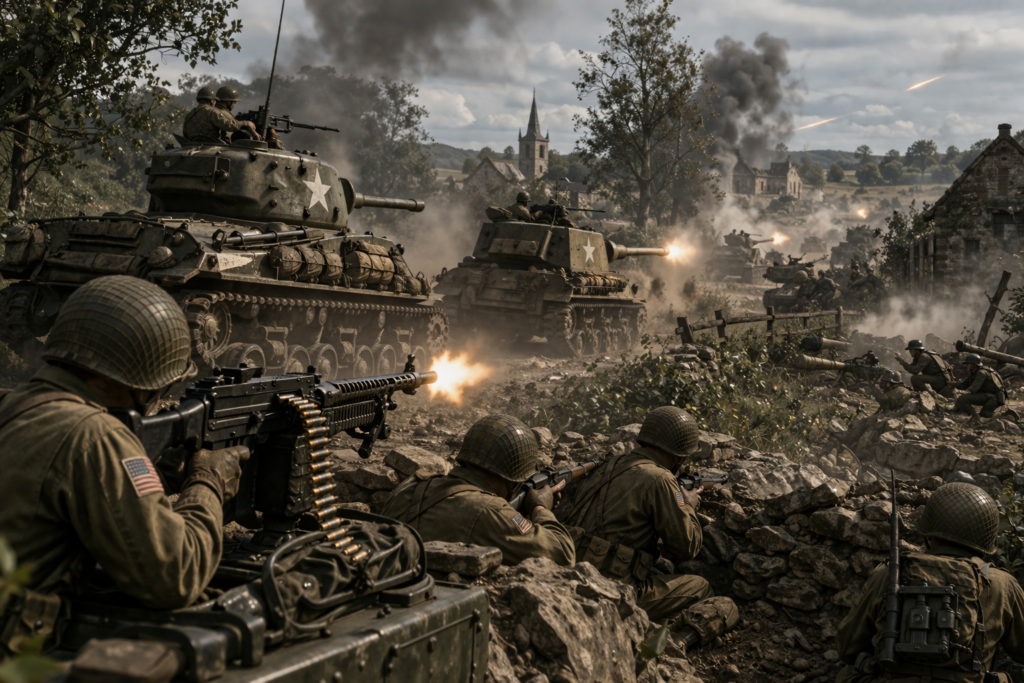
On the European front of World War II, professional literature from the armored branch of the US Army describes reconnaissance by fire as an important practice of rapidly advancing armored forces. In this context, reconnaissance elements moved ahead, self-propelled artillery followed close behind the spearhead, and armored formations used fire to pressure retreating German forces, prevent defensive reorganization, and expose teams armed with Panzerfausts hidden in ambush positions.
The same historical account adds that the M2 Browning machine gun proved particularly effective in this role, as it could force shooters and anti-tank teams to reveal themselves or abandon cover. A broader study of US Army doctrinal history similarly notes that tank and infantry teams extensively employed reconnaissance by fire during mechanized operations of the war.
Vietnam War
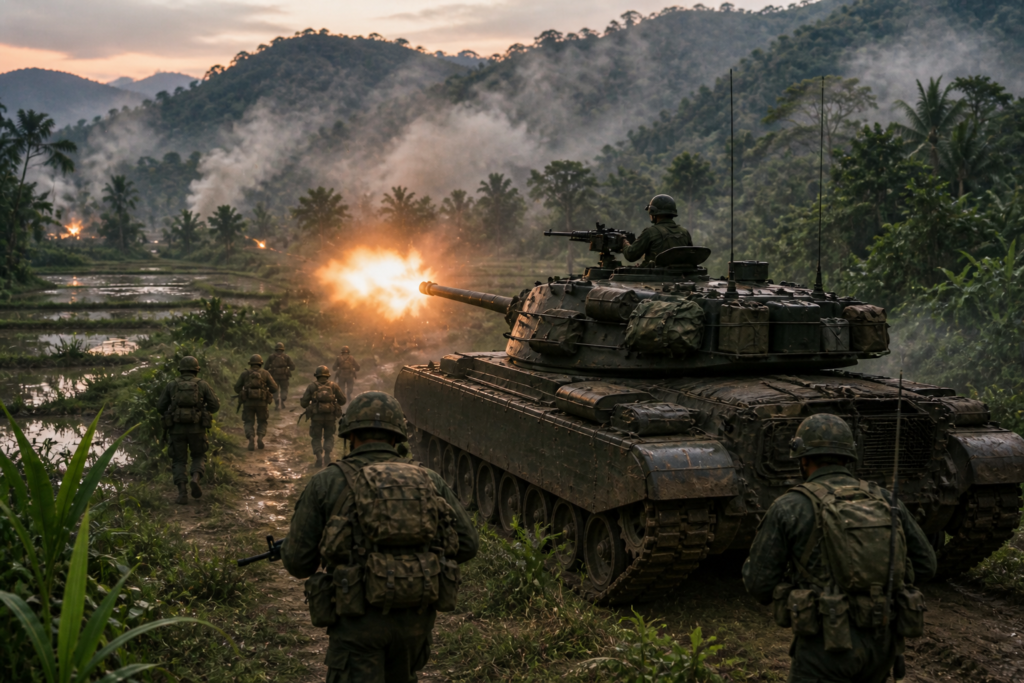
In a professional analysis of Marine tank employment in the Vietnam War, reconnaissance by fire appears as one of the typical offensive methods: tanks led infantry movement and fired ahead of the advance to force ambushes and defensive positions to reveal themselves. The same analysis links this use to the limitations of the Vietnamese terrain, where jungle, rice paddies, and reduced visibility constrained classic armored warfare and favored fire-based security techniques.
The Battle of Ia Drang provides a well-known case of speculative fire serving an immediate reconnaissance function. In a study of LZ Albany, a US Army analysis reports that Lieutenant Colonel McDade ordered a “Mad Minute” at dawn against all suspected enemy positions to confirm whether the area still contained hostile troops; no response followed. In another analysis, a study of LZ X-Ray concludes that the dawn “Mad Minute” ordered by Harold G. Moore anticipated and disrupted the main North Vietnamese attack. Functionally, these episodes resemble reconnaissance by fire, as they used coordinated bursts against likely positions to produce an observable reaction, or to confirm its absence.
Limitations and Legal Framework
Military manuals themselves emphasize that the method does not always work. Artillery doctrine notes that disciplined troops in prepared positions may not react, reducing the informational value of the technique. The same text warns that direct fire reveals the position of the firing force and requires a high degree of situational awareness to avoid fratricide. Infantry manuals share this caution, treating reconnaissance by fire as a target acquisition technique, not a universal substitute for observation, dismounted reconnaissance, or confirmation by other means.
From a legal perspective, the method is only compatible with international humanitarian law when directed against military objectives and carried out with verification and feasible precautions. The International Committee of the Red Cross summarizes the relevant customary rules clearly: parties must distinguish between civilians and combatants, between civilian objects and military objectives, prohibit indiscriminate attacks, take all feasible precautions to minimize incidental damage, and do everything feasible to verify that a target is military. Under these rules, reconnaissance by fire does not authorize arbitrary fire into civilian areas simply because an enemy might be present.
Summary
Historically, reconnaissance by fire has occupied a middle ground between stealthy observation and reconnaissance in force. Its appeal lies in something simple: when a force suspects an enemy in a likely position but lacks the time, visibility, or freedom of maneuver to confirm it otherwise, a short burst of fire can turn uncertainty into an observable reaction. This explains why the technique has persisted from interwar cavalry to World War II armored forces, through jungle warfare in Vietnam, and into contemporary infantry, armored, and artillery doctrine. Its value, however, always depends on fire discipline, accurate terrain assessment, coordination between arms, and strict adherence to the rules of distinction and precaution.
References
Doctrinal and Military Sources
- NATO, NATO Glossary of Terms and Definitions (AAP-06). Provides the formal definition of reconnaissance by fire and related terminology.
- United States Army, FM 3-21.8 Infantry Rifle Platoon and Squad. Details the tactical employment of reconnaissance by fire at the small-unit level.
- United States Army, ADP 3-90 Offense and Defense. Explains reconnaissance methods and the role of enemy reaction in target acquisition.
- United States Marine Corps, MCWP 3-11.2 Marine Rifle Squad. Discusses tactical techniques, including reconnaissance by fire in offensive operations.
- United States Army, FM 3-09 Field Artillery Operations and Fire Support. Covers target acquisition methods and limitations of fire-based reconnaissance.
Historical and Doctrinal Studies
- United States Army Center of Military History, studies on interwar cavalry doctrine, including 1938 cavalry manuals encouraging reconnaissance by fire.
- United States Army, armored warfare studies on operations in World War II, describing reconnaissance by fire in rapid advances.
- United States Marine Corps analyses of tank employment in the Vietnam War highlight the use of fire to expose ambushes.
- Battle of Ia Drang after-action studies, including LZ Albany and LZ X-Ray, documenting “Mad Minute” fire techniques.
Weapons and Tactical Equipment
- M2 Browning machine gun, widely cited in US Army armored doctrine as effective for forcing enemy exposure.
Legal and Humanitarian Framework
- International Committee of the Red Cross, Customary International Humanitarian Law Study. Defines rules on distinction, proportionality, and precautions in attack.
Category: Tactics
Explore this subject
Continue exploring related Open Chronicle Encyclopedia entries through the categories associated with this article.

Staff Writers at Open Chronicle produce trusted journalism, strategic analysis and authoritative reference content across global affairs, geopolitics, defense, science, history, technology, business, culture and sport. Their work combines accurate reporting with historical perspective and analytical depth, helping readers understand not only what is happening, but why it matters. Beyond daily news coverage, Staff Writers contribute to the Open Chronicle Encyclopedia, investigative features, original research projects and long-form reports, building a comprehensive knowledge platform designed to inform, educate and preserve reliable information for a global audience.