
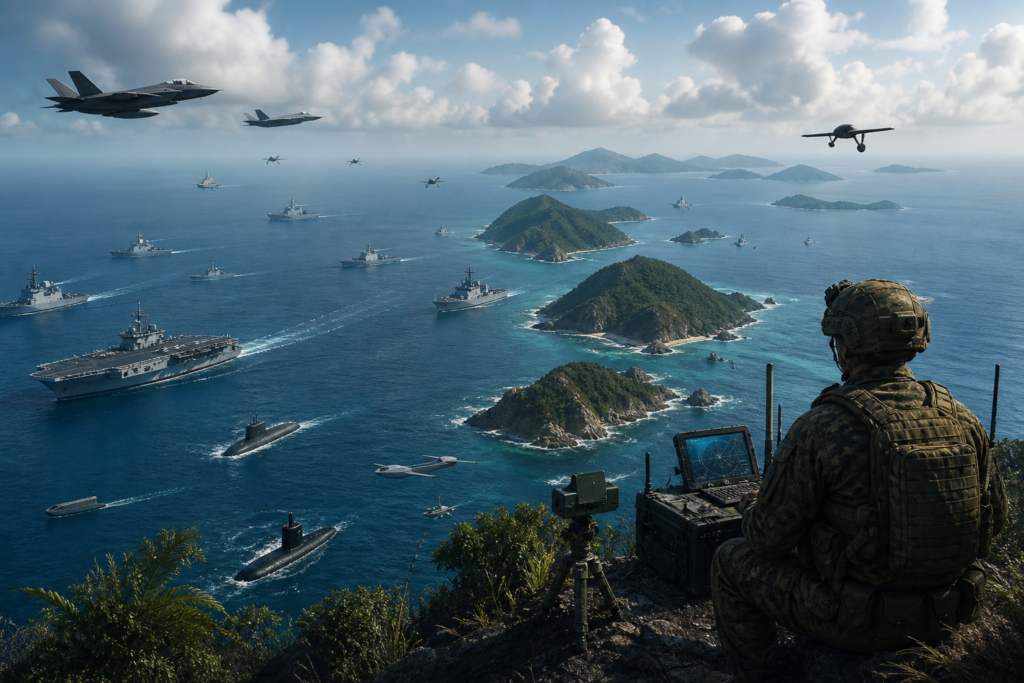
Image Credentials: Image Title: U.S. Indo-Pacific Strategy in 2026 Focuses on Denial Defense and Maritime Control Source: (chatgpt.com) Date: May 2026. Attribution: This image was created using AI-generated imagery (chatgpt.com) by Open Chronicle and does not depict a real-world scene.
By Open Chronicle
As of early 2026, the United States Indo-Pacific Command is reshaping its military posture across the region, prioritizing deterrence through what officials describe as a “denial defense” strategy. The approach is designed to counter the growing influence of China, identified by Washington as its primary long-term strategic challenge.
Guided by the latest U.S. Department of Defense National Defense Strategy, the emphasis has shifted toward maintaining strength without confrontation, reinforcing alliances, and securing vital maritime corridors across the Indo-Pacific.
A new maritime doctrine
At the heart of the strategy is a transformation in naval operations. The U.S. is moving toward a more distributed and resilient force structure, combining traditional warships with large numbers of unmanned systems operating in the air, on the surface, and underwater.
This concept, known as Distributed Maritime Operations, aims to complicate adversary targeting while enhancing surveillance and strike capabilities. At the same time, so-called “stand-in forces,” including Marine Littoral Regiments and forward-deployed Army units, are being positioned within contested zones to operate inside hostile anti-access environments.
These units are designed to remain low-profile while maintaining the ability to detect and respond to threats quickly, creating a persistent presence across strategic areas.
The importance of the First Island Chain
Central to this evolving strategy is the First Island Chain, a series of islands stretching from the Kuril Islands through Japan, Taiwan, and the Philippines down to Borneo.
This geographic line is seen as a natural barrier to limit Chinese naval expansion into the broader Pacific. Within this framework, Taiwan is considered a critical focal point, both strategically and symbolically.
Japan has taken a leading role in strengthening this defensive line. Tokyo is expanding its military presence across the Ryukyu Islands, forming what analysts describe as a “southern shield” designed to block potential maritime breakthroughs.
Further south, the Philippines has become a key partner. Joint exercises such as Balikatan 2026 have included long-range air operations and the deployment of anti-ship missile systems on remote islands, aimed at restricting the mobility of the Chinese navy.
Securing global chokepoints
Another pillar of the U.S. strategy involves controlling critical maritime chokepoints that are essential to global trade and energy flows.
The Strait of Malacca remains one of the most important. More than 60 percent of China’s oil imports pass through this narrow corridor, making it a strategic vulnerability often referred to as the “Malacca dilemma.” The United States is strengthening regional partnerships, including new agreements with Indonesia, to ensure continued access and security.
The Luzon Strait is another key focus. It serves as a gateway for naval movement between the South China Sea and the wider Pacific, making it a priority area for surveillance and military exercises.
Additional routes such as the Sunda Strait and the Lombok Strait are also gaining attention as alternative pathways for energy transport and naval transit.
Strategic pressures and challenges
Despite the clear direction of the strategy, several challenges remain. Analysts warn of a narrowing window for effective deterrence, with potential flashpoints emerging in the near term rather than the distant future.
Infrastructure gaps are a major concern. Key U.S. bases in the region, including those in Guam, lack sufficient hardened facilities to withstand missile attacks. This vulnerability has drawn criticism from lawmakers and defense experts.
At the same time, Washington is pushing for greater burden-sharing among allies. Countries in the region are being encouraged to increase defense spending and invest more heavily in their own capabilities, with targets reaching up to 3.5 percent of GDP.
A shifting balance of power
The Indo-Pacific remains the central theater of global strategic competition. The U.S. approach in 2026 reflects a broader shift toward layered defense, technological integration, and stronger alliances.
Rather than seeking dominance through confrontation, the strategy aims to shape the environment in ways that make conflict less likely, while ensuring that any attempt to alter the regional balance of power would face significant resistance.
The Grand Strategy Institute
Continue Exploring Strategic Analysis
Return to The Grand Strategy Institute for strategic assessments, long-form analysis and research examining geopolitics, military affairs, international security, emerging technologies and the changing international order.
← Back to The Grand Strategy Institute