
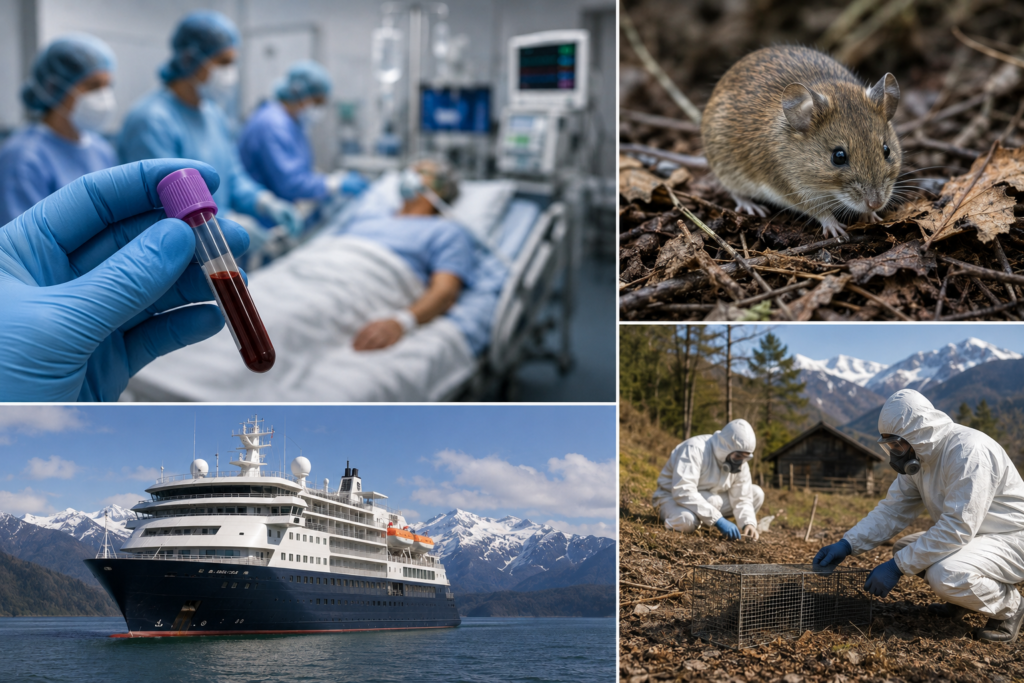
Image Credits: Image Title: Chile and Argentina Report Rising Hantavirus Cases as Health Authorities Monitor Regional Outbreak. Source: (chatgpt.com) Date: May 2026. Attribution: This image was created using AI-generated imagery (chatgpt.com) by Open Chronicle and does not depict a real-world scene.
By Open Chronicle with agencies
Health authorities in Chile and Argentina are reporting a significant increase in hantavirus infections and fatalities in 2026, raising concerns across South America as officials investigate links to climate change and the spread of the Andes strain of the virus.
The growing outbreak has gained international attention following infections connected to the expedition cruise ship MV Hondius, where several passengers were diagnosed with hantavirus after traveling through the Southern Cone region.
According to reports, the vessel departed from Ushuaia in March on a voyage toward the Arctic before multiple passengers became ill.
Cruise Ship Outbreak Draws International Attention
Tedros Adhanom Ghebreyesus said Thursday that five confirmed hantavirus cases and three suspected cases linked to the cruise had been identified.
Three infected passengers have died, while another remains in intensive care in Johannesburg, and one patient is hospitalized in Switzerland.
The outbreak has drawn particular concern because it involves the Andes strain of hantavirus, currently the only known variant capable of limited human-to-human transmission through prolonged close contact, according to the World Health Organization.
Despite the severity of some cases, the WHO has stated that the risk of a wider global epidemic remains low.
Rising Cases in Chile and Argentina
Chile has confirmed 39 hantavirus cases through May this year, with a fatality rate of approximately 33%, according to the country’s Health Ministry.
The figures already approach the total number of cases reported during all of 2025, when Chile registered 44 infections and eight deaths.
Most cases in Chile involve men working in rural, agricultural and forestry sectors where exposure to rodents is more common.
In Argentina, authorities have reported 42 confirmed cases in 2026, with mortality rates ranging between 31% and 39%, significantly higher than the historical average of roughly 22%.
Health officials warn that early hantavirus symptoms often resemble influenza or COVID-19, leading to delayed diagnosis and treatment. In severe cases, the disease can rapidly develop into hantavirus cardiopulmonary syndrome, a life-threatening respiratory condition.
Climate Change and Expanding Risk Areas
Researchers increasingly link the rise in infections to climate change and changing environmental conditions across Patagonia and central Argentina.
Warmer winters and shifting ecosystems have allowed larger populations of long-tailed pygmy rice rats, the primary carriers of the virus, to survive and reproduce more frequently.
Authorities have also observed the spread of infections into more densely populated regions.
In Argentina, provinces including Buenos Aires Province, Santa Fe Province and Entre Ríos Province now account for more than 70% of reported cases, surpassing the traditionally affected Andean areas.
Investigators believe the cruise-related outbreak may have begun after initial exposure to infected rodents near ports or excursion sites before transmission occurred among passengers and crew.
Reports indicate that a Dutch couple who later died from the virus had traveled extensively through Argentina, Chile and Uruguay before boarding the vessel.
Investigations Continue
Argentine authorities have deployed teams in Tierra del Fuego province to capture and test rodents as part of efforts to determine the source of the infections linked to the cruise ship.
Meanwhile, Chilean officials stated that the travel timeline of several infected individuals suggests that primary exposure likely did not occur inside Chile.
Although the Andes strain can spread between humans, experts emphasize that transmission requires prolonged close contact and is far less contagious than respiratory viruses such as COVID-19.
International health authorities continue monitoring the situation closely while maintaining that the overall risk to the broader population remains very low if existing monitoring and isolation protocols remain in place.