
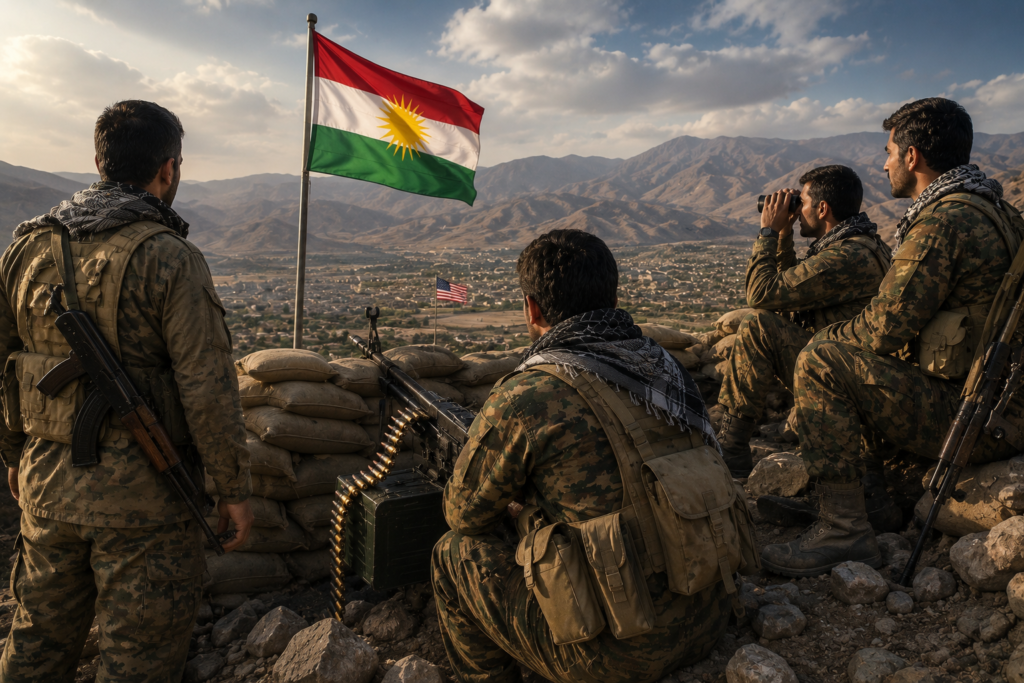
Image Credits: Image Title: Mystery Deepens Over Alleged Missing US Weapons Intended for Iranian Kurdish Groups. Source: (chatgpt.com) Date: May 2026. Attribution: This image was created using AI-generated imagery (chatgpt.com) by Open Chronicle and does not depict a real-world scene.
By Open Chronicle with agencies
A growing political controversy has erupted across Iraq’s Kurdistan region following claims that American weapons allegedly intended for Iranian Kurdish opposition groups disappeared before reaching their destination.
The dispute has triggered accusations among Kurdish political factions in Iraq and drawn attention to the complex relationships linking Kurdish groups across Iraq, Iran, Syria, and Turkey amid escalating regional tensions.
At the center of the controversy are comments made by Donald Trump, who claimed the United States had sent weapons to Kurdish groups opposing the Iranian government but suggested the arms never reached their intended recipients.
Trump Claims Weapons Were “Kept”
Soon after the United States and Israel launched military operations against Iran, reports emerged suggesting Washington was exploring possible cooperation with Iranian Kurdish opposition movements.
Trump later told American media outlets that the US had delivered “a lot of rifles” to Kurdish groups, later suggesting that the weapons had effectively been stolen.
In comments cited by media reports, Trump expressed frustration over the handling of what he described as a “small quantity” of weapons sent through intermediaries.
His remarks immediately fueled speculation that the arms may have passed through the Kurdistan Regional Government, which maintains close ties with Washington.
Iranian Kurdish Groups Deny Receiving Arms
Iranian Kurdish opposition organizations quickly denied receiving any American weapons.
Groups, including the Democratic Party of Iranian Kurdistan, Komala, the Khabat Organization, and the Kurdistan Free Life Party warned that Trump’s statements could expose them to additional attacks by Iranian forces.
The Kurdistan Regional Government also rejected the allegations, describing the claims as completely false.
Meanwhile, Iran’s Islamic Revolutionary Guard Corps has repeatedly accused Kurdish opposition groups of collaborating with Washington and has continued conducting artillery and drone strikes against Kurdish positions inside Iraq.
Kurdish Political Rivals Trade Blame
The controversy intensified after Bafel Talabani commented publicly on the issue during an interview with British journalist Piers Morgan.
Talabani said the alleged weapons had not been stolen in Sulaymaniyah, indirectly shifting suspicion toward the rival administration in Erbil, controlled by the Kurdistan Democratic Party.
He also criticized the idea of using Kurdish groups as instruments in regional conflicts, warning of serious consequences if allied forces had mishandled American support.
Officials aligned with the Patriotic Union of Kurdistan argued that military coordination with Washington has historically been managed primarily through Erbil, where American aircraft regularly land at military facilities, including Harir Air Base.
KDP officials rejected accusations against Erbil and warned that internal Kurdish disputes over the issue risk damaging broader Kurdish interests.
No Evidence of Shipment Emerges
Despite days of accusations and political debate, Kurdish officials and analysts interviewed by regional media said no concrete evidence has emerged proving that any American weapons shipment actually arrived.
Several Kurdish officials argued that it would have been nearly impossible to secretly transfer such weapons in a region heavily monitored by intelligence services, political rivals, and media networks.
One senior Kurdish official reportedly stated that Washington eventually abandoned plans to arm Iranian Kurdish groups after those organizations declined to participate in efforts aimed at destabilizing Iran.
The official also warned that Iraqi Kurdish authorities feared becoming directly involved in a broader regional war involving Iran, Turkey, and Baghdad.
Analysts Suggest Information Chaos
Political analysts say the controversy may reflect broader confusion and disinformation generated during the recent conflict involving Iran, Israel, and the United States.
Some researchers argued that Trump may have exaggerated discussions about potential support into claims of an actual weapons transfer.
Others suggested the episode demonstrates how sensitive Kurdish politics remain across the Middle East, where divisions between Kurdish factions frequently intersect with regional rivalries involving Tehran, Ankara, Baghdad, and Washington.
For now, the alleged weapons shipment remains unverified, but the political fallout continues to deepen tensions inside Iraq’s Kurdistan region at a time of heightened instability across the broader Middle East.
The Grand Strategy Institute
Continue Exploring Strategic Analysis
Return to The Grand Strategy Institute for strategic assessments, long-form analysis and research examining geopolitics, military affairs, international security, emerging technologies and the changing international order.
← Back to The Grand Strategy Institute