
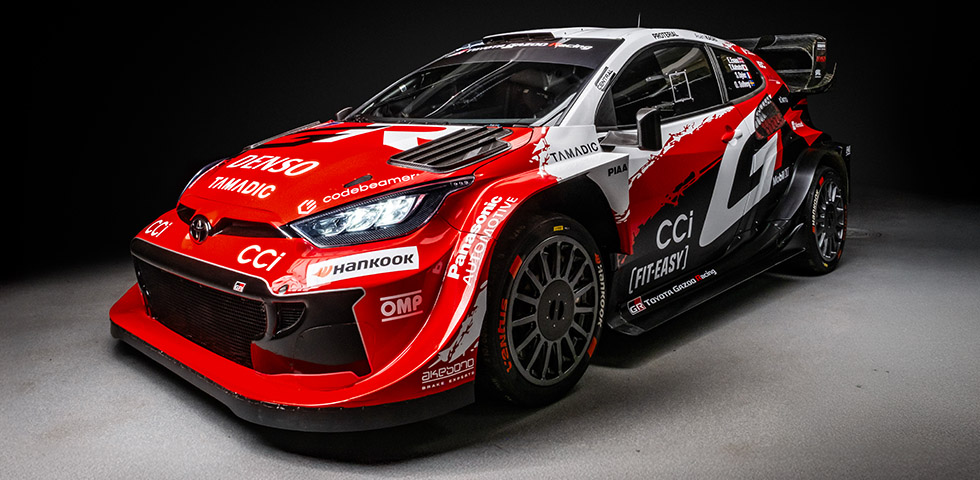
Image: from Gazoo Racing
By Open Chronicle MotorSport
Few manufacturers in modern motorsport have embraced rallying with the same intensity and consistency as Toyota. From the glory days of the Celica GT-Four to the dominant Yaris WRC era, the Japanese giant has transformed the FIA World Rally Championship into one of its most important proving grounds for performance, engineering, and driver development.
Now, as the WRC approaches another major technical turning point, Toyota heads into the 2026 season with the evolved GR Yaris Rally1, a machine that continues to define the modern era of rally competition.
Built under the FIA’s Rally1 regulations, the GR Yaris Rally1 represents the highest level of rally technology currently allowed in the championship. While the first generation of Rally1 cars introduced hybrid systems to the sport in 2022, regulatory changes for 2025 removed the hybrid component entirely. Sustainable fuel, however, remains central to the WRC’s future direction, with all top-level cars continuing to run on 100 percent fossil-free fuel.
The result is a lighter, more agile, and more visceral rally car.
Toyota’s current GR Yaris Rally1 retains its aggressive spaceframe chassis and advanced four-wheel-drive system, while continuing to prioritize driver safety through heavily reinforced construction. Power still comes from a turbocharged 1.6-litre inline four-cylinder engine, though revised regulations have slightly reduced output by restricting airflow and eliminating the hybrid boost system. Even so, the car still produces more than 370 horsepower and delivers the explosive acceleration expected from a modern WRC machine.
More importantly, the removal of the hybrid system has dramatically reduced weight. Toyota engineers cut approximately 80 kilograms from the package, lowering the minimum weight to 1,180 kilograms and fundamentally changing the car’s driving characteristics. The GR Yaris Rally1 has become sharper, more responsive, and arguably closer to the raw spirit of traditional rally cars.
For Toyota, the current machine is more than just another competition car. It is the continuation of a dynasty.
The company returned to top-level rallying in 2017 with the Yaris WRC after a long absence from the championship. What followed was one of the most successful periods in modern WRC history. Toyota secured manufacturers’ titles, drivers’ championships, and numerous rally victories with stars including Sébastien Ogier, Ott Tänak, Elfyn Evans, and Kalle Rovanperä.
When the Rally1 era began in 2022, Toyota adapted immediately. The GR Yaris Rally1 HYBRID won 12 of 14 rallies during its debut season and captured another manufacturer’s title. The team’s dominance reinforced Toyota’s reputation not just as a manufacturer with fast cars, but as one of motorsport’s most complete organizations.
Heading into 2026, Toyota remains one of the favorites for both drivers’ and manufacturers’ championships. The team continues to rely on an elite lineup combining experience and youth, with the GR Yaris Rally1 expected to remain highly competitive during what is likely to be the final season under the current Rally1 technical regulations.
Yet Toyota’s rally ambitions extend far beyond the factory team itself.
The GR Yaris Rally2 has become increasingly important as a development platform for young talent and customer racing programs around the world. Toyota-backed drivers continue to emerge through the WRC ladder system, while the company has expanded rally involvement into other markets, including North America, through the GR Corolla RC2 project developed for the American Rally Association.
This broader philosophy reflects the identity of Toyota Gazoo Racing itself. Motorsport is not treated as marketing decoration; it is treated as a laboratory. Lessons learned in rallying directly influence road-going GR models such as the GR Yaris, GR Corolla, and GR Supra. The connection between competition and production remains central to Toyota chairman Akio Toyoda’s vision of building “ever-better cars.”
As the WRC evolves, uncertainty remains over what the championship’s next technical era will look like after 2026. Electrification, cost reduction, and manufacturer sustainability all continue to shape the debate.
But for now, Toyota’s mission remains unchanged.
Win rallies. Develop drivers. Push engineering limits.
And continue proving that the world’s toughest stages still represent one of motorsport’s purest forms of competition.
VEHICLE SPECS
| Engine | |
|---|---|
| Engine type | In-line 4-cylinder turbo, direct injection |
| Engine displacement | 1,600 cc |
| Maximum power | Over 370 PS |
| Maximum torque | Over 425 Nm |
| Bore/stroke | 83.8 mm / 72.5 mm |
| Air restrictor | 35 mm, following FIA regulations |
| Transmission | |
| Gearbox | 5-speed mechanical shift |
| Gearbox final drive | 4-wheel drive, 2 x mechanical differentials |
| Clutch | Double Plate Sintered Clutch |
| Chassis/suspension | |
| Front/rear | Macpherson |
| Suspension travel | Damper travel 270mm |
| Steering | Hydraulic Rack and Pinion |
| Braking system | Gravel 300 mm, Tarmac 370 mm |
| Dimension and weight | |
| Length/width/height | 4,225 mm (incl. aero device) / 1,875 mm / adjustable |
| Track width | Adjustable |
| Wheelbase | 2,630 mm |
| Minimum weight | 1,180 kg |
| Performance | |
| Top speed | 201 kph (Ratio Specific) |