
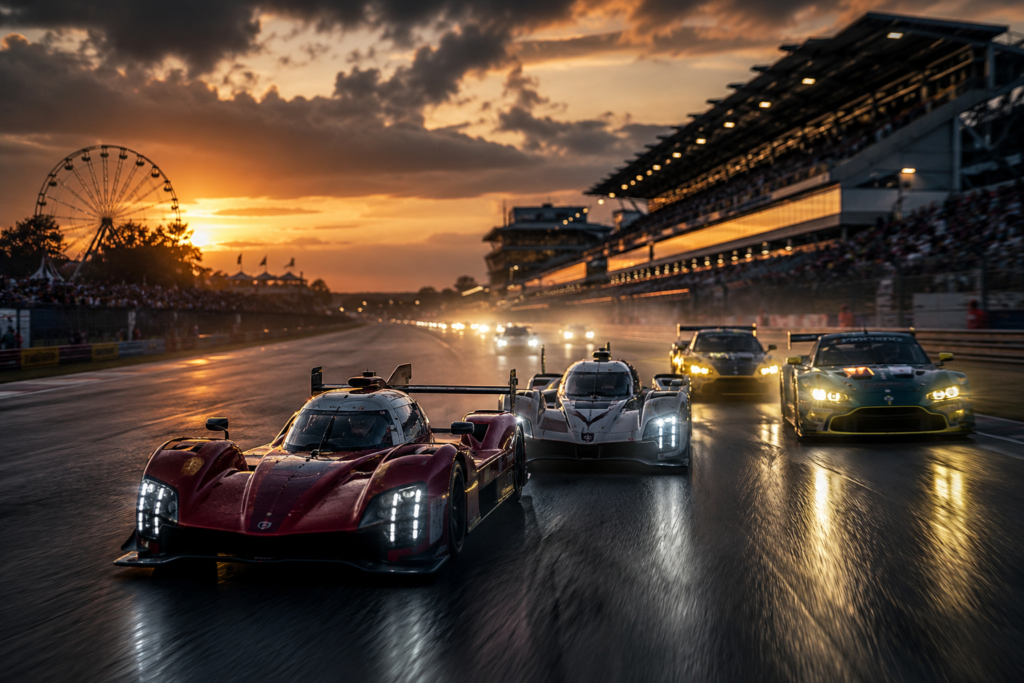
Image Credentials: Image Title: Why Le Mans Remains the Ultimate Test of Speed, Survival and Glory. Source: (chatgpt.com) Date: May 2026. Attribution: This image was created using AI-generated imagery (chatgpt.com) by Open Chronicle and does not depict a real-world scene.
By Open Chronicle MotorSport
Some races define a season. Some races define careers. And then there is the 24 Hours of Le Mans, a competition so demanding, so unforgiving and so deeply woven into motorsport mythology that it exists in a category entirely of its own.
Held on the legendary Circuit de la Sarthe in western France, Le Mans is not simply about speed. It is about survival. For 24 relentless hours, drivers battle fatigue, machinery battles attrition, and manufacturers gamble fortunes in pursuit of one of the most prestigious trophies in world sport.
Part permanent racetrack and part public road, the circuit is one of the most intimidating venues in motorsport. Cars rocket down the Mulsanne Straight at extraordinary speeds before braking violently into narrow chicanes and technical corners. Through the Esses, Tertre Rouge, and the Porsche Curves, drivers balance aggression with precision, repeating the same sequence through daylight, darkness, and dawn.
Mistakes are punished immediately. Mechanical failures are expected. At Le Mans, endurance is not a side story; it is the story.
The race’s reputation has also been shaped by tragedy. The darkest chapter came in 1955 when Pierre Levegh’s Mercedes-Benz 300 SLR launched into the crowd after contact with another car, killing the driver and more than 80 spectators. It remains the deadliest accident in motorsport history and a permanent scar on Le Mans’ legacy. Yet that danger, however uncomfortable to acknowledge, has always been part of the race’s mystique. Le Mans represents the outer edge of what drivers, engineers, and machines are willing to endure.
That atmosphere helped immortalize the event far beyond racing circles. Steve McQueen’s 1971 film Le Mans, filmed during the real 1970 race, captured the brutal beauty of endurance racing with unprecedented authenticity. Sparse dialogue gave way to the sound of engines echoing through the French countryside, showing audiences worldwide why La Sarthe occupies such a sacred place in motorsport culture.
For manufacturers, victory at Le Mans carries a significance few other races can match. Ferrari, Porsche, Ford, Audi, and Toyota have all spent decades chasing glory there because success at Le Mans validates far more than raw pace. Winning proves reliability, engineering excellence, strategic discipline, and operational perfection over an entire day of racing.
A single lap can showcase speed. Twenty-four hours prove greatness.
Ferrari Versus Porsche Takes Center Stage
The modern era of endurance racing is technologically complex, especially under the Hypercar regulations that currently define the top category. Different engineering philosophies are allowed to compete together through a system known as Balance of Performance, or BoP, which adjusts weight, power, and energy deployment to maintain competitive parity.
Two distinct concepts dominate the field.
Le Mans Hypercar, known as LMH, allows manufacturers greater design freedom, including hybrid systems driving the front axle. Ferrari’s dominant 499P is built under these rules. Run by AF Corse, the car combines a twin-turbocharged 3-litre V6 with a front-mounted electric motor powered by a bespoke 900-volt battery system.
Ferrari arrives at Le Mans in formidable form after victories at Qatar, Imola, and Spa Francorchamps in the FIA World Endurance Championship. The Italian manufacturer has already won the last two editions of the race and enters 2025 as the benchmark team.
Porsche, meanwhile, represents Ferrari’s greatest threat. The German giant’s 963 prototype follows the LMDh formula, pairing a manufacturer-developed powertrain with a standardized chassis supplied by Multimatic. The car uses a twin turbocharged 4.6 litre V8 assisted by hybrid technology and is operated by Porsche Penske Motorsport.
Although Porsche’s 2025 campaign has lacked Ferrari’s consistency, the manufacturer’s Le Mans pedigree remains unmatched. Porsche owns 19 overall victories at La Sarthe, more than any other brand in history. Ferrari sits on 11 wins, while Audi, currently absent as it focuses on Formula 1 ambitions, remains second with 13.
At Le Mans, history matters. So does experience. Porsche possesses both in abundance.
Aston Martin’s Valkyrie Brings Pure Emotion
Even if outright victory remains unrealistic, Aston Martin’s Valkyrie is expected to become one of the stars of the event.
The machine is unlike anything else in the Hypercar field. Originally conceived through a collaboration between Aston Martin and Red Bull Advanced Technologies, the Valkyrie carries the fingerprints of legendary Formula 1 designer Adrian Newey. Its aggressive aerodynamic tunnels and screaming naturally aspirated V12 give it an unmistakable presence.
Powered by a Cosworth-built 6.5-litre engine, the road-going Valkyrie produces more than 1,100 horsepower. Regulations reduce that figure significantly for racing trim, yet the car still promises one of the most visceral sensory experiences at Le Mans.
Its greatest challenge is not speed but experience. Rivals such as Ferrari, Porsche, and Toyota have spent years refining their endurance programs, while Aston Martin Thor Team enters the race at the beginning of a long development journey.
Simply reaching the finish could be considered a success.
Still, few cars in the modern era embody the original Hypercar vision more completely than the Valkyrie. Exotic, dramatic, and unapologetically emotional, it feels tailor-made for Le Mans.
Beyond the Headlines
While Ferrari and Porsche dominate attention, the depth of competition across the 2025 grid remains remarkable.
Toyota continues searching for another victory after years of dominance. Cadillac arrives with its thunderous V Series. The R prototype is powered by a naturally aspirated V8. Peugeot hopes home advantage and favorable BoP adjustments can elevate its radical 9X8. BMW has shown flashes of pace throughout the season, while Alpine aims to establish itself among endurance racing’s elite manufacturers.
The supporting categories add even more intrigue.
LMP2 remains a proving ground for emerging talent, using standardized Gibson V8 engines to keep competition fiercely close. Meanwhile, LMGT3 delivers some of the most recognizable machines in motorsport, with Ferrari, Porsche, Corvette, Ford, Aston Martin, Lexus, and BMW all represented.
McLaren returns to Le Mans, celebrating the 30th anniversary of its famous 1995 victory, fielding two 720S GT3 entries through United Autosports. Mercedes also returns for the first time since 1999, thanks to the Iron Lynx team.
Among the most beloved entries is the all-female Iron Dames Porsche crew featuring Celia Martin, Rahel Frey, and Sarah Bovy, who replaces Michelle Gatting after the Danish driver suffered foot fractures during testing. Even before the race begins, Le Mans reminds competitors how unforgiving it can be.
More Than a Race
What ultimately separates Le Mans from every other motorsport event is not merely the machinery or the history. It is the atmosphere.
The race unfolds like a living drama. The changing light, the fatigue in the pit lane, the tension of mechanical failures in the middle of the night, and the unpredictability of rain transform the event into something almost cinematic.
Fans experience it as both a celebration and an endurance test. Some line the barriers and camp beside the circuit for days, armed with earplugs, beer, and baguettes. Others watch through sleepless nights from living rooms across the world, drawn into the hypnotic rhythm of racing that never stops.
Le Mans does not simply crown winners. It creates legends.
For anyone who truly loves cars, engineering, and motorsport history, witnessing the 24 Hours of Le Mans at least once is not just a recommendation.
It is an obligation.