
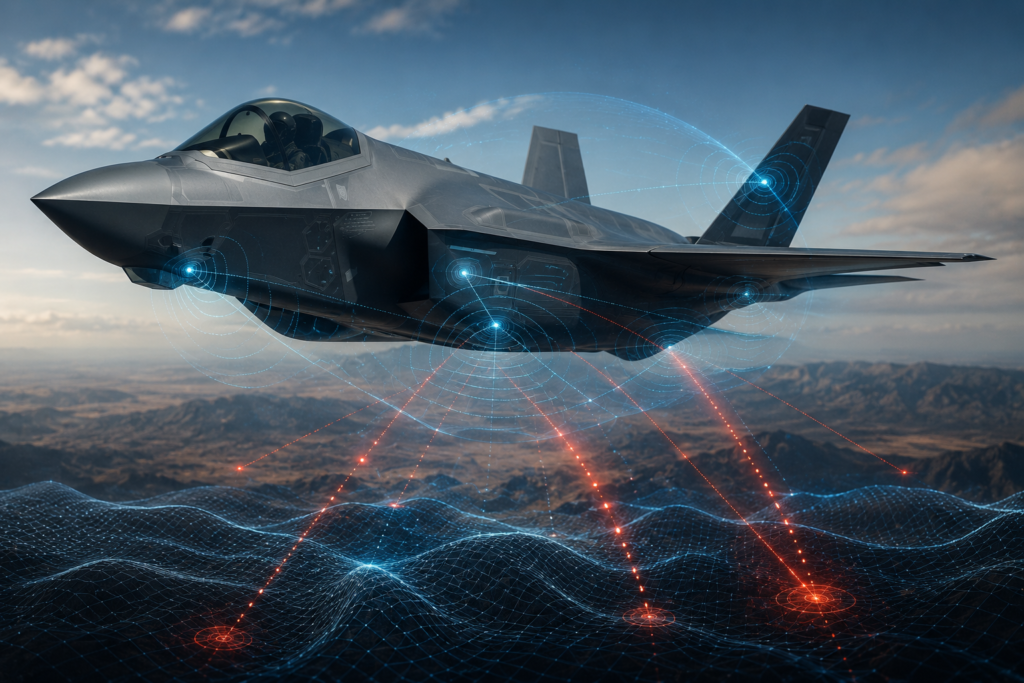
Image Credentials: Image Title: Pentagon Awards Nearly $1 Billion Contract for Major F-35 Electronic Warfare Upgrade. Source: (chatgpt.com) Date: May 2026. Attribution: This image was created using AI-generated imagery (chatgpt.com) by Open Chronicle and does not depict a real-world scene.
By Open Chronicle with agencies
The US Department of Defense has awarded Lockheed Martin a contract worth nearly $1 billion to modernize the electronic warfare capabilities of the F-35 Lightning II fighter jet as the Pentagon seeks to strengthen the aircraft against increasingly sophisticated air defense threats from rivals such as China and Russia.
The $991.12 million agreement covers the production and delivery of 432 electronic warfare modification kits for the F-35 fleet, forming part of the broader Block 4 modernization program designed to enhance the fifth-generation stealth aircraft’s combat performance over the coming decade.
Although the Pentagon has not officially disclosed the exact upgrade package included in the contract, defense officials and analysts expect the work to focus heavily on improvements to the jet’s AN/ASQ-239 electronic warfare suite, one of the aircraft’s most critical survivability systems.
The upgrade program will affect all three operational variants of the F-35.
According to the Department of Defense, 193 kits are allocated to US military aircraft, including 97 F-35A conventional takeoff fighters for the US Air Force, 54 F-35B short takeoff and vertical landing variants used by the Marine Corps, and 42 carrier-capable F-35C aircraft for the US Navy.
The remaining systems will be delivered to international operators, with 106 kits designated for Foreign Military Sales customers and another 133 for partner nations participating directly in the multinational F-35 program.
Production will take place at Lockheed Martin’s facilities in Fort Worth, Texas, with deliveries expected to continue through March 2032.
The F-35 remains the centerpiece of Western fifth-generation airpower strategy and is currently operated or ordered by more than a dozen allied nations across Europe, the Indo-Pacific, and the Middle East.
At the heart of the modernization effort is the aircraft’s AN/ASQ-239 electronic warfare system, developed to provide radar warning, electronic attack, infrared countermeasures, and advanced battlespace awareness capabilities.
The system allows the aircraft to detect, jam, deceive, and evade hostile radar and communications networks while giving pilots a constantly updated 360-degree picture of threats around the aircraft.
Pentagon officials increasingly view electronic warfare superiority as essential for maintaining the F-35’s effectiveness against next-generation integrated air defense systems being developed by Russia and China.
Military planners have warned that advances in radar technology, signal processing, and sensor fusion are gradually making stealth aircraft more vulnerable to detection, especially in heavily defended environments.
The Block 4 modernization program is intended to address those concerns by significantly improving the F-35’s sensing, processing, and electronic attack capabilities.
Defense analysts say the new upgrades are expected to improve the aircraft’s ability to detect and track difficult-to-observe targets, manage multiple simultaneous threats, and operate more effectively in highly contested electromagnetic environments.
The contract also reflects a broader transformation in modern warfare, where control of the electromagnetic spectrum has become nearly as important as air superiority itself.
Electronic warfare capabilities are now viewed as critical tools not only for protecting aircraft from enemy systems but also for disrupting command networks, suppressing missile defenses, and enabling long-range precision operations.
As tensions continue to rise in both the Indo-Pacific and Eastern Europe, the Pentagon is accelerating efforts to ensure the F-35 remains technologically ahead of rival systems for decades to come.