
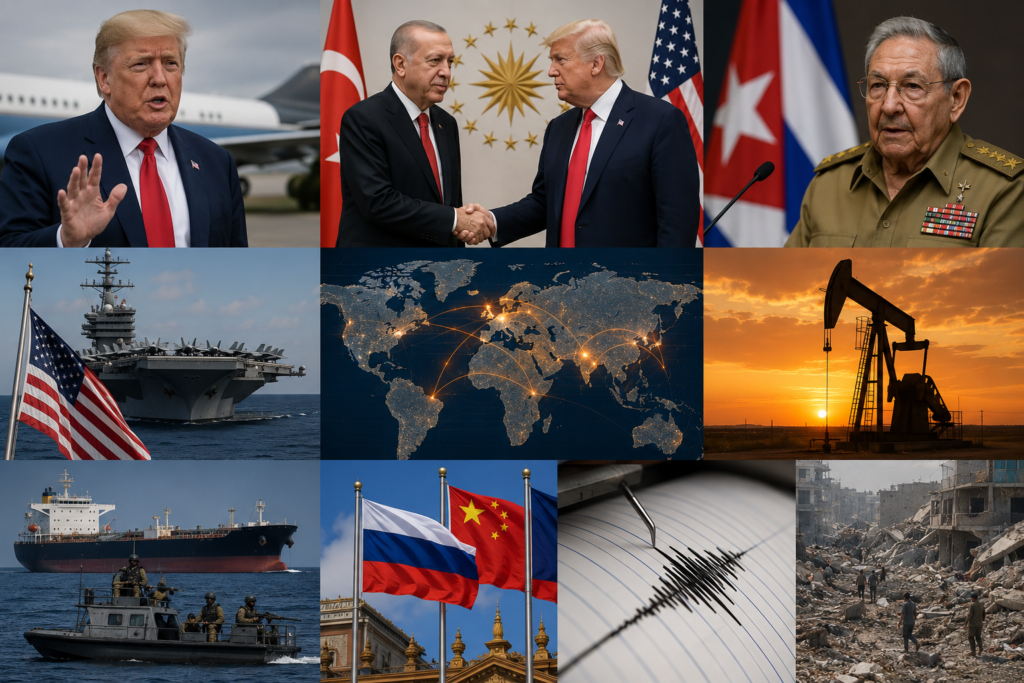
Image Credentials: Image Title: Global News Brief: Key Events and Developments for May 21, 2026. Source: (chatgpt.com) Date: May 2026. Attribution: This image was created using AI-generated imagery (chatgpt.com) by Open Chronicle and does not depict a real-world scene.
By Open Chronicle with agencies
Global tensions surrounding Iran, renewed diplomatic activity between Washington and Ankara, growing pressure on Cuba, and rising instability in energy markets dominated international headlines on Thursday as geopolitical uncertainty continued to shape both security and economic developments worldwide.
Trump Gives Diplomacy With Iran “One Shot”
US President Donald Trump said his administration would make one final attempt to secure a diplomatic resolution to the ongoing conflict with Iran before considering additional military escalation.
Speaking to reporters before departing Andrews Air Force Base, Trump said he was not rushing toward further military action despite mounting political pressure ahead of the upcoming midterm elections.
“We’re going to give this one shot,” Trump said, adding that he would prefer “few people killed, as opposed to a lot.”
The remarks came amid continuing regional instability following months of confrontation between the United States, Israel, and Iran, including maritime tensions in the Strait of Hormuz and repeated military incidents across the Gulf region.
Erdogan and Trump Discuss Regional Crises
Turkish President Recep Tayyip Erdogan and President Trump held a phone conversation focused on regional conflicts and bilateral relations between Türkiye and the United States.
According to Türkiye’s Communications Directorate, Erdogan described the extension of the ceasefire with Iran as “a positive development” and stressed that a reasonable diplomatic solution remained possible.
The Turkish leader also reaffirmed Ankara’s support for constructive diplomatic initiatives aimed at reducing regional tensions.
Türkiye has increasingly positioned itself as a mediator between regional actors during the Iran crisis while simultaneously attempting to preserve strategic ties with both Washington and Tehran.
US Announces Criminal Charges Against Raúl Castro
The US Justice Department announced criminal charges against former Cuban President Raúl Castro and several other individuals in connection with the 1996 downing of an aircraft operated by a Miami-based exile group.
Acting Attorney General Todd Blanche said the indictment includes conspiracy to kill US nationals, destruction of aircraft, and multiple murder charges.
The announcement marks a major escalation in already deteriorating relations between Washington and Havana.
Tensions Grow Around Cuba and the Caribbean
The United States also deployed the USS Nimitz Carrier Strike Group to the Caribbean amid heightened tensions involving Cuba.
Meanwhile, Cuba’s ambassador to the United Nations condemned Israeli actions against Gaza aid flotilla activists in international waters and criticized what Havana described as growing impunity regarding violations of international law.
Russia and China Deepen Strategic Partnership
Russia and China signed 20 new cooperation agreements covering energy, transportation, economic coordination and international cooperation following talks between Russian President Vladimir Putin and Chinese President Xi Jinping in Beijing.
The agreements further reinforce the increasingly close strategic relationship between Moscow and Beijing amid continued confrontation with the West.
Hormuz Tensions Continue to Shake Energy Markets
Iran’s Persian Gulf Strait Authority formally announced the establishment of a controlled maritime zone in the Strait of Hormuz, requiring vessels to coordinate with Iranian authorities before transiting the strategic waterway.
At the same time, US Marines boarded an Iranian-flagged commercial oil tanker in the Gulf of Oman as part of ongoing enforcement operations connected to Washington’s maritime blockade strategy.
The situation continues to fuel uncertainty in global energy markets.
Britain announced it would ease certain sanctions involving Russian oil products and liquefied natural gas due to fears of supply disruptions tied to the Hormuz crisis. Officials said the temporary waiver was necessary to help stabilize fuel supplies and protect energy markets.
US Oil Inventories Fall Sharply
New data from the US Energy Information Administration showed American commercial crude oil inventories fell by 7.9 million barrels during the week ending May 15, significantly exceeding market expectations.
Strategic petroleum reserves also declined by nearly 10 million barrels, adding to concerns over tightening global supply conditions amid continued Middle East instability.
Additional Developments
Other major developments included:
The United States removed UN Special Rapporteur Francesca Albanese from its sanctions list.
UN Secretary-General Antonio Guterres condemned Israel’s decision to establish military facilities at a UNRWA compound in occupied East Jerusalem.
Italy summoned Israel’s ambassador over the treatment of activists involved in a Gaza aid flotilla.
Pakistan’s Interior Minister Mohsin Naqvi arrived in Tehran for discussions reportedly linked to mediation efforts between Iran and the United States.
A magnitude 5.9 earthquake struck southern Japan without immediate reports of major damage.
As diplomatic maneuvering intensifies across multiple regions, global markets and governments continue closely monitoring the evolving security landscape stretching from the Middle East to Eastern Europe and East Asia.