
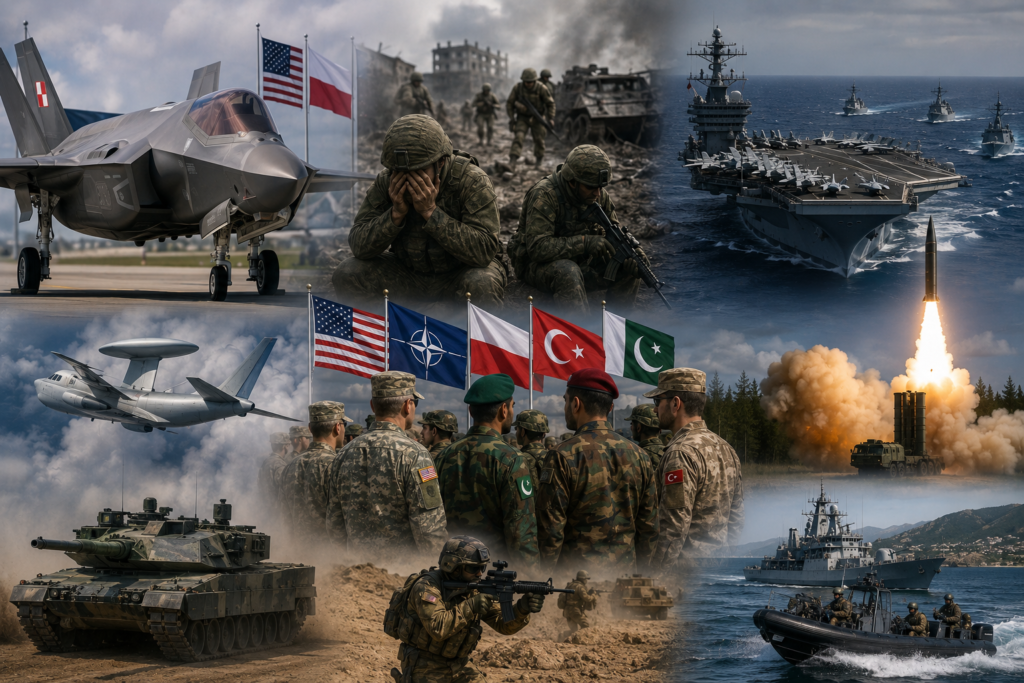
Image Credentials: Image Title: Tax Refunds Rise Across the US, but Many Families Spend Them on Basic Needs. Source: (chatgpt.com) Date: May 2026. Attribution: This image was created using AI-generated imagery (chatgpt.com) by Open Chronicle and does not depict a real-world scene.
By Open Chronicle with agencies
Global military tensions continued to rise on 22 May 2026 as NATO allies confronted growing uncertainty over American troop deployments, Russia and Ukraine escalated their battlefield confrontation, and major powers accelerated missile, naval, and defense modernization programs across Europe, Asia, and the Middle East.
The day was marked by major strategic announcements involving the United States, NATO, China, Russia, Iran, Pakistan, Türkiye, and several European nations, reflecting an increasingly unstable global security environment.
NATO Faces Growing Pressure Over US Strategic Shifts
One of the dominant themes of the day involved confusion and concern among NATO allies following a series of abrupt military decisions by the Trump administration.
US President Donald Trump confirmed the deployment of an additional 5,000 American troops to Poland, a move welcomed by Warsaw but one that reportedly caught several NATO partners off guard.
NATO Secretary General Mark Rutte acknowledged that allies are increasingly adapting to a reality in which Europe may need to assume greater responsibility for its own defense while the United States gradually shifts strategic focus elsewhere.
Secretary of State Marco Rubio stated during NATO meetings in Sweden that alliance leaders would need to address Trump’s concerns directly ahead of the NATO summit scheduled for July in Ankara.
Rubio reiterated longstanding American frustrations over burden sharing and military cooperation, especially regarding the recent Iran conflict and restrictions placed on US operations by some European allies.
Several NATO diplomats privately described Washington’s recent troop decisions as “confusing,” particularly after earlier announcements involving withdrawals from Germany and pauses in other European deployments.
Russia-Ukraine War Continues to Escalate
The war in Ukraine remained one of the central military flashpoints globally.
Ukrainian officials claimed that Russian military casualties in 2026 alone had already surpassed 83,000 dead, while intelligence assessments suggested Moscow is aggressively searching for additional recruits to sustain the war effort.
Russian troops reportedly experienced severe battlefield communication failures after Ukrainian strikes disrupted command systems, leading to chaotic incidents in which Russian soldiers allegedly fired on one another.
NATO officials simultaneously praised Ukraine’s growing technological and intelligence capabilities, with Pentagon-linked assessments suggesting Ukrainian drone warfare and battlefield intelligence continue limiting Russian breakthrough attempts.
Estonia’s foreign minister accused Russia of deliberately directing Ukrainian drones into NATO airspace through electronic warfare manipulation, adding further tension to the alliance’s eastern flank.
Meanwhile, Zelenskyy was formally invited to attend the NATO summit in Ankara, reinforcing Ukraine’s expanding strategic alignment with the alliance.
Iran Crisis Reshapes Global Military Calculations
The ongoing crisis involving Iran continued to reshape military strategy across several regions.
The United States reportedly paused a $14 billion arms sale to Taiwan due to operational and strategic pressures linked to the Iran conflict.
At the same time, Iran’s Islamic Revolutionary Guard Corps Navy claimed it coordinated the safe passage of dozens of vessels through the Strait of Hormuz, while US Central Command reported nearly 100 ships had diverted routes since Iran’s naval blockade activities began.
Sweden indicated openness to participating in potential NATO maritime operations aimed at protecting shipping lanes in the Strait of Hormuz.
Pakistan also intensified its diplomatic and military role in the crisis. Army Chief General Asim Munir traveled to Tehran for high-level discussions tied to US-Iran mediation efforts, while Pakistan and Türkiye reaffirmed what officials described as a “growing strategic convergence” in defense cooperation.
China and Taiwan Remain Major Strategic Flashpoints
Tensions between China and the United States in the Asia-Pacific region also escalated sharply.
Beijing firmly opposed any American deployment of midrange missile systems in Asia, warning Washington against expanding military infrastructure near China’s sphere of influence.
Taiwan stated it had received no formal notification from the United States regarding reports of delayed arms sales, despite growing speculation that Washington is reassessing military priorities amid simultaneous crises involving Iran, Europe, and Cuba.
Taiwanese military security also faced scrutiny after an air force captain was sentenced to seven years in prison for allegedly passing missile secrets to China.
Military Modernization Accelerates Worldwide
Several countries unveiled or advanced major military modernization initiatives.
Poland officially received its first F-35 fighter jets, significantly strengthening Warsaw’s long-term air power capabilities and deepening defense integration with the United States.
India successfully test-fired the Agni-1 short-range ballistic missile, while Russia reportedly tested what was described as the world’s largest nuclear missile system.
France announced plans to strengthen the European long-range missile project, signaling continued European investment in strategic autonomy and advanced deterrence capabilities.
The United Kingdom also marked the arrival of its first RAF E-7 Wedgetail airborne warning aircraft as Britain rebuilds its airborne surveillance fleet after years of delays.
Spain confirmed plans to equip several A400M transport aircraft with firefighting kits, reflecting the growing overlap between military logistics and climate emergency response capabilities.
Expanding Naval and Air Power Operations
Naval activity intensified across several regions.
The USS Nimitz carrier strike group entered the Caribbean amid escalating tensions between Washington and Havana following the US indictment of former Cuban President Raúl Castro.
Meanwhile, the US Navy awarded General Atomics a new contract linked to electromagnetic aircraft launch systems for future Ford-class aircraft carriers.
Iranian naval authorities claimed dozens of vessels transited Hormuz under IRGC coordination, while NATO ministers debated possible future maritime security roles in the Gulf region.
Military aviation activity also increased significantly across Europe.
Bulgaria announced expanded military transit operations involving Turkish and American personnel and equipment between late May and early June.
The cancellation of RIAT 2026, one of the world’s largest military air shows, highlighted how operational demands connected to the Iran conflict are beginning to affect broader military planning across NATO countries.
UFO Files and Emerging Security Narratives
The Pentagon also released a second batch of declassified UFO files and videos, continuing an unusual trend of increasing transparency regarding unexplained aerial phenomena.
The disclosures generated renewed public attention, particularly after footage emerged involving an F-16 encounter with an unidentified object over Michigan.
While officials stressed no evidence currently points to extraterrestrial origins, defense analysts increasingly view unexplained aerial events as part of broader airspace security and intelligence concerns.
A Rapidly Fragmenting Global Security Environment
The military developments of 22 May 2026 reflected a world experiencing simultaneous strategic crises across multiple theaters.
From Eastern Europe and the Middle East to the Asia-Pacific and the Caribbean, governments are rapidly adapting to an increasingly unstable security landscape marked by intensified rivalry between major powers, evolving military technologies, and shifting alliance structures.
As NATO prepares for its July summit in Ankara and several global conflicts remain unresolved, defense analysts warn that the international system is entering one of its most unpredictable periods since the end of the Cold War.