
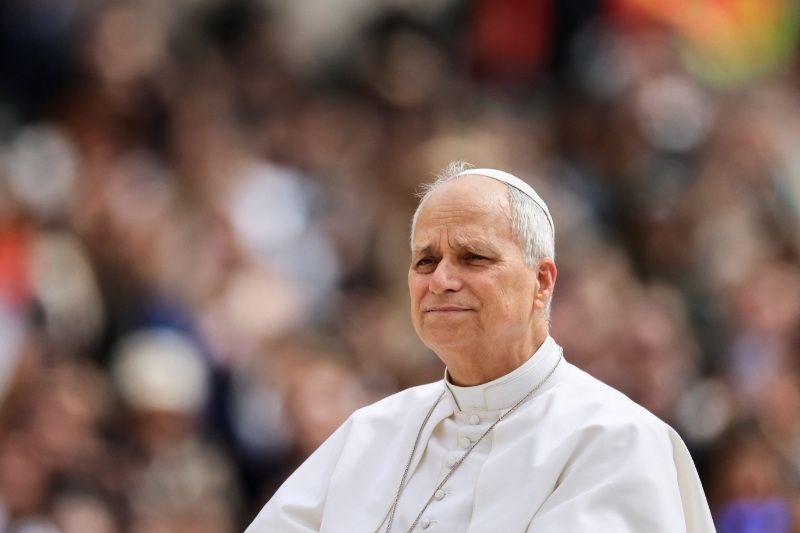
Image: from Yahoo News X @YahooNews
By Open Chronicle with agencies
Pope Leo XIV has issued the strongest warning yet from the Catholic Church against the growing use of artificial intelligence in warfare, calling for strict global limits on autonomous weapons systems and warning humanity against surrendering moral responsibility to machines.
In his first encyclical since becoming pope, Leo described artificial intelligence as one of the defining challenges of the modern age, arguing that technological progress must never come at the expense of human dignity or ethical accountability.
The document, presented personally by the pontiff at the Vatican on Monday, focused heavily on the dangers posed by AI-powered military systems, algorithmic warfare, and the increasing detachment between human decision-makers and the consequences of violence.
A direct warning about autonomous weapons
The encyclical represents the Vatican’s clearest intervention so far in the global debate over artificial intelligence and warfare.
Leo warned that no machine should ever be permitted to make life-and-death decisions independently, arguing that the use of autonomous weapons risks lowering the moral barriers that traditionally restrain armed conflict.
“No algorithm can make war morally acceptable,” the pope wrote.
He added that technologies allowing attacks without direct human confrontation create a dangerous psychological and ethical distance from violence.
“Any technology that facilitates attacks without seeing the face of human beings lowers the moral threshold of conflict,” the encyclical stated.
The pope called for artificial intelligence to be “disarmed” and placed firmly under international legal and ethical oversight before governments and corporations allow the technology to dominate military strategy.
Vatican enters the global AI race debate
The timing of the document is significant as major world powers rapidly expand investments in AI-driven defense systems, including autonomous drones, predictive targeting software, and battlefield decision-making platforms.
The Vatican’s position could place it increasingly at odds with governments pursuing AI as a strategic military advantage.
The encyclical was unveiled alongside Canadian technology entrepreneur Christopher Olah, co-founder of artificial intelligence company Anthropic, underlining the Vatican’s effort to engage directly with leaders shaping the future of AI development.
While the pope acknowledged the potential benefits of artificial intelligence in areas such as medicine, education, and scientific research, he insisted that technological innovation must remain subordinate to moral principles.
AI as a civilizational turning point
Leo framed artificial intelligence not simply as a technical issue, but as a broader question about the future of civilization itself.
The pope warned that chatbots and advanced AI systems should never be confused with human consciousness or moral agency, cautioning against treating machines as equivalents to human beings.
He argued that societies risk undermining their own humanity if moral responsibility becomes increasingly delegated to automated systems.
The encyclical also raised concerns about labor displacement, digital manipulation, and the concentration of technological power in the hands of governments and corporations.
A pope with scientific training
Leo XIV’s intervention carries additional weight because of his own academic background. Before entering higher church leadership, the pope earned a graduate degree in mathematics and taught physics, giving him a rare scientific perspective among modern pontiffs.
Rather than rejecting artificial intelligence outright, Leo called for stronger governance structures capable of ensuring that emerging technologies “truly serve humanity.”
His remarks are likely to intensify ongoing international debates at the United Nations and among Western allies regarding the regulation of lethal autonomous weapons systems.
As AI continues reshaping both civilian and military life, the Vatican’s message signals that ethical questions surrounding artificial intelligence are rapidly becoming central not only to politics and security, but also to global moral and religious discourse.