
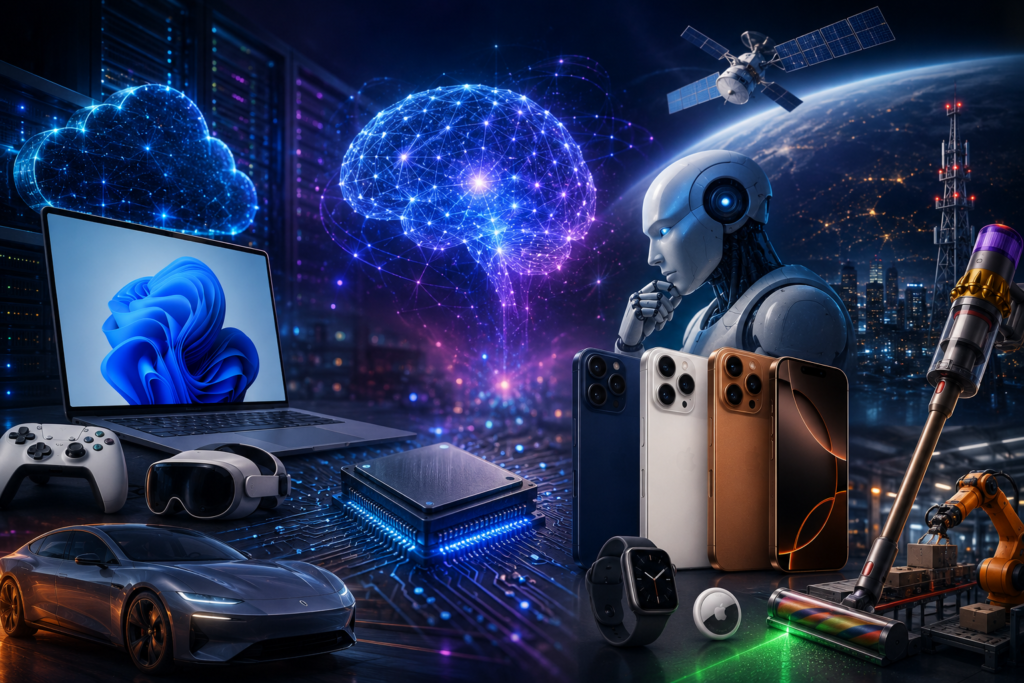
Image Credentials: Image Title: Tech News Brief: Key Events and Developments for May 27, 2026. Source: (chatgpt.com) Date: May 2026. Attribution: This image was created using AI-generated imagery (chatgpt.com) by Open Chronicle and does not depict a real-world scene.
By Open Chronicle with agencies
Tech Sector Accelerates Into New AI Era as Global Competition Intensifies
The global technology industry continued to evolve at a rapid pace on May 27, with major developments across artificial intelligence, consumer electronics, semiconductors, cybersecurity, and connected services highlighting the increasingly competitive race shaping the digital economy.
Artificial intelligence remained at the center of much of the day’s momentum. Technology companies across the United States, Europe, and Asia unveiled new products, software upgrades, and infrastructure investments designed to strengthen their positions in the expanding AI market. The pace of innovation also intensified debates around regulation, ethics, and the future role of AI in daily life.
Microsoft released its Windows 11 KB5089573 update, focusing on performance improvements and system stability as the company continues refining its operating system amid growing integration of AI-powered features. Microsoft is also moving ahead with changes to its software ecosystem, including new security functions for Microsoft Defender and the gradual transition away from Nvidia’s legacy Control Panel toward newer application environments.
Samsung remained one of the busiest companies in the consumer technology sector. The South Korean giant expanded the rollout of its One UI 8.5 software update to more affordable Galaxy devices, while also introducing improved camera controls previously limited to flagship models. Samsung additionally announced advances in memory chip technology, including the development of 900-layer V-NAND storage using hybrid bonding technology, further intensifying competition in the semiconductor industry.
Meanwhile, Apple continued drawing attention ahead of its next product cycle. Reports suggested future iPhone models could adopt enhanced anti-theft protections and new design refinements, while updates for AirTag devices and growing satellite communication partnerships highlighted Apple’s broader push into integrated ecosystem services.
The artificial intelligence race also continued to reshape global competition between Washington and Beijing. Huawei unveiled further advances in chip design and semiconductor scaling, presenting what analysts described as another important milestone in China’s efforts to reduce dependence on Western technology amid ongoing US restrictions.
Chinese technology firms also expanded their ambitions in AI-generated media, robotics, and cloud infrastructure. Beijing’s decision to assign identification numbers to humanoid robots reflected growing concerns about safety oversight as robotics becomes more widespread.
In the United States, OpenAI reportedly accelerated efforts to build more advanced advertising systems powered by AI, potentially increasing pressure on Google’s dominance in digital advertising markets. Anthropic and other AI companies also remained under scrutiny as debate intensified over the social and ethical implications of increasingly powerful generative AI systems.
Cybersecurity concerns were another major theme throughout the day. The FBI issued fresh warnings about phishing attacks targeting Microsoft 365 accounts, while security researchers identified new malware campaigns exploiting AI chatbots, browser vulnerabilities, and cloud infrastructure. Growing fears about ransomware, cryptojacking operations, and AI-assisted cyberattacks are increasingly pushing governments and corporations to invest heavily in digital defenses.
At the same time, the technology industry’s relationship with society and politics continued evolving. Pope Leo XIV’s recent warning about the risks of unchecked artificial intelligence continued to spark reactions among technology executives and researchers worldwide, with many acknowledging growing public unease about AI’s role in warfare, labor markets, and online information ecosystems.
Elsewhere, companies across telecommunications and satellite services expanded next-generation connectivity projects. Starlink partnerships with airlines and mobile providers advanced satellite-enabled communications for smartphones and in-flight internet access, while Europe continued debating digital sovereignty and technological independence from both American and Chinese platforms.
The rapid expansion of AI infrastructure is also transforming energy consumption and data center economics. Industry executives increasingly face criticism over rising power demands linked to massive AI computing systems, even as investors continue pouring billions into the sector.
Despite economic uncertainty and geopolitical tensions, the technology industry shows little sign of slowing down. From smartphones and AI chips to cloud systems and cybersecurity, the race to dominate the next generation of digital infrastructure is accelerating across every major global market.