
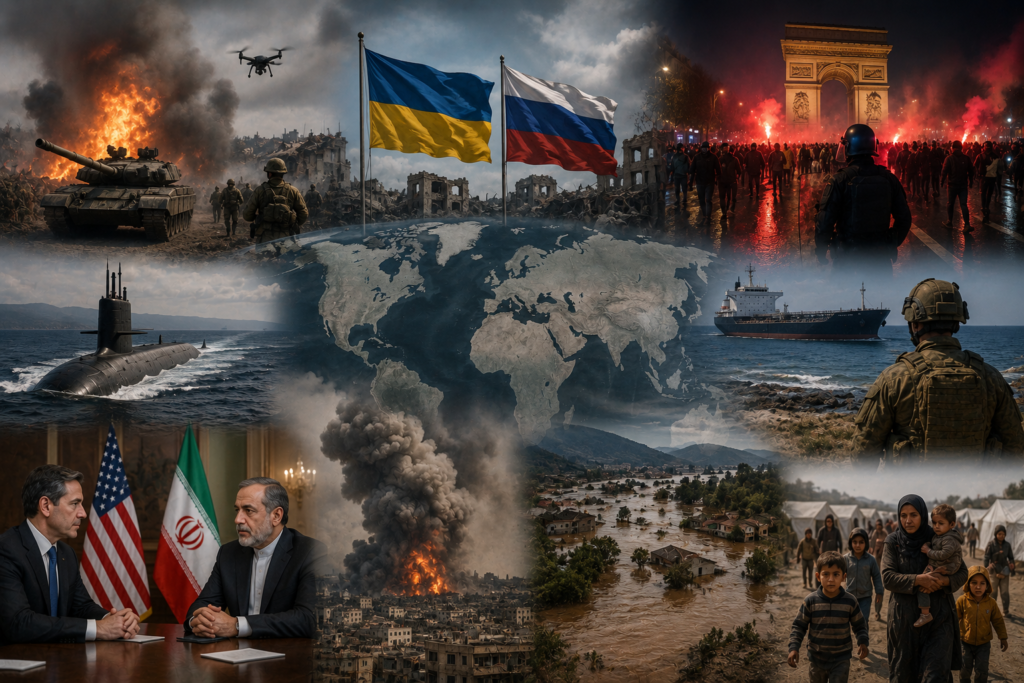
Image Credentials: Image Title: Global News Brief: Key Events and Developments for May 31, 2026. Source: (chatgpt.com) Date: May 2026. Attribution: This image was created using AI-generated imagery (chatgpt.com) by Open Chronicle and does not depict a real-world scene.
By Open Chronicle with agencies
A series of security crises, military escalations, political tensions, and international incidents dominated global headlines on Sunday, underscoring growing instability across several regions. From renewed conflict in the Middle East and Eastern Europe to security concerns in Asia and domestic unrest in Western countries, governments are facing mounting geopolitical challenges.
Israel Expands Operations in Lebanon
Tensions along the Israel-Lebanon border intensified dramatically after Israeli forces launched what military officials described as a large-scale offensive in southern Lebanon.
Israeli Defense Minister Israel Katz announced that Israeli troops had crossed the Litani River and were determined to “crush” Hezbollah. Israeli forces reportedly captured the historic Beaufort Castle, marking Israel’s deepest military advance into Lebanese territory in more than two decades.
The escalation follows days of increased Hezbollah rocket and drone attacks against northern Israel. Lebanese officials condemned the offensive, while France called for an emergency meeting of the United Nations Security Council to address the deteriorating situation.
Lebanon’s prime minister warned that the latest developments represent an “unprecedented escalation” despite existing ceasefire arrangements.
Ukraine-Russia Conflict Continues to Escalate
The war in Ukraine remained highly active as Ukrainian drones carried out strikes against Russian energy infrastructure deep inside Russian territory.
Russian authorities reported attacks on pipelines, refineries, fuel depots, and other strategic facilities. Ukrainian officials confirmed several operations targeting military and energy assets but denied Russian accusations that Kyiv had attacked the Russian-controlled Zaporizhzhia Nuclear Power Plant.
The International Atomic Energy Agency expressed concern after reports emerged that a drone strike had occurred near the facility, renewing fears over the security of Europe’s largest nuclear power station.
Meanwhile, NATO member Romania continued to face security concerns following recent incidents involving Russian drones near its territory. Italy announced the deployment of troops and aircraft to Romania as part of broader alliance reassurance measures.
Paris Celebrations Turn Violent
What began as celebrations of Paris Saint-Germain’s Champions League triumph ended in widespread disorder across the French capital.
French authorities arrested hundreds of individuals following riots that erupted after PSG’s victory. Dozens of police officers were reportedly injured during clashes, while property damage was recorded in several districts of Paris.
The unrest has renewed debate about public security during major sporting celebrations and prompted calls for stricter crowd control measures at future events.
AUKUS Deal Modified
Australia’s submarine acquisition plans received a significant adjustment as the United States confirmed that only previously used nuclear-powered submarines will be transferred under the revised AUKUS security agreement.
The decision reflects ongoing concerns regarding production capacity within the American naval shipbuilding industry while maintaining commitments to strengthen Australia’s maritime capabilities amid growing strategic competition in the Indo-Pacific region.
The announcement came as defense officials attending regional security forums continued to express concern over China’s military modernization and expanding naval presence.
US-Iran Negotiations Continue Amid Tensions
Diplomatic efforts between Washington and Tehran continued despite persistent military tensions in the Persian Gulf.
Former President Donald Trump claimed that Iran had agreed in principle not to develop or acquire nuclear weapons, although negotiators reportedly remain divided on several key issues.
At the same time, naval tensions remained elevated. Reports indicated that US forces intercepted a commercial vessel attempting to reach Iran in defiance of the ongoing maritime blockade.
Military officials also warned shipping companies about continuing security risks in the Strait of Hormuz, one of the world’s most critical energy corridors.
Security Concerns Grow Across Europe
Several European governments raised alarms about emerging threats to regional stability.
Denmark announced plans that could mobilize up to 180,000 troops in the event of a major conflict, reflecting broader concerns about Europe’s security environment.
Meanwhile, reports indicated that Russian “shadow fleet” vessels had entered British waters hundreds of times despite previous warnings and enforcement measures.
Eastern European governments also continued monitoring developments in Belarus, where analysts warned that increased military activity could potentially support future Russian operations.
Asia Faces Strategic Challenges
Defense officials meeting in Asia highlighted growing concerns regarding regional security dynamics.
Japan’s defense minister rejected accusations of militarization while criticizing China’s expanding military capabilities. South Korea and Japan resumed joint naval exercises after a nine-year hiatus, signaling closer security cooperation between the two allies.
Elsewhere, Vietnam’s President To Lam began an official visit to the Philippines, while discussions at regional defense forums focused heavily on Taiwan, maritime security, and China’s strategic ambitions.
Humanitarian Crises Continue
Beyond military and political developments, humanitarian concerns remained severe in several regions.
The World Health Organization continued efforts to contain the Ebola outbreak in the Democratic Republic of Congo, warning that travel restrictions could hamper response efforts.
In Gaza, health authorities reported additional casualties despite ongoing ceasefire arrangements, while humanitarian organizations warned of worsening conditions for civilians.
In Syria and Iraq, recent flooding linked to rising water levels along the Euphrates River has shifted attention toward environmental and infrastructure challenges after years of drought.
A World Facing Multiple Flashpoints
The developments of May 31 highlight a global environment marked by simultaneous crises. Conflicts in Ukraine and the Middle East continue to generate international repercussions, while major powers increasingly compete across military, economic, and technological domains.
As diplomatic efforts struggle to keep pace with rising tensions, governments around the world face growing pressure to manage security risks without allowing local confrontations to evolve into wider international crises.