
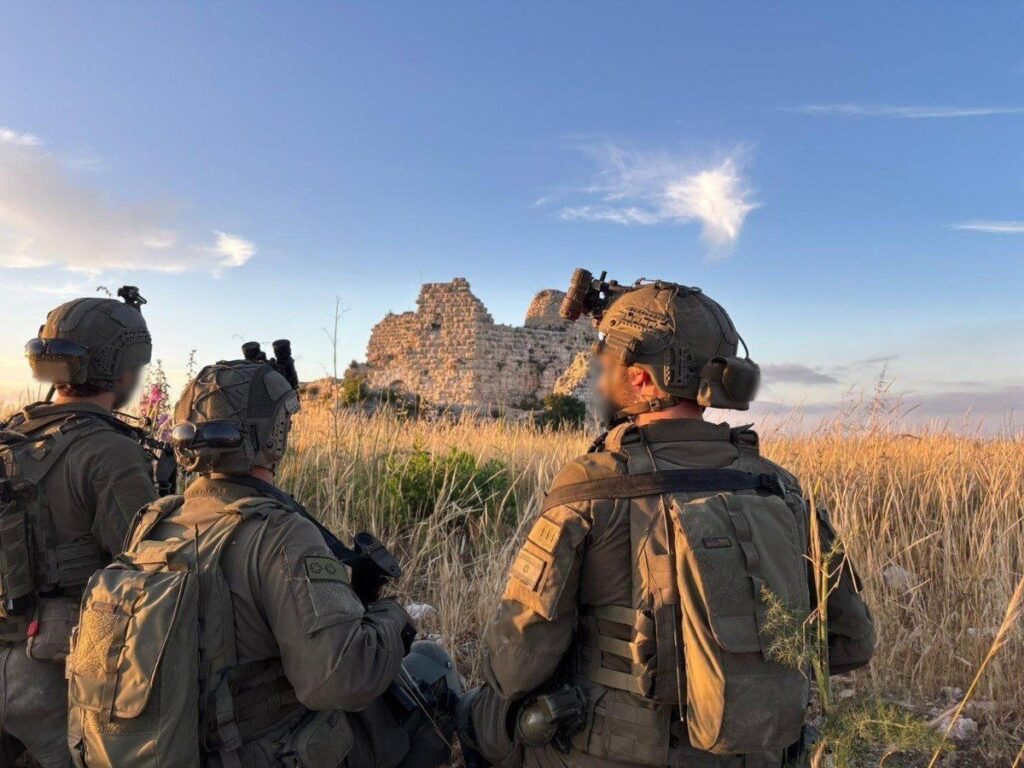
Image Credentials: Image Title: Israeli Troops Seize Strategic Castle in Lebanon During Deepest Incursion in Decades. Source: (chatgpt.com) Date: May 2026. Attribution: This image was created using AI-generated imagery (chatgpt.com) by Open Chronicle and does not depict a real-world scene.
By Open Chronicle with agencies
Israeli forces have captured the historic Beaufort Castle in southern Lebanon, marking the deepest Israeli military advance into Lebanese territory in more than a quarter century and signaling a significant escalation in the ongoing conflict with Hezbollah.
The fortress, perched atop a commanding mountain overlooking the Litani River and large areas of southern Lebanon and northern Israel, fell after days of intense fighting and airstrikes in the surrounding region. Israeli military officials described the operation as a strategic achievement in their expanding campaign against Hezbollah positions in southern Lebanon.
The capture comes amid a conflict that has intensified since March, when Hezbollah launched rocket attacks into northern Israel following regional tensions involving Iran, a key ally of the Lebanese group. Since then, both sides have engaged in sustained exchanges of fire, with Israel conducting a ground offensive into southern Lebanon and Hezbollah responding with missile, drone, and rocket attacks.
🚨🚨🇮🇱🇱🇧 BREAKING: The IDF has liberated Beaufort Castle in southern Lebanon, marking Israel's deepest incursion into the country in 26 years.
Built by Crusaders 900 years ago, the fortress sits 717 meters above sea level atop a sharp cliff. pic.twitter.com/fZ2YBYNuNa— C14 News | EN (@Terror_Alarm) May 31, 2026
A Symbolic and Strategic Victory
Beaufort Castle, known in Arabic as Al-Shaqif Castle, occupies one of the most strategically important locations in southern Lebanon. The fortress dates back to the Crusader era and has served military powers for centuries, including the armies of Saladin, the Mamluks, the Ottomans, French colonial forces, and the Palestine Liberation Organization.
Israeli Defense Minister Israel Katz announced that Israeli troops had raised the national flag over the castle, emphasizing the symbolic significance of the operation.
The site holds particular meaning in Israel. Israeli forces first captured Beaufort during the 1982 Lebanon War and maintained control of the area until their withdrawal from southern Lebanon in 2000. The fortress later became a symbol of Israel’s long military presence in Lebanon and inspired the acclaimed Israeli war film Beaufort, which explored the final days before the withdrawal.
Katz stated that Israel intends to maintain control of the position as part of broader efforts to dismantle what it describes as Hezbollah military infrastructure throughout southern Lebanon.
Expanding Military Operations
The seizure of Beaufort Castle is part of a broader Israeli offensive that has expanded beyond previous operational boundaries. Israeli forces have crossed the Litani River, long considered a de facto dividing line in southern Lebanon, and designated extensive areas as active combat zones.
Prime Minister Benjamin Netanyahu described the operation as a major shift in Israeli policy, linking it to broader security strategies involving buffer zones along Israel’s borders.
Israeli troops have advanced through villages surrounding Beaufort and are now reportedly within a few kilometers of Nabatiyeh, one of southern Lebanon’s most important urban centers. Residents in several areas, including parts of Nabatiyeh and the coastal city of Tyre, have been urged to evacuate.
According to Israeli officials, approximately 3,000 Hezbollah fighters have been killed since the beginning of the conflict, although Hezbollah has not publicly confirmed casualty figures.
International Concern
The Israeli advance has drawn sharp international criticism, particularly as it unfolds despite a ceasefire agreement that officially remains in place.
French Foreign Minister Jean-Noël Barrot called for an emergency meeting of the United Nations Security Council, describing the continued military operations as unacceptable and warning against a prolonged Israeli occupation of Lebanese territory.
Lebanese Parliament Speaker Nabih Berri, a key political ally of Hezbollah, reiterated support for a ceasefire and accused Israel of undermining efforts to end hostilities.
The timing of the offensive is particularly significant, coming just days before scheduled direct talks between Lebanese and Israeli representatives in Washington.
Hezbollah Continues Resistance
Despite Israeli gains, Hezbollah remains active across the front. The group has claimed responsibility for attacks against Israeli troops, armored vehicles, and military positions both near the border and deeper inside northern Israel.
Military analysts note that Hezbollah’s increasing use of fiber optic-guided drones has created new challenges for Israeli forces. These systems are difficult to jam electronically and have proven effective in recent operations.
Rocket barrages and drone alerts continue to affect northern Israel, with hundreds of warnings issued to civilians in recent days.
Humanitarian Impact
The latest escalation has deepened an already severe humanitarian crisis. More than one million people have reportedly been displaced across Lebanon since the conflict began, while thousands have been killed or injured.
Lebanese health authorities reported additional casualties following Israeli strikes near Tyre and Nabatiyeh, including attacks that affected medical facilities and civilian areas.
As fighting intensifies and diplomatic efforts struggle to gain traction, the capture of Beaufort Castle may prove to be a pivotal moment in the conflict, one that could shape both battlefield dynamics and future negotiations between Israel, Lebanon, and regional actors.