
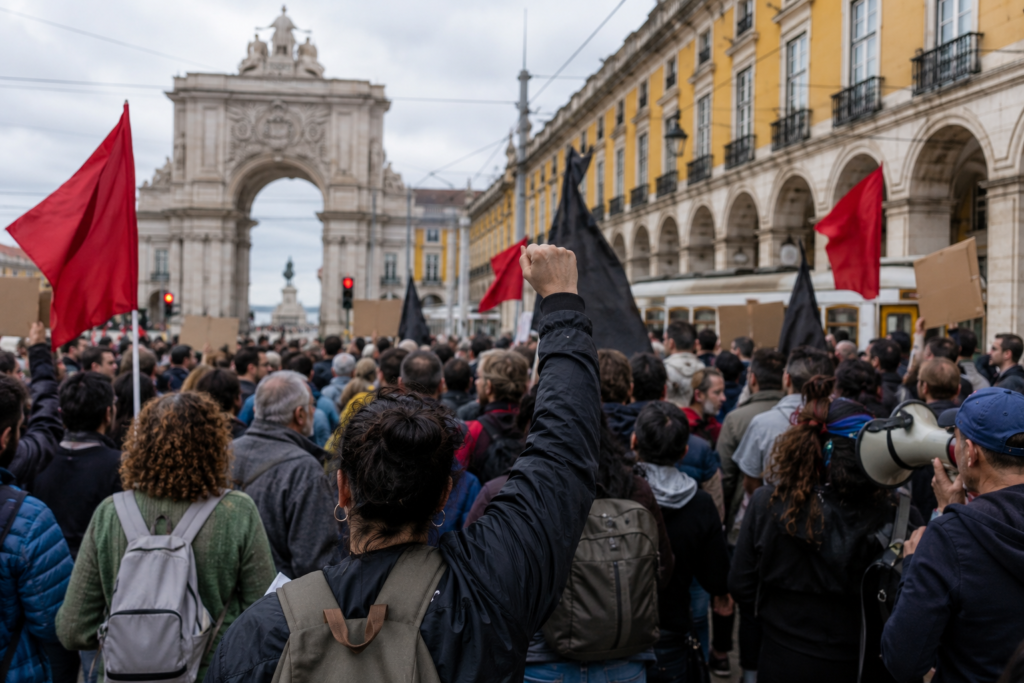
Image Credentials: Image Title: Portugal Braces for Nationwide Strike as Transport, Health, Education, and Public Services Face Major Disruptions. Source: (chatgpt.com) Date: May 2026. Attribution: This image was created using AI-generated imagery (chatgpt.com) by Open Chronicle and does not depict a real-world scene.
By Open Chronicle with agencies
Portugal is preparing for a nationwide general strike on Wednesday, June 3, with disruptions expected to begin as early as Tuesday evening across several key sectors, including transport, healthcare, education, aviation, and public administration.
The strike was called by the General Confederation of Portuguese Workers (CGTP) in protest against the government’s proposed labour reform package, known as “Trabalho XXI”, which would introduce more than 100 amendments to the country’s Labour Code. Trade unions argue that the reforms weaken workers’ rights, increase job insecurity, and undermine collective bargaining protections.
The walkout follows a major nationwide strike held in December, the first jointly supported by Portugal’s two largest union confederations in more than a decade.
Transport Network Faces Significant Impact
Transportation is expected to experience some of the most visible disruptions. Several unions representing railway, metro, bus, ferry, and airport workers have confirmed their participation.
In Lisbon, Metro services will be suspended from 11:00 p.m. on June 2 and throughout the entire strike day, with normal operations expected to resume on the morning of June 4.
Porto’s metro system will operate only limited services on selected sections of the Yellow and Blue lines, while most other routes will remain closed.
National railway operator CP has warned passengers of widespread disruptions to train services, including possible effects before and after the official strike period. Minimum services will continue on key long-distance, regional, and suburban routes under agreements reached with authorities.
Ferry services across the Tagus River and public transport systems in Lisbon, Porto, and Coimbra are also expected to face interruptions.
Air Travel Disruptions Expected
The aviation sector will also be affected after airport workers and flight personnel unions joined the strike.
Portugal’s national airline, TAP, has announced that only a limited number of flights will operate under mandatory minimum service requirements. The carrier stated that most scheduled flights for June 3 will be cancelled, and affected passengers are being contacted to arrange alternative travel options.
Travelers using Portuguese airports are being advised to check flight status updates before heading to the airport.
Hospitals and Health Services to Operate Under Minimum Services
Healthcare professionals, including nurses and doctors from public, private, and social-sector institutions, are expected to participate in the strike.
Hospitals, health centres, and clinics will maintain essential services, operating at staffing levels similar to those used on Sundays and public holidays.
Emergency departments, dialysis treatments, chemotherapy, radiotherapy, and palliative care services are expected to remain available, although patients may experience delays in non-urgent appointments and procedures.
Healthcare unions say the strike is intended to defend labour protections and oppose what they describe as a deterioration of working conditions under the proposed reforms.
Schools and Universities Join the Protest
The education sector is also preparing for widespread disruption.
Teachers, university lecturers, and researchers have been called to stop work throughout the day, potentially affecting classes, examinations, student support services, and academic assessments across the country.
Education unions argue that the proposed labour legislation would make precarious employment more common and weaken legal protections for workers.
Unlike health services, no minimum service requirements have been established for schools or universities.
Public Administration and Municipal Services Affected
Workers in local government, public institutions, and administrative services are also expected to participate.
Municipal services, licensing offices, citizen service centres, and waste collection operations may experience delays or temporary closures.
Union representatives warn that the government’s proposals could negatively affect wages, employment stability, and collective bargaining rights across the public sector.
Industry, Retail, and Hospitality Join the Walkout
The strike extends beyond public services.
Workers in manufacturing, retail, hospitality, insurance, communications, and media sectors have announced their participation. Employees at Autoeuropa and other major industrial facilities have expressed support for the action, describing it as a necessary response to protect workers’ rights.
Hospitality workers, including those employed in hotels, restaurants, cafeterias, and catering services, are also expected to join the protest, potentially affecting service levels across tourism-related businesses.
Labour Reform at the Centre of the Dispute
The government led by Prime Minister Luís Montenegro argues that the Trabalho XXI package is designed to modernize labour legislation, improve productivity, support wage growth, and adapt Portugal’s economy to digital-era challenges.
Trade unions strongly disagree, describing the reforms as a significant rollback of labour protections and a threat to constitutional rights.
Although the Council of Ministers has already approved the proposal, the legislation still awaits debate and voting in Parliament.
As Portugal prepares for one of its largest labour actions in recent years, Wednesday’s strike is expected to test both the government’s reform agenda and the strength of organised labour opposition across the country.