
Image Credentials: Image Title: Texas Primaries Reshape Key US Senate and House Battles Ahead of Midterms. Source: (chatgpt.com) Date: June 2026. Attribution: This image was created using AI-generated imagery (chatgpt.com) by Open Chronicle and does not depict a real-world scene.
By Open Chronicle with agencies
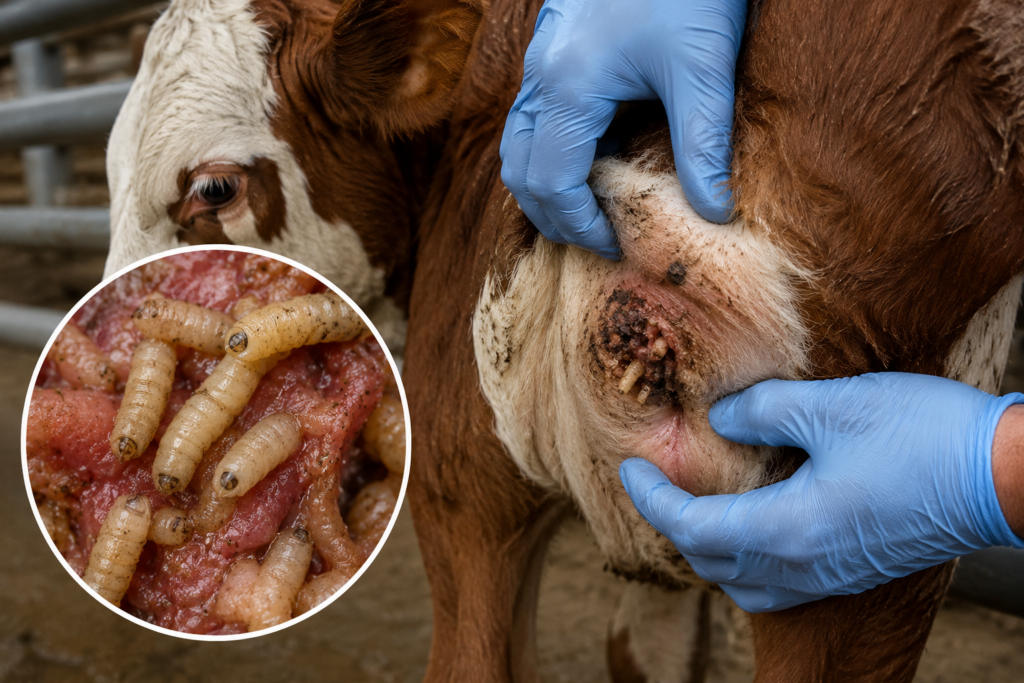
The United States Department of Agriculture (USDA) has confirmed the detection of the New World screwworm (NWS) in Texas, marking the first known livestock case in the country in years and prompting an immediate containment response by federal and state authorities.
U.S. Secretary of Agriculture Brooke Rollins announced that the parasitic larvae were discovered in a three-week-old calf in Zavala County, Texas. The infestation was identified in the animal’s umbilical area, and officials emphasized that no additional cases have been detected so far.
The discovery comes after months of concern that the parasite could spread northward from ongoing outbreaks in Mexico and several Central American countries, where livestock infections have been reported since at least 2022.
Florida Commissioner of Agriculture Wilton Simpson Statement on New World Screwworm Detection in South Texas: pic.twitter.com/BhP6SbnYcN
— Florida Dept. of Agriculture & Consumer Services (@FDACS) June 4, 2026
According to the USDA, a joint Incident Command Team has been established alongside the Texas Animal Health Commission to coordinate eradication efforts. Authorities have already deployed personnel to the affected area and implemented a 12.5-mile infested zone that includes quarantines, livestock movement restrictions, and intensified surveillance.
The New World screwworm is a parasitic fly whose larvae feed on the living tissue of warm-blooded animals, particularly cattle and other livestock. The pest derives its name from the way its larvae burrow into flesh using sharp mouth hooks, causing severe wounds that can lead to serious infection and death if untreated.
🚨NEW: Yesterday, the USDA confirmed a New World screwworm detection in a 3-week-old calf in Zavala County, Texas. Officials said there have been no further detections so far, but APHIS and Texas officials are establishing a 20 km infested zone, implementing quarantines and… pic.twitter.com/TMPBEeLEdn
— MTS Insights (@MTSInsights) June 4, 2026
Although human infections are possible, they remain extremely rare. Public health officials have repeatedly stressed that the risk to humans is very low. However, widespread infestation among livestock could have significant economic consequences for the cattle industry.
The United States successfully eradicated the New World screwworm in 1966 through a large-scale biological control program involving the release of sterilized male flies. By preventing successful reproduction, the technique gradually eliminated the parasite from the country.
To prevent a renewed outbreak, authorities are currently releasing approximately 100 million sterile flies every week across affected areas of the United States and Mexico. The USDA also plans to accelerate targeted ground releases around the Texas detection site, complementing the four million sterile flies already being released by air each week in the region.
While the screwworm has remained largely absent from the United States for decades, isolated outbreaks have occurred in the American Southwest during the 1970s and in the Florida Keys in 2016. Both incidents were successfully contained using sterile fly programs.
The Centers for Disease Control and Prevention notes that people who travel to outbreak regions, work closely with livestock, sleep outdoors, or have untreated open wounds face a higher risk of infestation.
Despite concerns about potential impacts on cattle production, Rollins sought to reassure consumers, stating that the nation’s food supply remains safe.
“The food supply is 100% safe,” she said, while acknowledging that authorities are closely monitoring the situation to prevent further spread of the parasite.
Agricultural officials say rapid detection and immediate intervention will be crucial to preventing the New World screwworm from re-establishing itself in the United States after nearly six decades of successful eradication.