
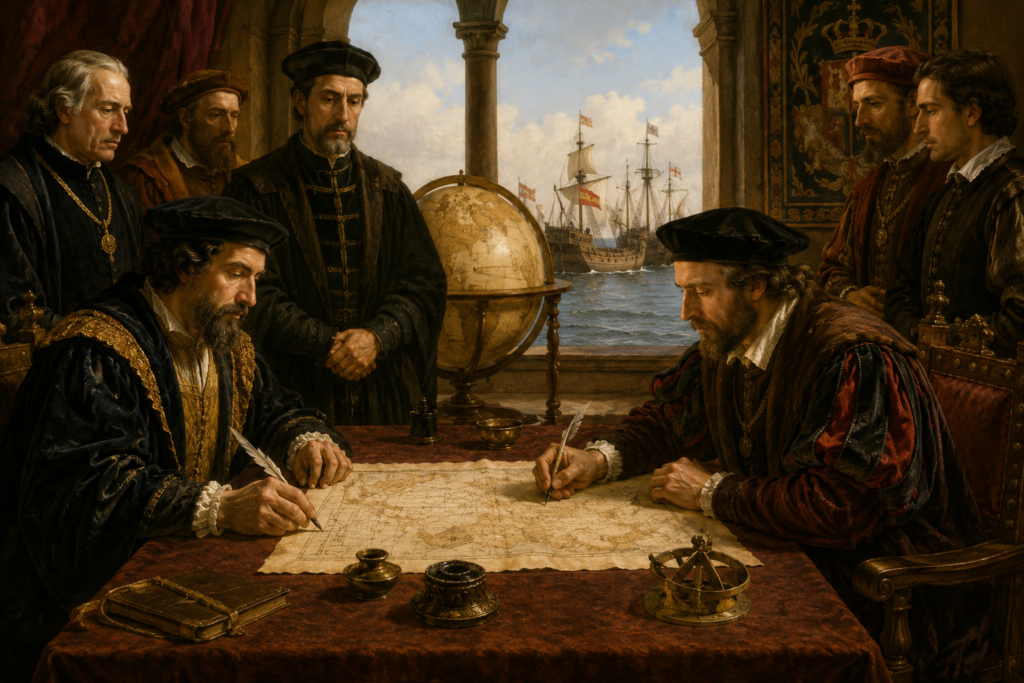
Image Credentials: Image Title: Today in History, June 7: The Treaty of Tordesillas Divides the New World. Source: (chatgpt.com) Date: May 2026. Attribution: This image was created using AI-generated imagery (chatgpt.com) by Open Chronicle and does not depict a real-world scene.
By Open Chronicle
On June 7, 1494, representatives of the kingdoms of Spain and Portugal signed the Treaty of Tordesillas, an agreement that sought to resolve competing claims over newly discovered lands beyond Europe. The treaty became one of the most consequential diplomatic agreements of the Age of Exploration, shaping the future political, cultural, and linguistic map of the Americas and other parts of the world.
The agreement followed Christopher Columbus’s voyages across the Atlantic, which opened new opportunities for exploration and colonization. Both Spain and Portugal, Europe’s leading maritime powers of the late fifteenth century, sought exclusive rights to territories discovered overseas. To prevent conflict between the two kingdoms, negotiations were held in the Spanish town of Tordesillas.
The treaty established an imaginary north-south line approximately 370 leagues west of the Cape Verde Islands. Lands discovered east of the line would belong to Portugal, while those to the west would belong to Spain. Although the geography of the world was still poorly understood, both kingdoms accepted the arrangement as a means of avoiding rivalry and securing their overseas ambitions.
One of the treaty’s most significant consequences emerged in South America. When Portuguese explorers later reached the coast of what is now Brazil, they claimed the territory under the terms of the agreement. As a result, Brazil developed as a Portuguese-speaking nation, while most of the rest of Latin America came under Spanish influence and adopted Spanish.
The treaty also had far-reaching effects beyond the Americas. It influenced exploration, trade routes, missionary activities, and colonial expansion across Africa and Asia. For decades, it served as a framework for European overseas ambitions, although other emerging powers such as England, France, and the Netherlands eventually rejected its authority.
The agreement was endorsed by Pope Alexander VI and reflected the growing influence of both the Catholic Church and European monarchies during the era of global exploration. However, the treaty made no consideration for the millions of Indigenous peoples already living in the territories being divided. This reality would have profound consequences in the centuries that followed.
Today, the Treaty of Tordesillas is regarded as a landmark moment in world history. It helped determine the linguistic and cultural divisions that remain visible across Latin America and stands as a symbol of the ambitions, rivalries, and global transformations that characterized the Age of Exploration.