
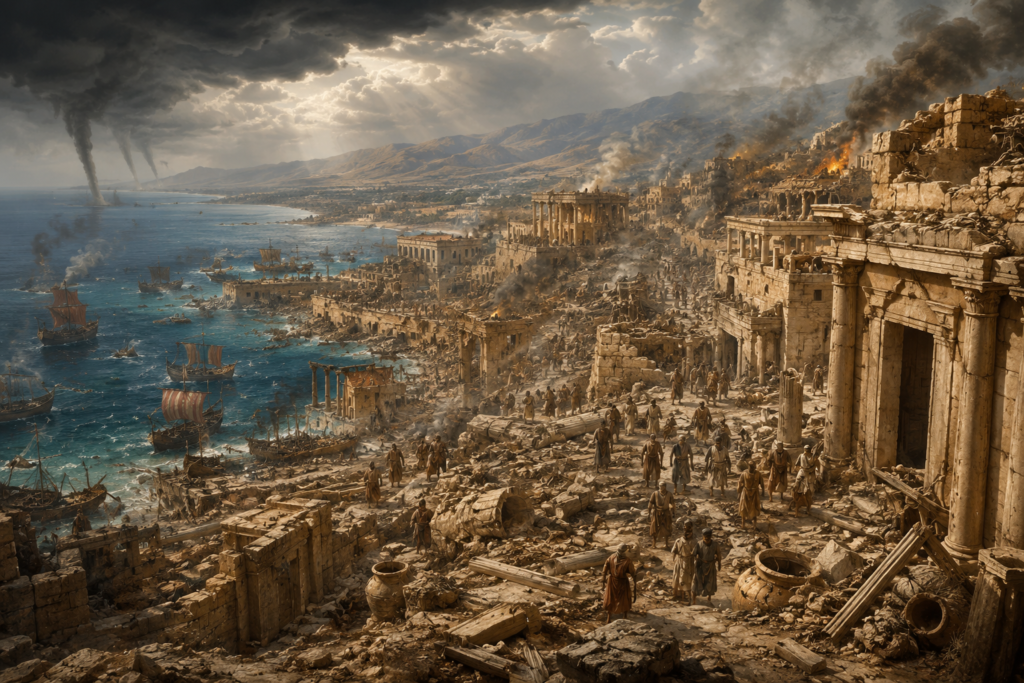
Image Credentials: Image Title: What Archaeologists Found About the 1177 BC Collapse Changes How We View Ancient Trade Networks. Source: (chatgpt.com) Date: June 2026. Attribution: This image was created using AI-generated imagery (chatgpt.com) by Open Chronicle and does not depict a real-world scene.
By Madison Walker | Open Chronicle Senior Editor
Around 1200 BC, some of the most powerful civilizations of the ancient world collapsed with remarkable speed. Within a few decades, the Mycenaeans, Hittites, Egyptians, Babylonians, and several other major societies across the eastern Mediterranean and Near East experienced widespread disruption. Cities were destroyed, palace administrations disappeared, and long-established trade routes ceased to function. The result was a regional dark age that lasted for centuries.
For generations, historians largely attributed this dramatic collapse to the Sea Peoples, a mysterious group of maritime raiders mentioned in Egyptian records. While these attacks undoubtedly played a role, modern archaeological research suggests a far more complex explanation. Increasingly, scholars argue that the downfall of these civilizations was not caused by a single enemy, but by the vulnerabilities created by an interconnected economic system that failed under multiple simultaneous pressures.
A Connected World at Risk
The Late Bronze Age was characterized by an extensive international trade network linking kingdoms and empires across vast distances. Essential resources moved regularly between regions, including copper from Cyprus and luxury materials such as lapis lazuli from Afghanistan. This exchange generated wealth, supported royal administrations, and helped sustain complex urban societies.
However, the same interconnectedness that fueled prosperity also created systemic weaknesses.
Archaeologist Eric Cline, a leading expert on the period, argues that no single factor can adequately explain the collapse. Instead, he describes the event as a large-scale systems failure involving several overlapping crises.
According to current evidence, these societies faced a combination of drought, famine, invasions, earthquakes, and possibly disease. While any one of these challenges might have been manageable, their convergence overwhelmed the political and economic structures that held the region together.
The Earthquake Storm Theory
Research conducted by Cline and geophysicist Amos Nur suggests that a rapid sequence of major earthquakes struck the Mediterranean between approximately 1225 and 1175 BC. They describe this phenomenon as an “earthquake storm,” a period in which multiple urban centers suffered severe seismic damage over several generations.
Many of the region’s major cities show archaeological signs of destruction consistent with earthquakes. Infrastructure, defensive walls, storage facilities, and administrative centers were damaged or destroyed, placing enormous strain on already vulnerable governments.
Yet the physical destruction was only part of the story.
Evidence of Famine and Drought
Clay tablets discovered at Ugarit, an important coastal trading city in present-day Syria, reveal the growing desperation of the period. Letters preserved in royal archives describe burned agricultural lands, food shortages, and urgent requests for assistance.
Scientific evidence has recently provided a more precise picture of the environmental conditions behind these reports.
A study led by Cornell University archaeologist Sturt Manning examined tree rings from ancient juniper wood preserved in a Hittite royal tomb in modern Turkey. The analysis identified an exceptionally severe drought lasting from 1198 to 1196 BC.
The findings indicate that this was the driest three-year period experienced in the region for more than six centuries.
Such prolonged agricultural failure would have devastated food production, weakened economies, and increased social instability. Communities that relied on regular harvests and imported supplies suddenly faced severe shortages with limited means of recovery.
When coastal raids and military pressures arrived, they encountered societies already struggling to survive.
Why the Entire System Failed
The collapse of the Bronze Age world was not simply the fall of individual kingdoms. It was the breakdown of a highly interconnected network.
Palace economies controlled the distribution of resources, trade, and administration across much of the region. These centralized systems worked efficiently during times of stability but lacked flexibility when confronted with multiple crises.
As drought reduced agricultural output, earthquakes damaged infrastructure, and attacks disrupted maritime trade, governments found themselves unable to maintain the flow of goods and services. Trade routes collapsed, urban populations declined, and administrative institutions disappeared.
In many regions, writing systems fell out of use, and major cities were abandoned. Recovery would take centuries.
Lessons for the Modern World
The story of the 1177 BC collapse carries important lessons for the present day.
Although modern economies are vastly more advanced, they remain deeply dependent on interconnected global supply chains. Instead of relying on copper and tin shipments, modern industries depend on complex logistics networks and highly specialized manufacturing hubs.
Recent events have demonstrated how vulnerable these systems can be. The COVID-19 pandemic disrupted transportation and production worldwide, while semiconductor shortages in 2021 affected industries ranging from automobiles to consumer electronics. Localized disruptions quickly spread through global networks, creating shortages and economic strain far from the source of the problem.
The Bronze Age collapse serves as a reminder that efficiency and integration often come at the cost of resilience. Ancient civilizations built prosperous societies on interconnected trade networks, but when environmental disasters, political instability, and external threats converged, the entire system proved unable to adapt.
More than three thousand years later, archaeologists are uncovering evidence that the fall of these civilizations was not the result of a single catastrophe. Instead, it was the consequence of a complex and interconnected world facing multiple shocks at the same time, a lesson that remains strikingly relevant today.
References
Cline, E. H. (2014). 1177 B.C.: The Year Civilization Collapsed. Princeton University Press.
Cline, E. H. (2021). After 1177 B.C.: The Survival of Civilizations. Princeton University Press.
Manning, S. W., Lorentzen, B., Manning, J. G., et al. (2023). “Severe Multi-Year Drought and the Collapse of the Hittite Empire Around 1200 BCE.” Nature. Research examining tree-ring evidence from ancient juniper wood identifies a prolonged drought in Anatolia during the Late Bronze Age.
Nur, A., & Cline, E. H. (2000). “Poseidon’s Horses: Plate Tectonics and Earthquake Storms in the Late Bronze Age Aegean and Eastern Mediterranean.” Journal of Archaeological Science, 27(1), 43–63.
Kaniewski, D., Van Campo, E., Guiot, J., et al. (2013). “Environmental Roots of the Late Bronze Age Crisis.” PLoS ONE, 8(8), e71004.
Weiss, H. (1982). “The Decline of Late Bronze Age Civilization as a Possible Response to Climatic Change.” Climatic Change, 4(2), 173–198.
Singer, I. (1999). A Political History of Ugarit. Society of Biblical Literature.
Liverani, M. (2014). The Ancient Near East: History, Society and Economy. Routledge.
Bryce, T. (2005). The Kingdom of the Hittites (2nd ed.). Oxford University Press.
Drews, R. (1993). The End of the Bronze Age: Changes in Warfare and the Catastrophe ca. 1200 B.C. Princeton University Press.
Knapp, A. B., & Manning, S. W. (2016). “Crisis in Context: The End of the Late Bronze Age in the Eastern Mediterranean.” American Journal of Archaeology, 120(1), 99–149.