
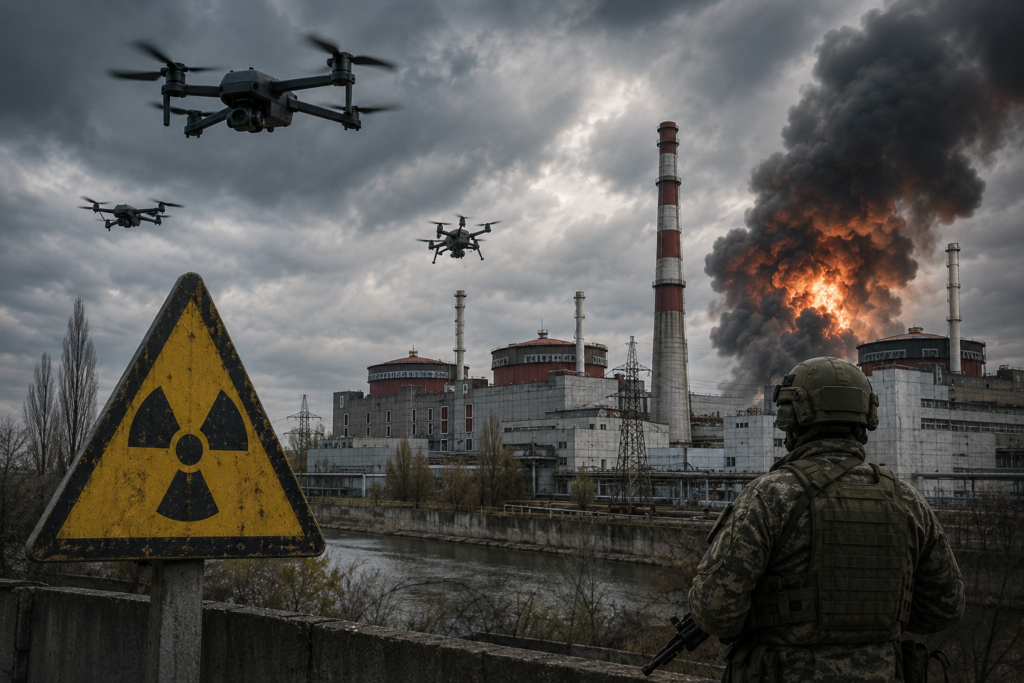
Image Credentials: Image Title: IAEA Warns of Growing Military Activity Around All of Ukraine’s Nuclear Sites. Source: (chatgpt.com) Date: June 2026. Attribution: This image was created using AI-generated imagery (chatgpt.com) by Open Chronicle and does not depict a real-world scene.
By Open Chronicle with agencies
The International Atomic Energy Agency (IAEA) has raised fresh concerns over the safety of Ukraine’s nuclear infrastructure, reporting increased military activity around all of the country’s operational nuclear power plants and the Chornobyl exclusion zone.
According to the agency, monitoring teams have observed more than 100 drones operating within observation areas surrounding the Khmelnytskyy, Rivne, and South Ukraine nuclear power plants, as well as the Chornobyl site, during the past two weeks. Some of the unmanned aircraft were reportedly detected as close as two kilometers from the facilities.
IAEA Director General Rafael Grossi described the situation as deeply alarming, warning that military operations near sites containing nuclear material create unacceptable risks.
“This should not be happening,” Grossi said, adding that “attacking a facility with large amounts of nuclear material is extremely dangerous. It must not happen.”
Chornobyl strike raises fresh concerns
Among the most worrying incidents was a drone strike in the Chornobyl exclusion zone, where the impact occurred at a centralized spent fuel storage facility located only a few hundred meters from containers holding spent nuclear fuel from Ukraine’s operating reactors.
Although no release of radioactive material has been reported, the event has renewed international concerns about the vulnerability of nuclear-related infrastructure in an active war zone.
The IAEA stressed that its experts continue to monitor the situation closely and remain present at several Ukrainian nuclear facilities to assess safety and security conditions.
Drone attack reported at Zaporizhzhia plant
The agency also disclosed new details about an incident at the Russian-occupied Zaporizhzhia Nuclear Power Plant (ZNPP), Europe’s largest nuclear facility.
On 30 May 2026, a drone struck the turbine hall of Unit 6. During a subsequent inspection, IAEA specialists documented a hole in the building’s wall and localized damage to the metal cladding of an empty pipe several meters from the point of impact.
Experts are continuing to evaluate the affected area and determine whether the strike could have broader implications for the plant’s safety systems.
“This is the first time since April 2024 that military activity has directly impacted the ZNPP site,” Grossi noted.
The Zaporizhzhia plant has remained under Russian military occupation since March 2022 and continues to be one of the most sensitive locations in the conflict. The IAEA did not attribute responsibility for the drone strike to either Russia or Ukraine.
International law and nuclear protection
The latest incidents have also highlighted the legal protections surrounding nuclear facilities during armed conflict. Under Article 56 of Additional Protocol I to the Geneva Conventions, nuclear power plants and installations containing dangerous forces are specifically protected from attack if such actions could result in the release of hazardous material and severe civilian casualties.
While the IAEA’s mandate focuses on technical monitoring and nuclear safety rather than legal judgments, the agency continues to warn that military activity around these facilities significantly increases the risk of a nuclear accident with potentially cross-border consequences.
As the war continues, the growing presence of drones and other military operations near Ukraine’s nuclear sites underscores the fragile balance between battlefield objectives and the need to safeguard infrastructure whose destruction could have catastrophic humanitarian and environmental consequences.