
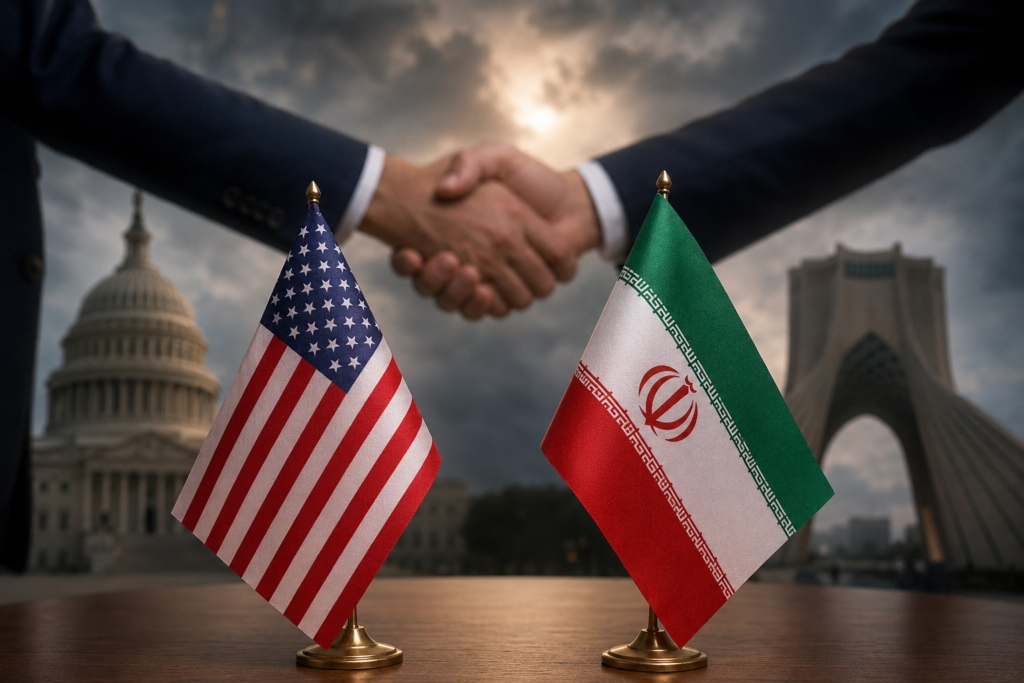
Image Credentials: Image Title: Iran Says U.S. Deal Is Closer Than Ever as Trump Warns Tehran Against “Dishonest” Negotiations. Source: (chatgpt.com) Date: June 2026. Attribution: This image was created using AI-generated imagery (chatgpt.com) by Open Chronicle and does not depict a real-world scene.
By Open Chronicle with agencies
Diplomatic efforts to end months of conflict between the United States and Iran appear to be approaching a critical moment, with both sides signaling that a breakthrough may be within reach, even as public exchanges between Washington and Tehran grow increasingly tense.
Iranian Foreign Minister Abbas Araghchi said on Friday that an agreement with the United States to end the Middle East conflict “has never been closer,” attempting to calm speculation after President Donald Trump sharply criticized what he described as misleading information emerging from Tehran.
The latest dispute erupted after Iranian media outlets published what they claimed were details of a draft agreement under negotiation. According to those reports, Iran would retain the right to enrich uranium, continue to possess enriched nuclear material during a transitional period, and maintain control over maritime traffic through the strategically vital Strait of Hormuz.
The Iranian account, however, contrasts sharply with statements attributed to a senior White House official, who said Tehran had accepted far-reaching concessions, including dismantling its nuclear program, eliminating its stockpiles of enriched uranium, and reopening the Strait of Hormuz to unrestricted international shipping. According to the same source, frozen Iranian assets would only be released after these commitments had been fully implemented.
On Thursday, Trump suggested that a deal was close after weeks of difficult negotiations aimed at ending the conflict that erupted following U.S. and Israeli strikes launched on 28 February. Yet by Friday, the U.S. president forcefully rejected the version of the negotiations circulating in Iranian media.
“The terms Iran leaked to the Fake News have NOTHING to do with the terms that were agreed to in writing,” Trump said in a post on his social media platform. “Their weak and pathetic statement that there is a deal bears no relation to the truth. They are very dishonorable people to deal with. They’d better get their act together, and FAST!”
Araghchi sought to play down the controversy, writing on social media that “the Islamabad Memorandum of Understanding has never been closer,” referring to the Pakistani capital, which has hosted several rounds of indirect talks between the two countries.
“Until the text is finalized, the media should refrain from speculating about its content,” the Iranian foreign minister added. Trump later shared a screenshot of Araghchi’s message on his own account, a move widely interpreted as an acknowledgment that diplomatic channels remain open despite the heated rhetoric.
Pakistan, which has acted as a mediator between Washington and Tehran for several months, also expressed optimism. Prime Minister Shehbaz Sharif announced that negotiators had agreed on a final peace text and were now working to finalize the next steps.
“We can confirm that a final, agreed text of the peace agreement has been reached, and Pakistan is working closely with both parties to coordinate the path forward,” Sharif wrote on X, adding that “peace has never been closer than it is today.”
Ceasefire Holds, but Tensions Remain
A ceasefire has technically been in place since April, but isolated incidents of violence have repeatedly raised fears that the region could slide back into full-scale conflict. Despite these flare-ups, Trump has continued to insist that diplomacy remains the preferred path and that an agreement is within reach.
Israel, a key U.S. ally, has maintained that any final settlement must include the complete removal of Iran’s enriched nuclear material. However, Iran’s state news agency IRNA reported that such a demand is not currently under discussion and that Tehran’s right to continue uranium enrichment would be explicitly recognized during a future negotiation phase.
According to the IRNA account, the initial agreement would be followed by 60 days of additional negotiations covering the long-term future of Iran’s nuclear activities. The report also claimed that Tehran would insist on maintaining authority over maritime traffic through the Strait of Hormuz, one of the world’s most important oil and gas shipping routes.
Iran has restricted traffic through the waterway since the outbreak of the conflict, allowing only a limited number of vessels to pass and requiring ships to obtain authorization from Iranian military authorities before transit.
Economic Incentives and Outstanding Disputes
The framework reportedly under discussion includes provisions to end hostilities across multiple fronts, including in Lebanon, where Israel continues military operations against the Iran-backed Hezbollah movement.
Iranian media reports suggest that a preliminary agreement could also lead to the release of approximately $24 billion in frozen Iranian assets, the easing of sanctions on Iranian oil exports, and the lifting of U.S. naval restrictions affecting Iranian ports. Additional proposals reportedly include compensation claims by Tehran for damage caused during the conflict.
The possibility of a deal has already had a noticeable impact on global financial markets. Optimism surrounding the negotiations has supported stock markets while contributing to a decline in oil prices, as investors anticipate greater stability in the Gulf region and a potential reopening of energy supply routes.
Uncertainty Inside Iran
Despite the diplomatic momentum, reactions inside Iran remain mixed. Some citizens have expressed uncertainty over whether a deal would improve their lives or merely strengthen the country’s political establishment.
“I honestly don’t know how to feel,” a 29-year-old café employee in Tehran, who requested anonymity for security reasons, told AFP. “I don’t know if it will be good or bad for us. The main goal of this war was supposed to be changing the system, and that didn’t happen. So what is the point of an agreement?”
For now, negotiators continue to work behind closed doors while world leaders watch closely. Although major differences remain over nuclear activities, sanctions relief, and security guarantees, officials involved in the process continue to signal that the prospect of a formal U.S., Iran agreement is closer than at any point since the conflict began.