
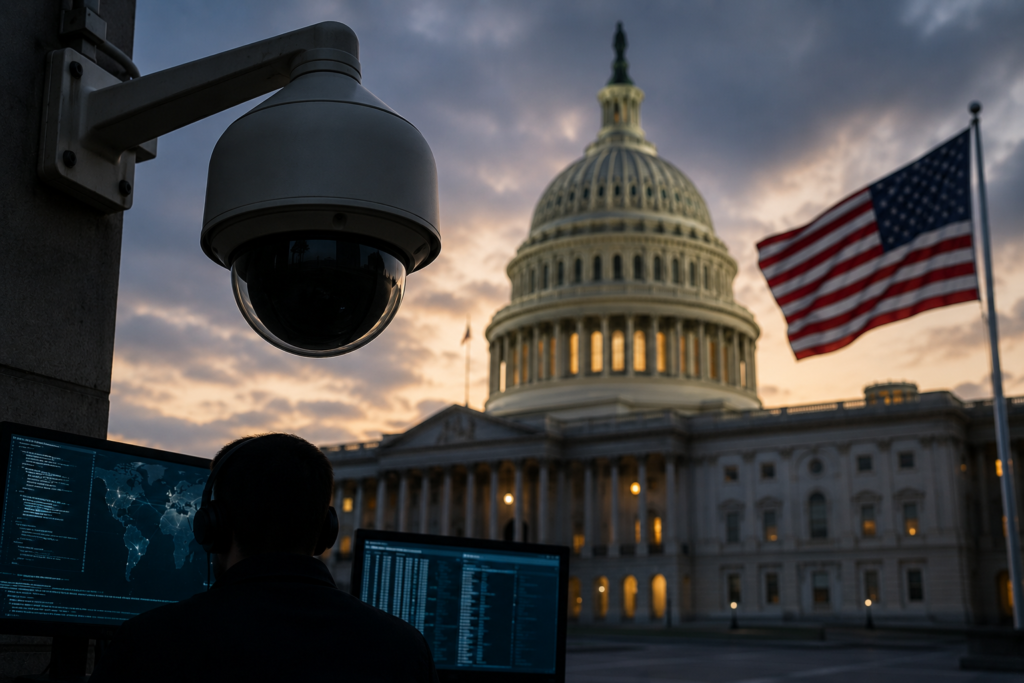
Image Credentials: Image Title: US Surveillance Law Expires After Congress Fails to Reach Agreement. Source: (chatgpt.com) Date: June 2026. Attribution: This image was created using AI-generated imagery (chatgpt.com) by Open Chronicle and does not depict a real-world scene.
By Open Chronicle with agencies
A key piece of United States surveillance legislation expired on Friday after lawmakers failed to reach a compromise before Congress left for its scheduled recess, creating fresh uncertainty over the future of one of the country’s most important intelligence tools.
The law, known as the Foreign Intelligence Surveillance Act (FISA), includes the controversial Section 702 provision, which authorizes US intelligence agencies to collect the communications of foreign individuals located outside the United States without obtaining individual court warrants. The program has long been regarded by security officials as a vital instrument for counterterrorism and national security operations.
US authorities have credited Section 702 with helping to disrupt terrorist plots, gather intelligence on cyberattacks targeting critical infrastructure, and locate senior al-Qaeda leader Ayman al-Zawahri, who was killed in a US drone strike in 2022.
Despite these successes, the legislation has faced sustained criticism from civil liberties groups and privacy advocates. Opponents argue that surveillance targeting foreign nationals can also capture the communications of American citizens, raising concerns about government overreach. Previous reviews found that FBI personnel had improperly searched the database for information connected to US citizens, including individuals associated with the January 6, 2021, Capitol riot and participants in the 2020 anti-racism protests.
Efforts to extend the program collapsed this week after the House of Representatives rejected a short-term renewal by a vote of 198 to 218. Nineteen Republicans joined the majority of Democrats in opposing the measure, while a similar attempt to move the legislation through the Senate also failed.
The political deadlock was intensified by controversy surrounding President Donald Trump’s decision to appoint Bill Pulte as acting head of US intelligence. Pulte, who currently leads the Federal Housing Finance Agency, has no professional background in intelligence, prompting criticism from lawmakers in both parties. The dispute over the appointment became intertwined with the broader debate over renewing Section 702.
Following the failed votes, Trump nominated former Securities and Exchange Commission chairman Jay Clayton for the intelligence leadership role. Although Clayton’s selection received a more positive reception on Capitol Hill, it came too late to revive the legislation before the congressional recess.
House Speaker Mike Johnson argued that Republicans had exhausted every available option to prevent the expiration, accusing Democrats of turning the issue into a political bargaining chip. However, divisions within the Republican Party also contributed to the collapse of the reauthorization effort.
Asked whether he would call lawmakers back from recess for another vote, Johnson dismissed the idea, questioning what practical benefit it would serve. He warned that allowing the authority to lapse could undermine national security at a time when the United States is co-hosting the 2026 FIFA World Cup alongside Canada and Mexico.
Even though the legislation has formally expired, intelligence operations are not expected to end immediately. A federal court ruling issued in March permits the existing surveillance framework to continue operating for up to another year while Congress considers its next steps.
Lawmakers are expected to revisit the issue when they return to Washington, but no timetable has yet been established. The debate is likely to once again pit national security priorities against concerns over privacy, government accountability, and the limits of state surveillance.