
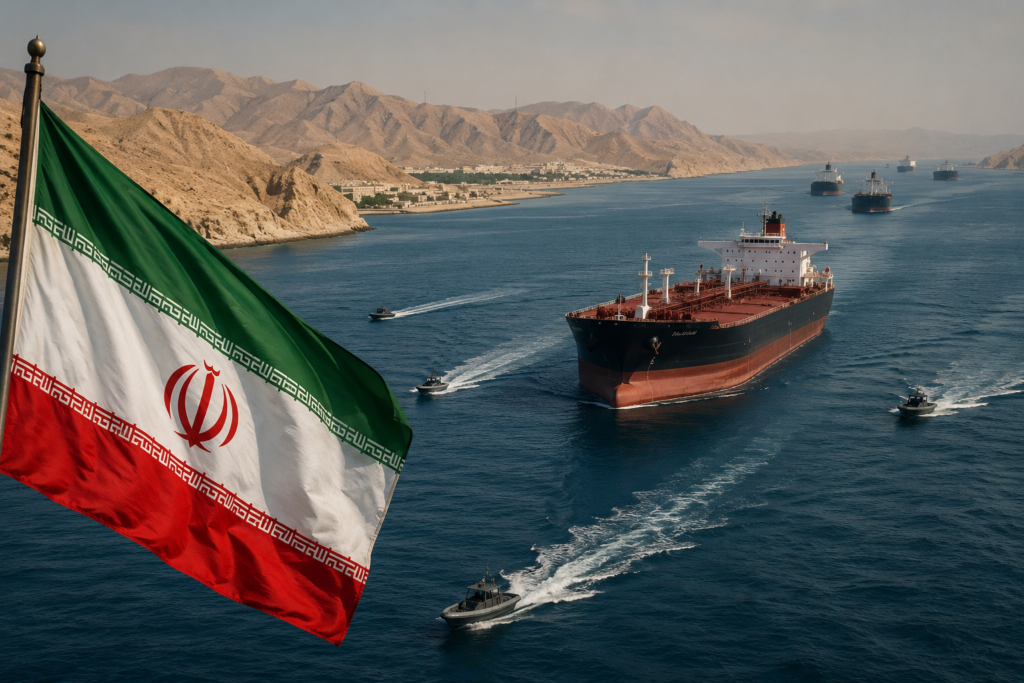
Image Credentials: Image Title: U.S. Intelligence Warns Iran Has Gained Powerful Economic Leverage Through Strait of Hormuz. Source: (chatgpt.com) Date: June 2026. Attribution: This image was created using AI-generated imagery (chatgpt.com) by Open Chronicle and does not depict a real-world scene.
By Open Chronicle with agencies
Recent assessments by U.S. intelligence agencies have concluded that Iran has demonstrated an effective ability to disrupt or block access to the Strait of Hormuz, significantly altering the strategic balance in the Gulf and giving Tehran what some officials describe as a powerful new form of geopolitical leverage.
According to sources familiar with the intelligence findings, the conflict between the United States and Iran has convinced analysts that Tehran can now threaten global trade and energy flows in ways that could have far-reaching economic consequences.
One source familiar with the assessments described the situation starkly, arguing that Iran has effectively gained a strategic tool capable of influencing the global economy on a scale comparable to major military capabilities.
The evaluations come as Washington and Tehran prepare to formally sign a preliminary agreement expected to reopen the Strait of Hormuz and pave the way for broader negotiations over Iran’s nuclear program. Despite the anticipated reopening, intelligence officials reportedly believe Iran has proven its capacity to disrupt maritime traffic through the waterway and could potentially do so again in the future.
Strategic Importance of the Strait
The Strait of Hormuz remains one of the world’s most critical maritime chokepoints, serving as a vital route for global oil and natural gas shipments.
U.S. intelligence assessments suggest that Iran’s actions during the recent conflict demonstrated both the intent and capability to interfere with commercial navigation. Officials also believe Tehran gained valuable operational experience in using pressure on maritime trade and regional energy infrastructure as an asymmetric tool against its adversaries.
According to sources familiar with the findings, Iranian attacks against energy-related targets in Gulf countries during the conflict reinforced the perception that such tactics can generate significant political and economic influence without requiring large-scale conventional military operations.
Concerns About Future Escalation
American officials are reportedly concerned that Iran may feel emboldened by what it views as the success of its recent actions.
Several intelligence assessments indicate that Tehran retains substantial military assets, including missiles, drones, launch systems, and fleets of fast attack boats capable of harassing vessels transiting the Gulf. Iran is also believed to maintain the capacity to deploy naval mines and has reportedly accelerated the rebuilding of parts of its military-industrial base.
Officials say these capabilities continue to provide Iran with significant influence over maritime security in the region, even as diplomatic efforts move forward.
The uncertainty surrounding the future implementation of the U.S.-Iran framework agreement has also led shipping industry experts to predict that commercial traffic through the Strait of Hormuz could remain below normal levels for some time as operators assess potential risks.
Regional Chokepoints Remain a Concern
Intelligence officials have also examined the possibility of broader disruptions affecting global trade routes.
According to sources familiar with the assessments, Iran could potentially encourage allied groups in the region to increase pressure on other strategic maritime corridors, including the Bab-el-Mandeb Strait, which connects the Red Sea to the Indian Ocean.
Analysts note that simultaneous disruptions affecting both Hormuz and Bab-el-Mandeb would have severe consequences for global commerce, energy markets, and international supply chains.
While officials emphasize that no such escalation is currently taking place, they acknowledge that these scenarios are part of ongoing contingency planning and intelligence monitoring.
Debate Over U.S. Strategy
The assessments have fueled debate within Washington regarding the strategic consequences of the conflict and the long-term effectiveness of current policy toward Iran.
Some officials believe the administration underestimated Tehran’s willingness to interfere with maritime traffic and overestimated the deterrent effect of economic pressure and international diplomacy.
Sources familiar with planning discussions suggest that early assumptions held that closing the Strait of Hormuz would damage Iran’s own economy so severely that Tehran would avoid taking such a step. Intelligence analysts now believe those calculations may have underestimated Iran’s willingness to accept economic costs in pursuit of broader strategic objectives.
According to multiple sources, Iranian leaders appear to view their ability to threaten maritime trade as a significant source of leverage in future negotiations.
Diplomatic Efforts Continue
Despite the concerns, U.S. officials maintain that the framework agreement offers a pathway toward de-escalation.
Vice President JD Vance recently argued that Iran’s willingness to engage in negotiations reflects recognition that continued instability in the Strait of Hormuz carries high costs for all parties involved.
President Donald Trump has stated that maritime traffic is gradually resuming and expressed confidence that the waterway will be fully operational once the agreement is formally signed.
American officials also insist that any economic relief granted to Iran will remain tied to compliance with the terms of the agreement, including maintaining freedom of navigation through the Strait of Hormuz.
As diplomatic negotiations continue, intelligence agencies are expected to closely monitor Iran’s military posture, regional activities, and future intentions regarding the world’s most strategically important energy corridor.