
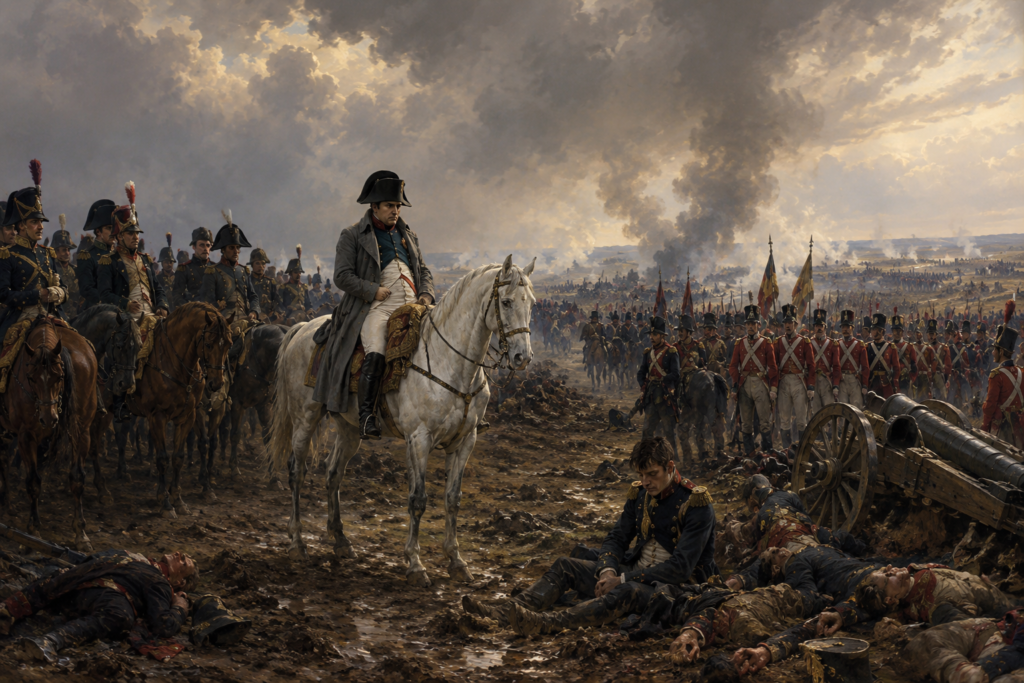
Image Credentials: Image Title: Today in History, June 18: Battle of Waterloo. Source: (chatgpt.com) Date: June 2026. Attribution: This image was created using AI-generated imagery (chatgpt.com) by Open Chronicle and does not depict a real-world scene.
By Open Chronicle
The Battle of Waterloo, fought on 18 June 1815 near the village of Waterloo in present-day Belgium, marked the final defeat of French Emperor Napoleon Bonaparte and brought an end to more than two decades of conflict that had reshaped Europe.
Following his dramatic return from exile on the island of Elba in March 1815, during the Hundred Days, Napoleon sought to restore his empire and challenge the coalition of European powers that had united against him. Recognizing the threat posed by the French emperor, Britain, Prussia, Austria, and Russia mobilized their armies to confront France once again.
Napoleon’s strategy was to strike quickly before the coalition forces could fully unite. He advanced into Belgium and engaged separate British and Prussian armies. After defeating the Prussians at the Battle of Ligny on 16 June, Napoleon turned his attention to the Anglo-Allied army commanded by the Duke of Wellington.
On the morning of 18 June, French forces launched a series of attacks against Wellington’s defensive positions. The battlefield became the scene of intense fighting, with key locations such as Hougoumont, La Haye Sainte, and Papelotte changing hands or coming under relentless assault. Despite heavy pressure, Wellington’s troops maintained their lines throughout the day.
As the battle progressed, the arrival of Prussian forces under Field Marshal Gebhard Leberecht von Blücher transformed the situation. Having recovered from their earlier defeat at Ligny, the Prussians marched to support Wellington and attacked the French right flank. Napoleon was forced to divert valuable troops to contain the new threat, weakening his main offensive.
In the evening, Napoleon committed his elite Imperial Guard in a final attempt to break the Allied centre. The assault failed, and the Guard was repelled. The sight of the supposedly invincible formation retreating caused panic among French troops. Allied forces launched a general counterattack, and the French army collapsed into a disorderly retreat.
The defeat at Waterloo ended Napoleon’s rule permanently. He abdicated for a second time only days later and surrendered to the British. He was subsequently exiled to the remote South Atlantic island of Saint Helena, where he remained until he died in 1821.
The Battle of Waterloo had profound consequences for Europe. It confirmed the victory of the Seventh Coalition and paved the way for the settlement established at the Congress of Vienna. The resulting balance of power helped shape European diplomacy throughout the nineteenth century and contributed to a period of relative stability among the continent’s major powers.
Today, Waterloo remains one of the most famous battles in world history. The term “Waterloo” has entered many languages as a metaphor for a decisive and final defeat, reflecting the battle’s enduring place in global historical memory.