
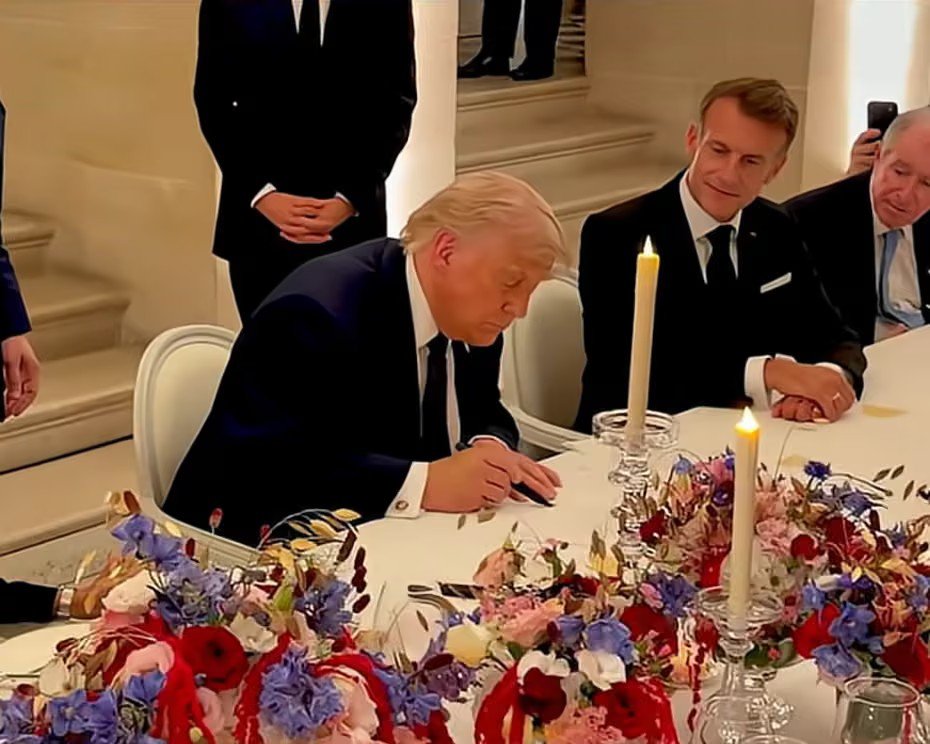
Image: from Good news for you X @qlineq912
By Open Chronicle with agencies
United States President Donald Trump and Iranian President Masoud Pezeshkian on Wednesday signed an interim agreement aimed at ending months of conflict between Iran, the United States, and Israel, opening a 60-day window for negotiations on a broader and more permanent settlement.
The memorandum of understanding, signed following diplomatic efforts led by Pakistan and supported by several regional and international actors, seeks to halt hostilities, restore maritime trade routes, and establish a framework for future discussions on Iran’s nuclear program.
The signing took place following a gathering of world leaders in France, with officials from both countries confirming that the agreement entered into force immediately.
Tehran and Washington sign interim peace deal to end US-Israeli war on Iran. US President Donald Trump and Iranian President Masoud Pezeshkian have signed an initial agreement to extend the ceasefire for another 60 days and reopen the Strait of Hormuz pic.twitter.com/XtChqTyu8q
— P Connect (@ConnectingPak) June 18, 2026
Immediate Measures
Under the terms of the interim accord, Iran has agreed to reopen the Strait of Hormuz, one of the world’s most important energy and shipping corridors. The move is expected to ease disruptions that have affected global trade and oil markets during the conflict.
In return, the United States will lift its naval blockade of Iranian ports and begin removing sanctions targeting Iran’s oil exports. The agreement is designed to reduce tensions while creating conditions for more comprehensive negotiations.
Pakistan’s Prime Minister Shehbaz Sharif, whose government played a mediating role, described the deal as an important first step toward regional stability and the prevention of further escalation.
MEMORANDUM OF UNDERSTANDING FOR PEACE BETWEEN THE UNITED STATES OF AMERICA AND THE ISLAMIC REPUBLIC OF IRAN
Also known as the Islamabad MOUAs Mediated by the Islamic Republic of Pakistan
START
1. The United States of America and the Islamic Republic of Iran and their allies… pic.twitter.com/WKWEbuEaBc
— The STRATCOM Bureau (@OSPSF) June 18, 2026
Nuclear Negotiations Ahead
The centerpiece of the upcoming talks will be Iran’s nuclear program. According to the framework agreement, Tehran will begin a process of diluting portions of its enriched uranium stockpile under international supervision, while discussions continue on longer-term monitoring and verification mechanisms.
The International Atomic Energy Agency (IAEA) is expected to play a central role in overseeing any future nuclear arrangements.
If a final agreement is reached within the 60-day negotiating period, the United States and its partners have pledged to facilitate extensive economic relief measures, including access to a proposed $300 billion reconstruction fund supported by countries across the Middle East.
Diverging Reactions
The agreement has generated sharply different reactions across the international community.
Iranian officials portrayed the deal as evidence that Tehran had successfully resisted military and economic pressure while preserving key elements of its national defense and political system. Iranian parliamentary figures described the arrangement as a diplomatic success for the Islamic Republic.
In Washington, however, the agreement has sparked criticism from some lawmakers and analysts who argue that Iran retains significant leverage despite months of conflict. Critics contend that Tehran has not surrendered its missile capabilities, remains politically intact, and continues to maintain relationships with allied regional groups.
Supporters of the agreement argue that diplomacy offers the best chance to prevent a wider regional war and stabilize energy markets after months of uncertainty.
US and Iran presidents sign ceasefire agreement, but Trump says he could still resume attackshttps://t.co/xiIPHsfsia
The U.S. and Iran released the text of an interim agreement their presidents have signed to end their war on Wednesday, with U.S. President Donald Trump… pic.twitter.com/U9rfOhgOPd
— Ariana News (@ArianaNews_) June 18, 2026
Regional Implications
The war has had profound consequences across the Middle East, affecting regional economies, trade routes, and security dynamics. The reopening of the Strait of Hormuz is expected to be among the first tangible outcomes of the agreement, providing relief to international shipping and energy markets.
The deal also includes provisions covering Lebanon, reflecting concerns about the broader regional dimensions of the conflict and the involvement of armed groups aligned with Tehran.
While the memorandum stops short of resolving the fundamental disputes between Washington and Tehran, it creates a diplomatic pathway that both sides hope can lead to a more durable settlement.
A Fragile Opportunity
The next two months will be crucial as negotiators attempt to transform the interim arrangement into a comprehensive agreement. Key issues remain unresolved, including the future of Iran’s nuclear activities, sanctions relief, regional security arrangements, and mechanisms to prevent renewed hostilities.
For now, the agreement marks the most significant diplomatic breakthrough between the two countries in years and offers a rare opportunity to move from confrontation toward negotiation in one of the world’s most volatile regions.