
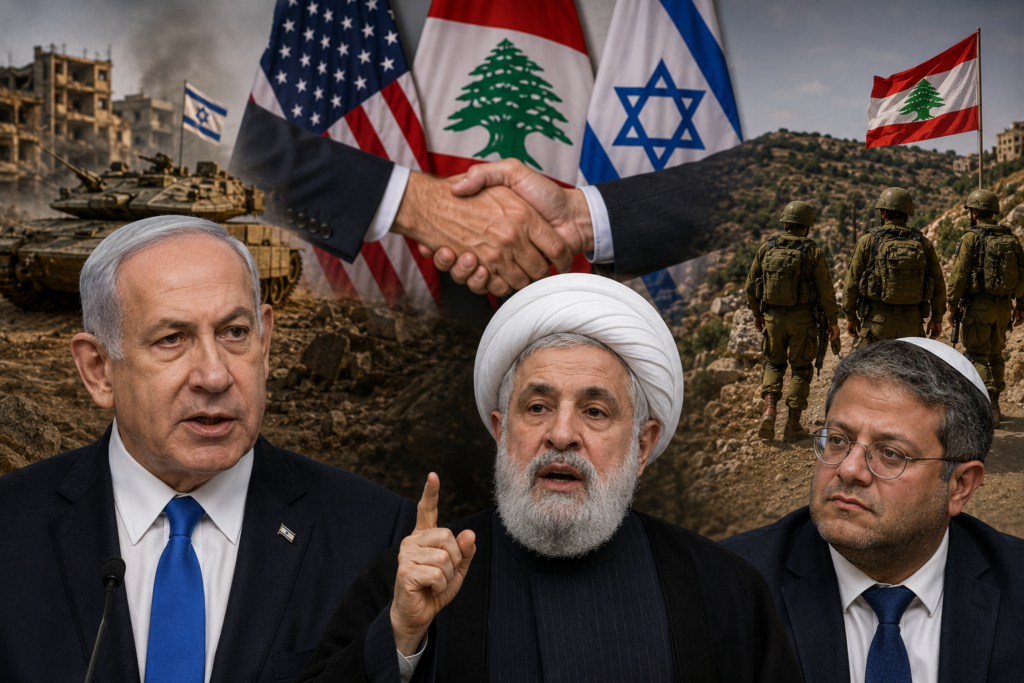
Image Credentials: Image Title: Netanyahu hails US-brokered Israel-Lebanon agreement as far-right and Hezbollah reject framework. Source: (chatgpt.com) Date: June 2026. Attribution: This image was created using AI-generated imagery (chatgpt.com) by Open Chronicle and does not depict a real-world scene.
By Open Chronicle News Desk with Agencies
JERUSALEM — Israeli Prime Minister Benjamin Netanyahu has welcomed the new United States brokered framework agreement between Israel and Lebanon, describing it as a historic diplomatic breakthrough that weakens both Iran and Hezbollah. The deal, however, has immediately drawn fierce criticism from Israel’s far right and outright rejection from Hezbollah.
Speaking on Saturday, Netanyahu said the agreement represented “a historic achievement for the State of Israel” following five rounds of negotiations held in Washington under US mediation.
“Yesterday we achieved a historic deal for the State of Israel after direct negotiations between Israel and Lebanon,” Netanyahu said during a televised address. “This is a blow to Iran and Hezbollah.”
The framework outlines a roadmap intended to formally end decades of conflict between the two neighboring countries. It includes a pilot plan allowing the Lebanese Armed Forces to gradually assume control of two areas currently held by Israeli forces, alongside a process aimed at dismantling Hezbollah’s military capabilities and restoring full Lebanese state authority across the country.
The agreement also states that both governments intend to conclude the long-standing state of war between Israel and Lebanon once its provisions have been fully implemented.
Lebanese President Joseph Aoun welcomed the accord as “a first step” toward restoring Lebanese sovereignty, while emphasizing that implementation will require sustained international support and political stability.
Israeli far right opposes agreement
Despite Netanyahu’s endorsement, the agreement has sparked strong opposition within Israel’s governing coalition.
National Security Minister Itamar Ben Gvir condemned the framework, arguing that Lebanon cannot be trusted to fulfill its commitments, particularly regarding Hezbollah’s disarmament.
“The agreement with Lebanon is a big mistake,” Ben Gvir wrote on his Telegram channel.
“Members of the Lebanese government are Hezbollah ministers, and Lebanon cannot be trusted to take Hezbollah’s weapons. Only IDF soldiers will destroy Hezbollah. No other party will do it for us.”
Ben Gvir warned that allowing Lebanese institutions to oversee the disarmament process could ultimately strengthen Hezbollah rather than eliminate the threat posed by the Iran-backed militant group.
Hezbollah rejects deal
Hezbollah also dismissed the agreement, declaring it invalid and accusing the Lebanese government of surrendering national sovereignty.
In his first public comments since the signing, Hezbollah Secretary General Naim Qassem described the framework as “humiliating” and “a surrender of sovereignty.”
“This agreement is null and void, and the provisions of the Iranian American memorandum of understanding must be implemented,” Qassem said.
He also rejected any proposal linking an Israeli withdrawal from southern Lebanon to Hezbollah’s disarmament, calling such a condition unacceptable.
The group’s position underscores the enormous challenges facing implementation of the agreement, particularly as Hezbollah continues to maintain a powerful military presence despite growing domestic pressure for the Lebanese state to regain full control over its territory.
Long road ahead
The agreement follows months of escalating violence that have devastated southern Lebanon.
According to Lebanese authorities, Israeli military operations since March have killed more than 4,000 people and wounded over 4,000 others. Large sections of southern Lebanon remain heavily damaged, with Israeli forces still maintaining positions in parts of the border region.
While Washington has described the framework as the beginning of a broader peace process, both Israeli domestic opposition and Hezbollah’s outright rejection suggest that significant political and security obstacles remain before any lasting settlement can be achieved.