
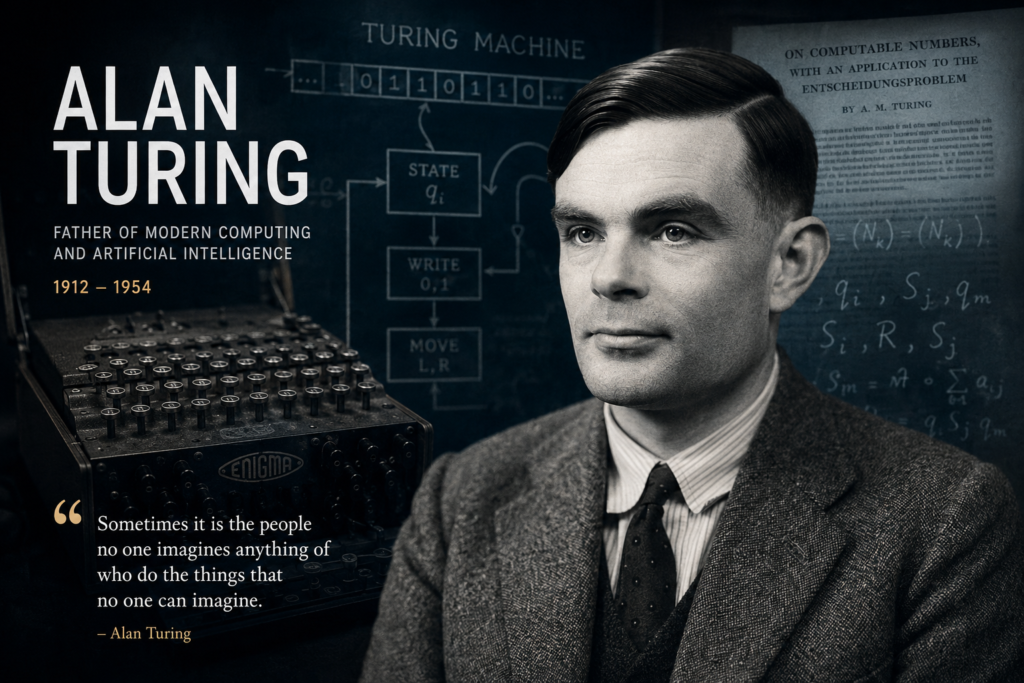
We can only see a short distance ahead, but we can see plenty there that needs to be done.”
Alan Turing, 1950
Alan Mathison Turing (23 June 1912 – 7 June 1954) was a British mathematician, logician, cryptanalyst, and computer scientist whose pioneering work laid the intellectual foundations of modern computing, artificial intelligence, and theoretical computer science. During the Second World War, he played a decisive role in Allied codebreaking efforts at Bletchley Park, contributing to the decryption of German military communications encrypted by the Enigma machine. Today, Turing is widely regarded as one of the most influential scientific figures of the twentieth century.
Quick Facts
| Profile |
|---|
| Full name | Alan Mathison Turing |
| Born | 23 June 1912, Maida Vale, London, England |
| Died | 7 June 1954 (aged 41), Wilmslow, Cheshire, England |
| Nationality | British |
| Occupation | Mathematician, Computer Scientist, Cryptanalyst, Logician |
| Known for | Turing Machine, Turing Test, Enigma codebreaking, Artificial Intelligence |
| Fields | Mathematics, Computer Science, Cryptography, Logic, Mathematical Biology |
| Education | Sherborne School; King’s College, Cambridge; Princeton University |
| Employers | Bletchley Park; National Physical Laboratory; University of Manchester |
| Years active | 1935–1954 |
| Notable works | On Computable Numbers (1936); Computing Machinery and Intelligence (1950) |
| Awards & Honours | Fellow of King’s College (1935); Royal Pardon (2013, posthumous); Featured on the Bank of England £50 note (2021) |
| Historical significance | Pioneer of modern computer science and artificial intelligence; key figure in Allied codebreaking during the Second World War |
Early Life and Education
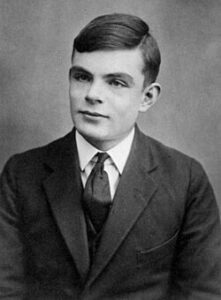
Alan Turing was born in Maida Vale, London, to Julius Mathison Turing and Ethel Sara Stoney. From an early age, he demonstrated an extraordinary aptitude for mathematics and science, often solving complex problems independently.
He attended Sherborne School in Dorset, where his enthusiasm for mathematics contrasted with the school’s emphasis on classical education. Despite this, his teachers recognized his exceptional intellectual abilities.
In 1931, Turing entered King’s College, Cambridge, where he studied mathematics. He graduated with distinction and was elected a Fellow of King’s College in 1935 after producing significant work in probability theory.
Historical Context
During the early twentieth century, computation was performed almost entirely by humans using mechanical calculators and mathematical tables. Electronic computers did not yet exist, and many mathematical problems concerning computation and logic remained unresolved. It was within this intellectual landscape that Alan Turing developed ideas that would fundamentally redefine how information could be processed.
The Birth of Modern Computing
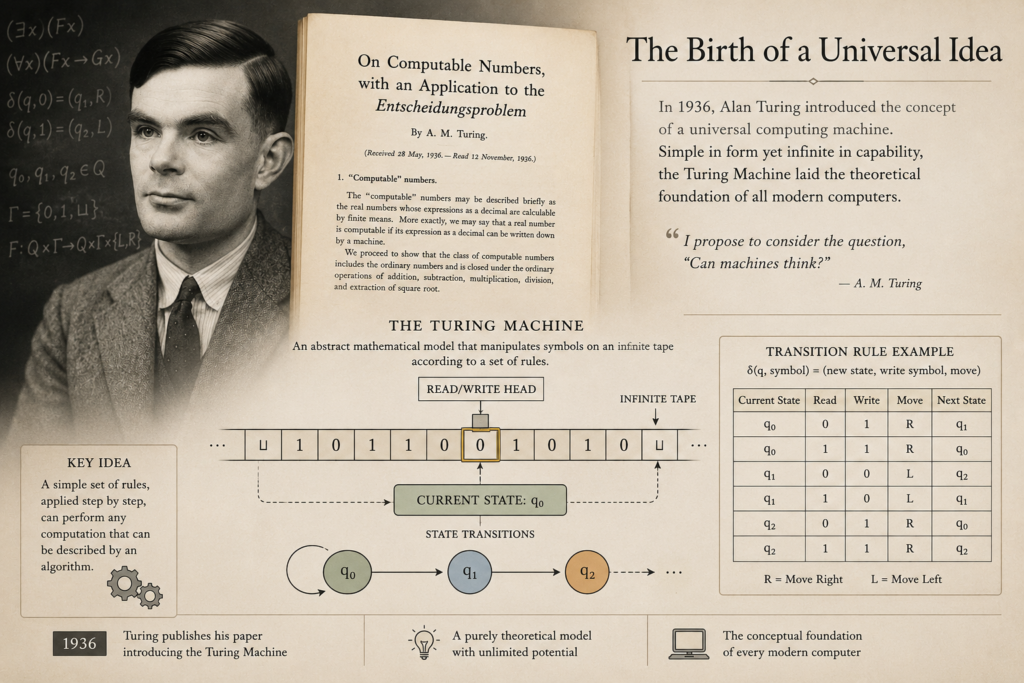
One of Turing’s greatest achievements came in 1936 with the publication of On Computable Numbers, with an Application to the Entscheidungsproblem.
In this groundbreaking paper, he introduced the concept now known as the Turing Machine, an abstract mathematical model capable of executing any computable algorithm.
Although entirely theoretical, the Turing Machine became the conceptual foundation upon which modern computers would later be built.
His work demonstrated that computation itself could be described mathematically, transforming logic into an engineering discipline.
Bletchley Park and the Second World War
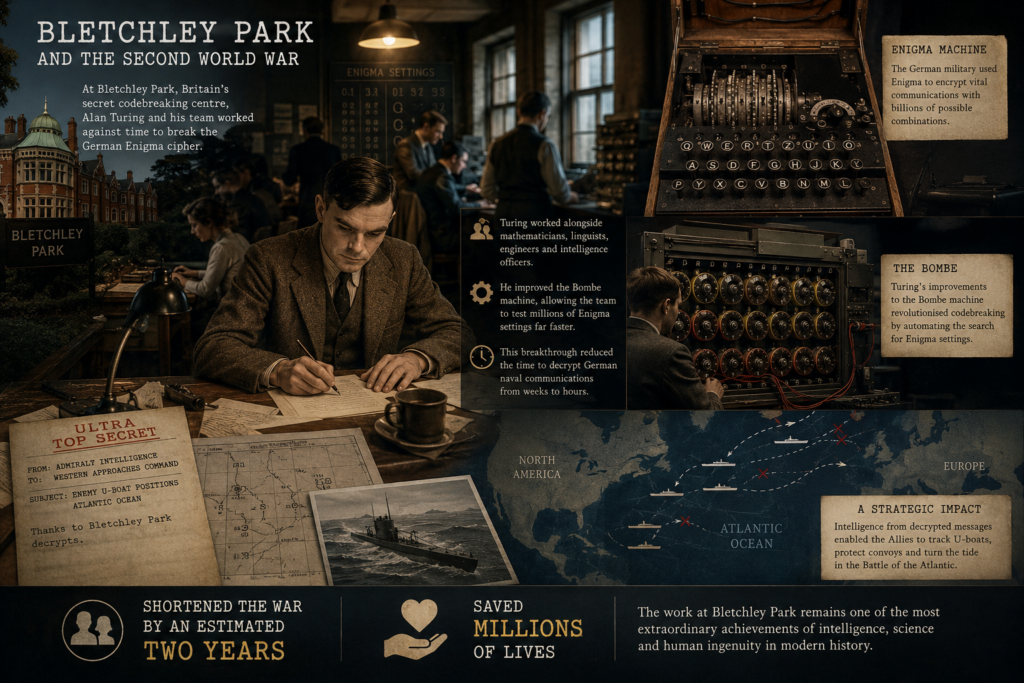
When the Second World War began, Turing joined the Government Code and Cypher School at Bletchley Park, Britain’s secret codebreaking centre.
His primary task was analysing communications encrypted using the German Enigma machine.
Working alongside mathematicians, linguists, engineers, and intelligence officers, Turing designed methods that dramatically accelerated the identification of Enigma settings.
One of his greatest contributions was improving the Bombe, an electromechanical machine capable of testing vast numbers of possible Enigma configurations.
By reducing the time required to decipher German naval communications, Allied commanders gained valuable intelligence regarding submarine movements in the Atlantic.
Many historians estimate that these achievements shortened the war in Europe by approximately two years and saved millions of lives.
Artificial Intelligence
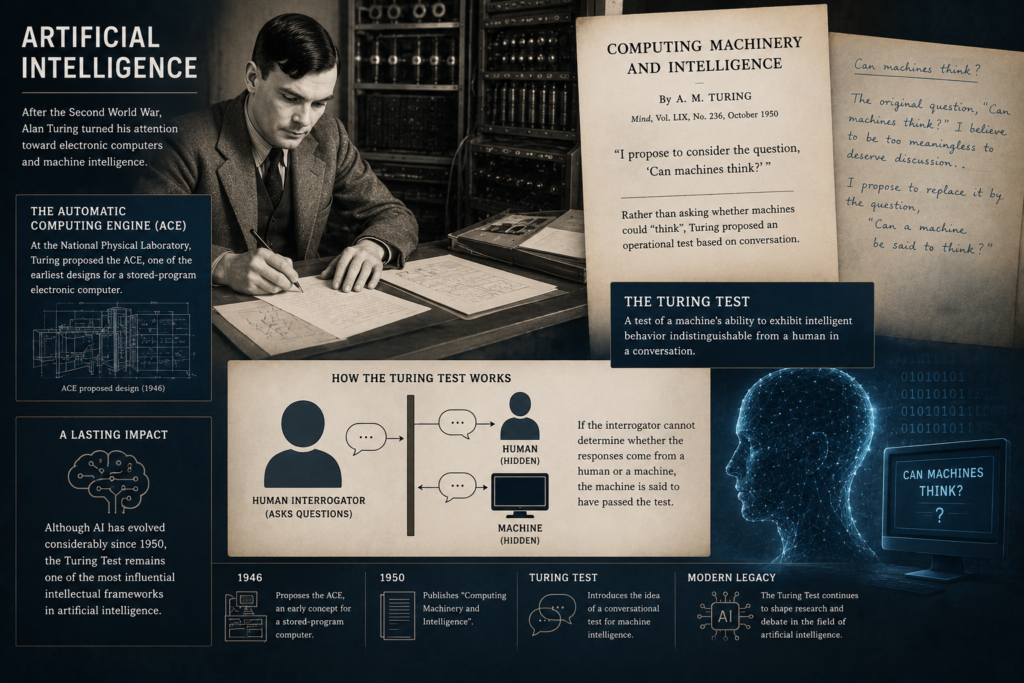
Following the war, Turing turned his attention toward electronic computers and machine intelligence.
At the National Physical Laboratory, he proposed the Automatic Computing Engine (ACE), one of the earliest stored-program computer designs.
His most famous philosophical contribution appeared in 1950 in the paper Computing Machinery and Intelligence.
Rather than asking whether machines could “think”, Turing proposed an operational test based on conversation.
This became known as the Turing Test, one of the defining concepts in artificial intelligence.
Although AI has evolved considerably since then, the Turing Test remains one of the field’s most influential intellectual frameworks.
Scientific Contributions
Turing’s work extended far beyond computing.
His research influenced:
- Mathematical logic
- Algorithms
- Computer architecture
- Artificial intelligence
- Cryptography
- Computational biology
- Morphogenesis
- Pattern formation in biology
His final scientific work explored how chemical reactions could produce natural biological patterns, providing foundations for modern mathematical biology.
Personal Life and Persecution
Despite his scientific achievements, Turing lived in a society where homosexuality was criminalised.
In 1952, he was prosecuted for “gross indecency” after acknowledging a relationship with another man.
Rather than imprisonment, he accepted chemical castration through hormone treatment.
The conviction severely affected both his health and professional career, resulting in the loss of his security clearance.
On 7 June 1954, Turing died at his home in Wilmslow at the age of 41 from cyanide poisoning. His death was officially ruled a suicide, although some historians continue to debate the circumstances.
Posthumous Recognition
During the decades following his death, Turing’s contributions gradually became widely recognised.
Important milestones include:
- 2009, an official apology was issued by British Prime Minister Gordon Brown.
- 2013, a royal pardon was granted by Queen Elizabeth II.
- 2017, the “Turing Law” extended pardons to thousands convicted under historical anti-homosexuality legislation.
- 2021, the Bank of England introduced the £50 banknote featuring Alan Turing.
Today, numerous universities, research institutes, and awards bear his name.
Legacy
Few individuals have influenced as many scientific disciplines as Alan Turing.
His theoretical work anticipated the digital revolution decades before modern computers became reality.
His wartime codebreaking altered the course of history.
His ideas about machine intelligence continue to shape research in artificial intelligence, robotics, and cognitive science.
For these reasons, Turing is widely regarded as one of the founding figures of the Information Age.
Open Chronicle Perspective
Alan Turing’s importance extends far beyond the invention of theoretical computing or his wartime service. He represents the intersection of scientific innovation, national security, and human rights. His life illustrates how groundbreaking discoveries can coexist with profound personal injustice, while his ideas continue to underpin nearly every aspect of the digital world. Every modern computer, smartphone, search engine, and artificial intelligence system exists within a conceptual framework that Turing helped define nearly a century ago.
Timeline
1912 – Born in London.
1931 – Entered King’s College, Cambridge.
1936 – Published the paper introducing the Turing Machine.
1939 – Joined Bletchley Park.
1940–1945 – Worked on breaking the Enigma cipher.
1946 – Designed the Automatic Computing Engine.
1950 – Proposed the Turing Test.
1952 – Prosecuted for homosexuality.
1954 – Died in Wilmslow.
2009 – Official British government apology.
2013 – Royal pardon granted.
2021 – Featured on the Bank of England £50 note.
Why Alan Turing Matters
Alan Turing transformed abstract mathematics into the conceptual language of modern computing. His work helped secure Allied victory during the Second World War, established the theoretical basis of computer science, and introduced questions about machine intelligence that remain central today. His legacy is not confined to one discipline but spans technology, cryptography, biology, philosophy, and ethics, making him one of the defining intellectual figures of the twentieth century.
See Also
- Artificial Intelligence
- Bletchley Park
- Enigma Machine
- Turing Machine
- Turing Test
- Cryptography
- Computer Science
- History of Computing
References
- Hodges, Andrew. Alan Turing: The Enigma. Princeton University Press, 2014.
- Copeland, B. Jack (ed.). The Essential Turing. Oxford University Press, 2004.
- Turing, Alan M. “On Computable Numbers, with an Application to the Entscheidungsproblem.” Proceedings of the London Mathematical Society, 1936.
- Turing, Alan M. “Computing Machinery and Intelligence.” Mind, Vol. 59, No. 236, 1950.
- Gannon, Paul. Colossus: Bletchley Park’s Greatest Secret. Atlantic Books, 2006.
Image Information
Title: Alan Turing
Creator: Open Chronicle
Creation Date: June 2026
Image Type: AI-generated editorial illustration
Description: Artistic interpretation of Alan Turing inspired by his work in computing, cryptography, and the Second World War. Created as an original illustration for the Open Chronicle Encyclopedia. This image is not an authentic historical photograph.
Article Information
| Article type | Biography |
| Historical period | 20th Century |
| Primary fields | Mathematics, Computer Science |
| Region | United Kingdom |
| Reading time | 12 minutes |
| Last reviewed | June 2026 |
| Editorial standard | Open Chronicle Encyclopedia |
Explore this subject
Continue exploring related Open Chronicle Encyclopedia entries through the categories associated with this article.

Staff Writers at Open Chronicle produce trusted journalism, strategic analysis and authoritative reference content across global affairs, geopolitics, defense, science, history, technology, business, culture and sport. Their work combines accurate reporting with historical perspective and analytical depth, helping readers understand not only what is happening, but why it matters. Beyond daily news coverage, Staff Writers contribute to the Open Chronicle Encyclopedia, investigative features, original research projects and long-form reports, building a comprehensive knowledge platform designed to inform, educate and preserve reliable information for a global audience.