
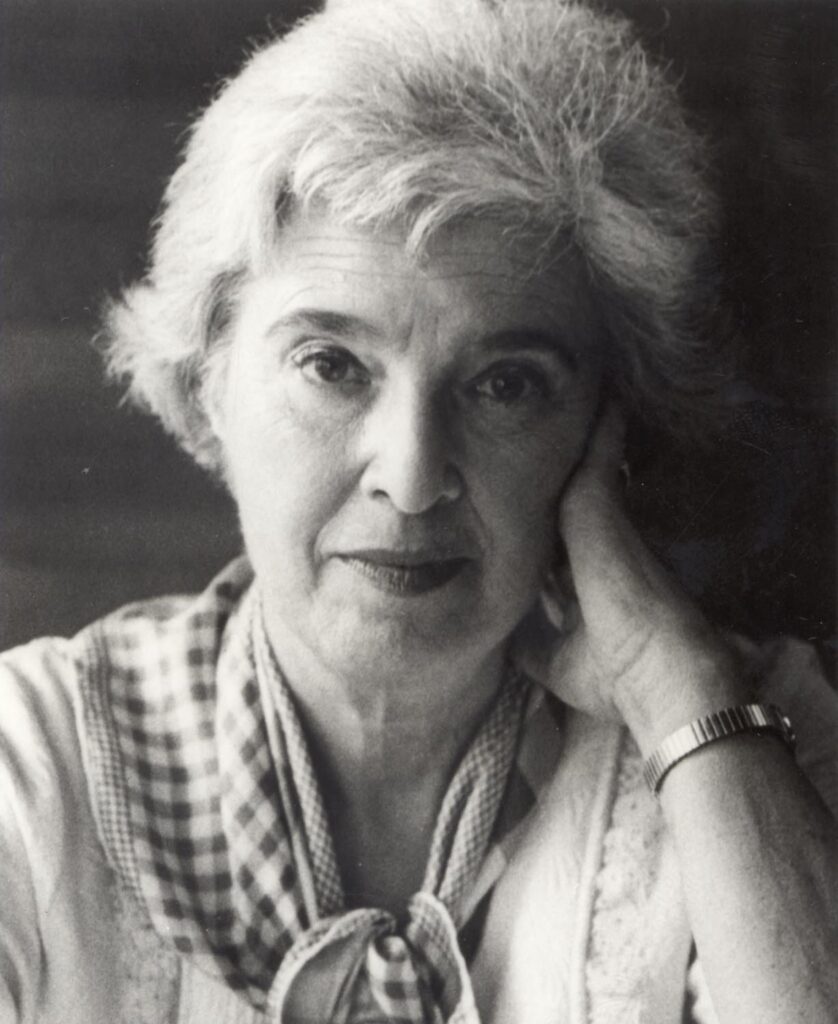
Licensed under Creative Commons Attribution 3.0.
Vienna, Austria
Madison, Wisconsin, United States
Columbia University (MA, PhD)
University of Wisconsin at Madison
Long Island University
Duke University
Columbia University
The Creation of Patriarchy (1986)
The Creation of Feminist Consciousness (1993)
Fireweed: A Political Autobiography (2003)
Carl Lerner (1941 to 1973)
Open Chronicle Encyclopedia | Women’s History | Featured Biography
The historian who helped transform women’s history into an established academic discipline and challenged generations of scholars to reconsider whose experiences deserved a place in the historical record.
Gerda Lerner was an Austrian American historian, author and educator whose work fundamentally changed the study of history. A refugee from Nazi persecution who later became a leading scholar in the United States, she helped establish women’s history as a recognized academic discipline and demonstrated that women’s experiences were essential to understanding the development of human societies.
Through her teaching, research and institutional leadership, Lerner challenged the traditional historical narratives that had largely concentrated on political leaders, military campaigns and the achievements of men. She argued that the historical experiences of women should not be treated as supplementary material but as an integral part of the broader human story.
Her scholarship extended from the history of American abolitionism and the experiences of African American women to the origins of patriarchy and the development of feminist consciousness. Her influence reached beyond universities, contributing to the expansion of women’s history education in schools and public institutions.
1. Early Life in Vienna
Gerda Hedwig Kronstein was born on 30 April 1920 in Vienna, Austria, into a prosperous Jewish family. Her father, Robert Kronstein, was a pharmacist, while her mother, Ilona Neumann Kronstein, was an artist.
Growing up in interwar Vienna, Gerda experienced a society marked by intellectual and artistic activity, political polarization and increasing hostility toward Jewish communities.
Her family circumstances also exposed her to questions about women’s independence and social expectations. Her mother pursued artistic interests while confronting the limitations associated with conventional expectations of marriage and motherhood.
These experiences would later contribute to Lerner’s interest in the relationship between individual lives, social institutions and historical change.
Nazi persecution and imprisonment
The annexation of Austria by Nazi Germany in March 1938 transformed Gerda’s life.
As antisemitic persecution intensified, she became involved in resistance to Nazi rule. Her father escaped Austria, but Gerda and her mother were arrested.
Gerda spent approximately six weeks in prison, sharing a cell with two Christian women who had been detained for political reasons.
The women shared their food with her because Jewish prisoners received smaller rations. This experience of solidarity across religious and social boundaries left a lasting impression on her.
In 1939, Gerda emigrated to the United States, escaping the persecution that had forced her family to separate.
Her experiences of imprisonment, displacement and exile subsequently informed her understanding of political oppression and the importance of preserving the experiences of people excluded from dominant historical narratives.
2. A New Life in the United States
After arriving in the United States, Gerda settled in New York and married her first husband, Bobby Jensen.
She supported herself through various occupations, including work as a waitress, salesperson, office clerk and X ray technician.
Alongside these jobs, she continued writing poetry and fiction, drawing on her experiences in Austria and her growing interest in social and political questions.
Her marriage to Jensen eventually ended. She subsequently married Carl Lerner, a film editor and director with whom she shared an interest in literature, cinema and political activism.
The couple moved to Hollywood, where Carl pursued his career in filmmaking and Gerda continued writing.
Political activism and the Hollywood blacklist
During the 1940s, Gerda Lerner participated in left wing political organizations and campaigns concerning civil rights, labor rights and women’s equality.
In 1946, she helped establish the Los Angeles chapter of the Congress of American Women, an organization associated with the American communist movement.
Both Gerda and Carl were involved in Communist Party activities during this period.
The rise of anticommunist investigations and the Hollywood blacklist during the late 1940s and 1950s affected their professional and political lives.
The couple eventually left the Communist Party and returned to New York.
Lerner’s experiences of political activism, ideological conflict and social exclusion would later influence her historical scholarship, particularly her interest in the relationship between power and the construction of historical narratives.
3. From Writer to Historian
Gerda Lerner did not initially follow a conventional academic career.
Before becoming a professional historian, she worked as a writer, producing fiction, poetry, theatrical works and screenplays.
In 1951, she collaborated with poet Eve Merriam on the musical The Singing of Women.
Her autobiographical novel No Farewell, published in 1955, explored experiences associated with the Nazi annexation of Austria.
She also collaborated with Carl Lerner on the screenplay for Black Like Me (1964), a film based on John Howard Griffin’s account of racial segregation in the American South.
These literary and cinematic activities reflected her continuing interest in the lives of people whose experiences were frequently marginalized in public discourse.
Returning to formal education
Lerner began her formal university studies as an adult, enrolling at the New School for Social Research in New York.
She completed her bachelor’s degree in 1963.
During her studies, she became increasingly aware of the limited attention given to women in conventional historical education.
Women appeared in historical narratives primarily as exceptional individuals, while their collective experiences, intellectual contributions and roles in shaping society received comparatively little attention.
Lerner began questioning the assumptions underlying this approach.
Rather than simply adding a small number of prominent women to established historical narratives, she sought to reconsider the methods and questions through which history itself was written.
She continued her education at Columbia University, earning a master’s degree in 1965 and a doctorate in history in 1966.
Her doctoral research examined Sarah and Angelina Grimké, two sisters from a South Carolina slaveholding family who became prominent abolitionists and advocates of women’s rights.
Published in 1967 as The Grimké Sisters from South Carolina: Rebels Against Authority, the study explored the relationship between slavery, gender, religious conviction and political activism.
It demonstrated how women’s lives could provide a perspective on major historical developments.
4. Establishing Women’s History as an Academic Discipline
Gerda Lerner’s most enduring institutional contribution was her role in establishing women’s history as a legitimate and independent field of historical scholarship.
In 1963, while completing her undergraduate education, she taught a course entitled Great Women in American History at the New School for Social Research.
The course is widely recognized as one of the earliest regularly offered university courses devoted specifically to women’s history.
At the time, the subject had little institutional recognition within American higher education.
Historical research frequently concentrated on political institutions, military conflicts, diplomacy and economic developments, with women’s experiences receiving limited attention.
Lerner argued that this approach produced an incomplete understanding of the past.
Women had participated in political movements, economic production, intellectual life, religious institutions, social reform and family structures throughout history.
Their experiences, she maintained, were essential to understanding how societies developed.
Sarah Lawrence College
In 1968, Lerner joined Sarah Lawrence College in New York.
There, she played a central role in developing a graduate program dedicated to women’s history.
The college introduced its Master of Arts program in Women’s History in 1972, establishing the first American graduate degree program specifically devoted to the field.
This development created opportunities for students to pursue advanced historical research centered on women’s experiences.
It also helped establish a professional foundation for a new generation of historians.
University of Wisconsin
In 1980, Lerner joined the University of Wisconsin at Madison as Robinson Edwards Professor of History.
She subsequently established the first doctoral program in women’s history in the United States.
The program provided advanced training for scholars investigating women’s lives, institutions, intellectual traditions and political participation.
Through her work at Sarah Lawrence and Wisconsin, Lerner helped transform women’s history from a relatively marginal subject into an established area of university teaching and research.
5. Recovering the History of African American Women
One of Lerner’s significant contributions was her research into the historical experiences of African American women.
Her edited collection Black Women in White America: A Documentary History, published in 1972, brought together historical documents illustrating approximately 350 years of African American women’s experiences.
The collection examined slavery, emancipation, education, labor, political activism and community organization.
It included material documenting how African American women responded to racial discrimination and gender inequality while contributing to the development of American society.
At a time when both conventional American history and emerging women’s history scholarship frequently concentrated on white women’s experiences, Lerner’s collection helped broaden the scope of historical investigation.
The book also demonstrated the importance of documentary evidence in reconstructing the lives of people whose perspectives had often been excluded from established historical accounts.
Her work contributed to the development of more inclusive approaches to American social history.
6. The Creation of Patriarchy
Published in 1986, The Creation of Patriarchy became one of Gerda Lerner’s most influential scholarly works.
The book was the first volume of her ambitious Women and History project, which examined the historical development of women’s subordination and the emergence of feminist consciousness.
Lerner investigated ancient societies, particularly those of the Near East, using archaeological, literary, religious and legal evidence to examine the development of patriarchal institutions.
Her central argument was that patriarchy was a historical creation rather than an inevitable or unchanging feature of human society.
She proposed that systems of male dominance developed gradually through changes in social organization, property relations, family structures, religious institutions and political authority.
In her interpretation, the emergence of patriarchal institutions was connected to the development of early states and the increasing regulation of women’s sexuality, reproductive roles and economic activities.
Patriarchy as a historical system
Lerner argued that the subordination of women could not be adequately explained through biological differences alone.
Instead, she examined the historical processes through which social institutions established and maintained unequal relationships between men and women.
Her research also explored the role of religion and symbolic representation in legitimizing social hierarchies.
She suggested that the increasing dominance of male religious authorities and male-centered religious traditions contributed to the consolidation of patriarchal institutions in certain ancient societies.
Her conclusions formed part of a broader scholarly debate about the origins of gender inequality.
Although historians and archaeologists have continued to examine and challenge particular aspects of her reconstruction of ancient societies, her work helped establish patriarchy as a subject of historical investigation rather than an assumed permanent condition.
7. The Creation of Feminist Consciousness
In 1993, Lerner published The Creation of Feminist Consciousness: From the Middle Ages to Eighteen-Seventy, the second volume of Women and History.
The book examined the development of women’s intellectual traditions across several centuries of European history.
Lerner investigated how women responded to restrictions on education, intellectual participation and public authority.
She explored the writings of women who questioned established social expectations and developed alternative interpretations of their position within society.
Religious writing, philosophical reflection, literature and educational advocacy provided important opportunities for women to express ideas that challenged prevailing assumptions about gender.
Lerner argued that the development of feminist consciousness was a gradual historical process rather than a phenomenon that emerged suddenly during the modern women’s rights movements.
Her research emphasized the importance of recovering earlier generations of women’s intellectual contributions.
By reconstructing these traditions, she sought to demonstrate that women had developed their own forms of historical understanding and social criticism long before the emergence of organized modern feminism.
8. Women’s History Month and Public Education
Gerda Lerner’s influence extended beyond academic institutions.
She supported efforts to make women’s history accessible to teachers, students and the wider public.
In July 1979, she chaired the Women’s History Institute at Sarah Lawrence College, a gathering attended by representatives of women’s organizations and educational institutions.
Participants discussed initiatives for expanding women’s history education and learned about the success of Women’s History Week in Sonoma County, California.
They subsequently supported efforts to establish similar commemorations across the United States.
These initiatives contributed to the national recognition of Women’s History Week and the later establishment of Women’s History Month.
Lerner’s participation reflected her conviction that historical education should not remain confined to universities.
She believed that understanding women’s experiences was essential to developing a more complete public understanding of history.
9. Recognition and Later Career
Gerda Lerner received numerous academic distinctions in recognition of her contributions to historical scholarship.
She served as president of the Organization of American Historians in the early 1980s and received the American Historical Association’s Joan Kelly Memorial Prize in 1986 for The Creation of Patriarchy.
In 1998, she was elected a Fellow of the American Academy of Arts and Sciences.
Harvard University awarded her an honorary Doctor of Letters degree in 2008.
After retiring from the University of Wisconsin in 1991, Lerner continued writing and contributing to historical scholarship.
Her later publications included Why History Matters: Life and Thought (1997), Fireweed: A Political Autobiography (2003) and Living with History/Making Social Change (2009).
Her autobiography examined her experiences of growing up in Vienna, escaping Nazi persecution, immigrating to the United States and participating in American political and intellectual life.
It also explored the relationship between personal experience and historical understanding.
10. Death and Historical Legacy
Gerda Lerner died on 2 January 2013 in Madison, Wisconsin, at the age of 92.
By the time of her death, women’s history had become an established field of academic research, with university programs, scholarly journals, professional associations and an extensive international body of literature.
Lerner had played a central role in this transformation.
Her contribution was not limited to recovering the biographies of individual women.
She challenged historians to reconsider the assumptions underlying historical research and to examine how the exclusion of women’s experiences had shaped conventional interpretations of the past.
Her scholarship demonstrated that questions concerning gender, family, labor, education, religion and political authority could reveal dimensions of historical change that traditional approaches had frequently overlooked.
Her work also influenced the development of gender history, feminist historiography and broader approaches to social and cultural history.
The academic programs she helped establish trained generations of historians, while her books continued to provide a foundation for research into the historical construction of gender relations.
Gerda Lerner’s legacy lies in her contribution to expanding the scope of historical inquiry and establishing women’s experiences as an essential part of the study of human history.
Selected Works
A selection of Gerda Lerner’s publications examining women’s history, historical scholarship and the development of feminist thought.
01 | DOCUMENTARY HISTORY
Black Women in White America: A Documentary History (1972)
A collection of historical documents examining African American women’s experiences from slavery through the twentieth century.
02 | HISTORICAL SCHOLARSHIP
The Majority Finds Its Past: Placing Women in History (1979)
Essays examining the importance of incorporating women’s experiences into historical scholarship.
03 | WOMEN AND HISTORY
The Creation of Patriarchy (1986)
An investigation into the historical development of patriarchal institutions in ancient societies.
04 | FEMINIST HISTORIOGRAPHY
The Creation of Feminist Consciousness (1993)
A study of women’s intellectual traditions and the development of feminist thought from the Middle Ages to the nineteenth century.
05 | AUTOBIOGRAPHY
Fireweed: A Political Autobiography (2003)
An autobiographical account of Lerner’s experiences of persecution, emigration, political activism and intellectual development.
Sources and Further Reading
Selected biographical, institutional and academic sources documenting Gerda Lerner’s life, historical scholarship and contribution to women’s history.
01 | BIOGRAPHY
Gerda Lerner | National Women’s History Museum
Mariana Brandman, 2022. Biographical overview of Lerner’s life, historical scholarship and contributions to women’s history education.
02 | ACADEMIC CAREER
Gerda Lerner, a Feminist, Historian and UW Madison Emeritus, Dies at 92
University of Wisconsin, 2013. Institutional account of Lerner’s academic career, publications and contribution to establishing women’s history as a university discipline.
03 | WOMEN’S HISTORY EDUCATION
Master of Arts in Women’s History | Sarah Lawrence College
Information about the graduate program in women’s history established through Lerner’s work at Sarah Lawrence College.
04 | HISTORICAL SCHOLARSHIP
Editing a Scholarly Persona in the New Field of Women’s History
Katharina Prager, European Journal of Life Writing, 2022. An academic examination of Lerner’s intellectual development and professional identity.
05 | HISTORICAL LEGACY
Gerda Lerner (1920 to 2013): Pioneering Historian and Feminist
Linda Gordon, Linda K. Kerber and Alice Kessler Harris, 2013. A scholarly tribute examining Lerner’s contribution to women’s history and historical research.
EDITORIAL NOTE
This biography is based on the historical and bibliographic material supplied for the article. Interpretations of patriarchy and feminist consciousness are presented as Lerner’s scholarly arguments rather than as universally established historical conclusions.
Explore this subject
Continue exploring related Open Chronicle Encyclopedia entries through the categories associated with this article.

Staff Writers at Open Chronicle produce trusted journalism, strategic analysis and authoritative reference content across global affairs, geopolitics, defense, science, history, technology, business, culture and sport. Their work combines accurate reporting with historical perspective and analytical depth, helping readers understand not only what is happening, but why it matters. Beyond daily news coverage, Staff Writers contribute to the Open Chronicle Encyclopedia, investigative features, original research projects and long-form reports, building a comprehensive knowledge platform designed to inform, educate and preserve reliable information for a global audience.