
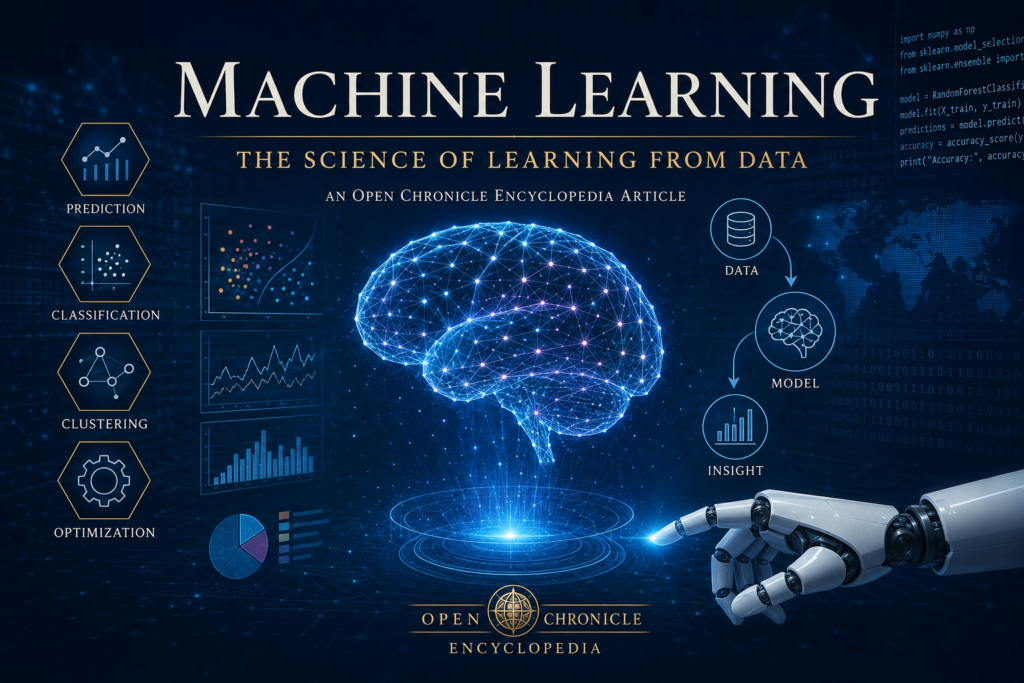
Image Credits Title: Machine Learning Collection: Open Chronicle Encyclopedia Creator: Open Chronicle Date: Medium: AI-generated editorial illustration Credit:© Open Chronicle. This original AI-generated illustration was created exclusively for the Open Chronicle Encyclopedia for editorial and educational purposes.
“Machine learning has transformed computers from systems that merely execute instructions into systems capable of discovering patterns, learning from experience and improving continuously. Today, it stands at the centre of modern artificial intelligence and the digital transformation of society.”
Open Chronicle Encyclopedia
By Open Chronicle Encyclopedia
Quick Facts
| Profile | |
|---|---|
| Field | Artificial Intelligence, Computer Science |
| Primary purpose | Enable computers to learn from data without explicit programming |
| First use of the term | 1959, by Arthur Samuel |
| Foundations | Statistics, Mathematics, Computer Science, Pattern Recognition |
| Major learning types | Supervised, Unsupervised, Semi-supervised, Reinforcement Learning |
| Key technologies | Neural Networks, Decision Trees, Support Vector Machines, Random Forests, Deep Learning |
| Common applications | Healthcare, Finance, Transportation, Industry, Education, Robotics, Scientific Research |
| Related fields | Artificial Intelligence, Data Science, Deep Learning, Computer Vision, Natural Language Processing |
| Modern significance | Core technology behind today’s intelligent software, predictive analytics and generative AI |
Introduction
Machine learning is one of the most significant technological advances of the modern era. It represents a fundamental shift in the way computers solve problems, moving beyond systems that simply follow predetermined instructions towards systems capable of learning from experience, recognising complex patterns and continuously improving their performance through data.
Today, machine learning underpins many of the technologies that shape everyday life. Search engines rank billions of web pages using learning algorithms, streaming platforms recommend films and music based on individual preferences, banks detect fraudulent transactions in real time, hospitals assist physicians in diagnosing diseases, and autonomous vehicles interpret their surroundings using sophisticated machine learning models.
Despite its widespread presence, machine learning is often misunderstood as a technology that enables computers to “think” in the human sense. In reality, machine learning is a mathematical discipline concerned with enabling computers to identify statistical relationships within data and use those relationships to make informed predictions or decisions.
Unlike traditional software, where programmers define every rule explicitly, machine learning systems construct their own mathematical models by analysing examples. Rather than being instructed exactly how to recognise a face, translate a language, or detect financial fraud, the system learns these tasks by processing enormous quantities of relevant data.
This learning process allows computers to adapt to situations that would be impossible to anticipate through conventional programming alone.
The emergence of machine learning has therefore transformed computing from a deterministic discipline into one increasingly characterised by probability, adaptation and prediction.
Its importance extends far beyond computer science.
Machine learning now influences economics, healthcare, engineering, agriculture, education, environmental science, astronomy, cybersecurity, and national security. Governments, universities and multinational companies invest billions of dollars annually in machine learning research because of its capacity to accelerate scientific discovery, optimise industrial processes and solve problems that were previously considered computationally intractable.
Within the broader field of artificial intelligence, machine learning serves as one of the principal mechanisms through which intelligent behaviour is achieved.
Many recent breakthroughs in artificial intelligence, including image recognition, speech synthesis, autonomous robotics and large language models, have been made possible through advances in machine learning.
As digital information continues to grow exponentially, the ability to extract knowledge from data has become one of the defining capabilities of twenty-first century computing.
Understanding machine learning is therefore no longer relevant solely to computer scientists. It has become an essential component of digital literacy in a world increasingly shaped by intelligent systems.
Historical Background
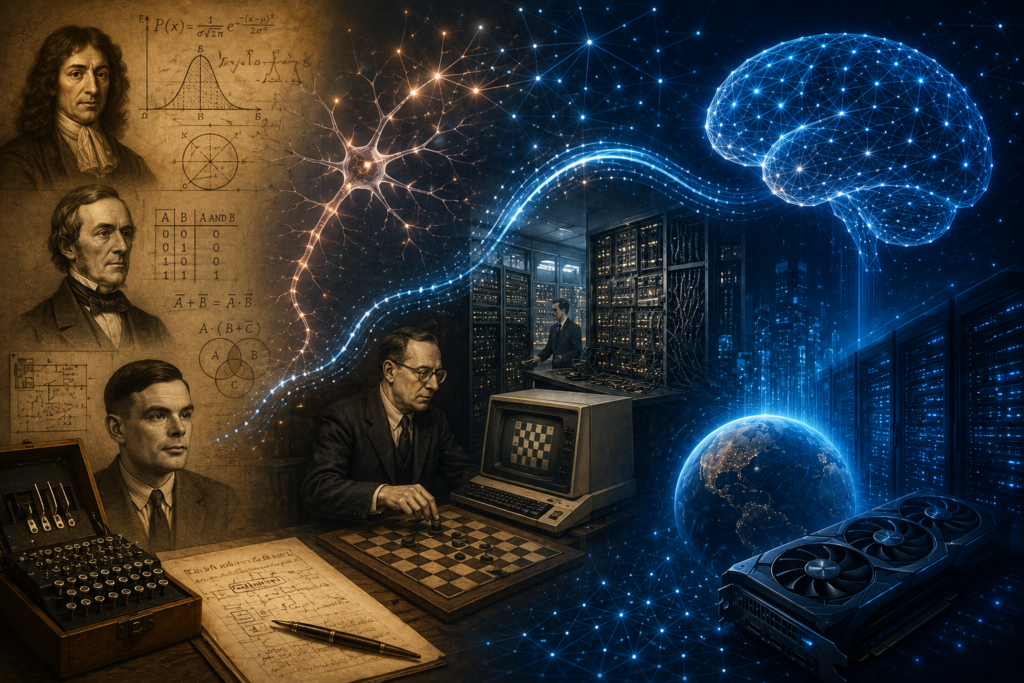
Although machine learning is widely associated with the rapid technological advances of recent decades, its intellectual origins extend much further into the history of mathematics, logic and scientific reasoning.
The idea that knowledge could be derived from observation rather than predetermined rules has philosophical roots stretching back centuries. During the seventeenth and eighteenth centuries, mathematicians and philosophers developed increasingly sophisticated methods for describing uncertainty using probability theory. These mathematical ideas would eventually become central to the algorithms that underpin modern machine learning.
The nineteenth century introduced further theoretical foundations through the work of pioneers such as George Boole, whose symbolic logic demonstrated that reasoning could be expressed mathematically. At the same time, advances in statistics enabled researchers to analyse increasingly complex relationships within observational data.
These developments established many of the mathematical tools that learning algorithms continue to use today.
The emergence of digital computing during the twentieth century transformed these theoretical concepts into practical possibilities.
One of the most influential figures in this transformation was Alan Turing, whose groundbreaking work demonstrated that computation itself could be described mathematically. Although Turing did not develop machine learning algorithms in the modern sense, his theoretical framework established the foundations upon which all subsequent artificial intelligence research would build.
During the late 1940s, Canadian psychologist Donald Hebb proposed a theory describing how biological neurons strengthen their connections through repeated activation. This principle, commonly summarised as “cells that fire together wire together,” became one of the earliest inspirations for artificial neural networks.
The expression machine learning itself was introduced in 1959 by IBM researcher Arthur Samuel.
Samuel developed a computer program capable of playing checkers at an increasingly competitive level by analysing previous games and improving its strategy through experience. Rather than relying exclusively upon predefined rules, the program modified its behaviour based upon performance, representing one of the earliest demonstrations of computational learning.
His work introduced a revolutionary concept.
Instead of attempting to program intelligence directly, researchers could design systems capable of acquiring knowledge independently through data.
Throughout the 1960s and 1970s, machine learning remained closely connected to the broader field of artificial intelligence. Researchers explored pattern recognition, statistical inference and early neural network models, although progress was constrained by the limited computational resources available at the time.
Computers lacked the processing power and memory required to train large mathematical models, while digital datasets remained relatively small compared with today’s standards.
Interest revived during the 1980s following important advances in artificial neural networks, particularly the development of improved training methods such as backpropagation. These techniques enabled increasingly complex neural networks to learn efficiently from data, renewing optimism regarding the future of intelligent computing.
The widespread adoption of the internet during the 1990s dramatically changed the landscape.
For the first time, researchers had access to vast quantities of digital information suitable for training learning algorithms.
Simultaneously, improvements in microprocessors and data storage made increasingly sophisticated computational models feasible.
The twenty-first century has witnessed an unprecedented acceleration in machine learning research.
Cloud computing, graphics processing units (GPUs), specialised AI processors and the availability of massive datasets have enabled the training of models containing billions of adjustable parameters.
This convergence of computational power, mathematical innovation, and abundant data has transformed machine learning from a specialised academic discipline into one of the most important technologies of the digital age.
Today, machine learning forms the technological foundation of many of the most influential advances in artificial intelligence, supporting applications that range from scientific discovery and medical diagnosis to autonomous vehicles and generative AI systems capable of producing human-like text, images and software.
What Is Machine Learning?
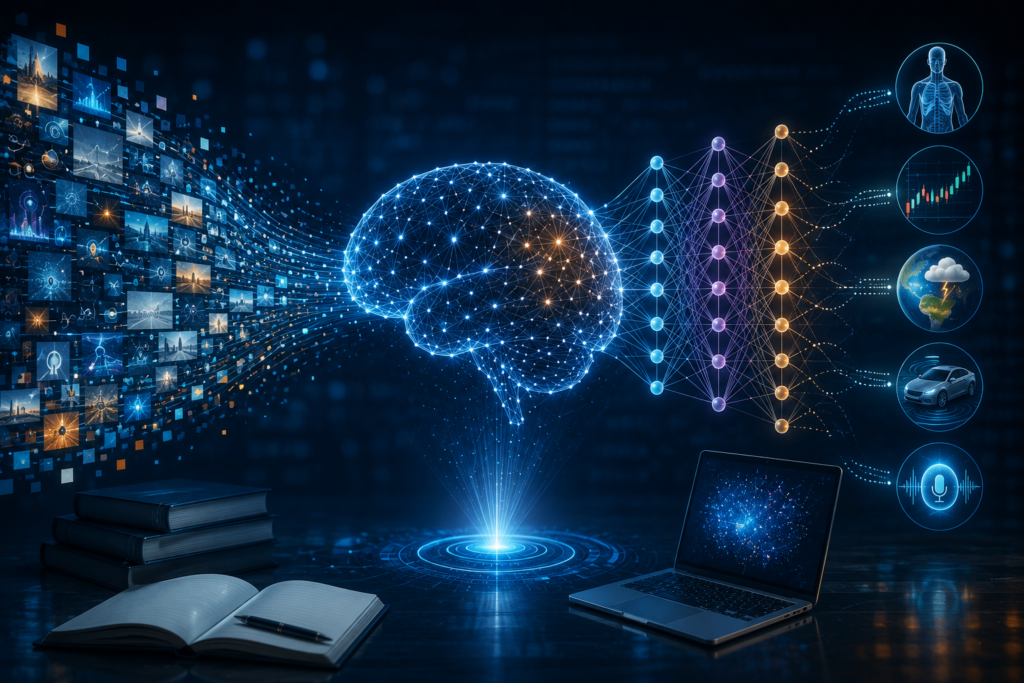
Machine learning is a branch of artificial intelligence dedicated to developing computational systems capable of improving their performance through experience rather than explicit programming.
Rather than receiving detailed instructions describing every possible situation, machine learning algorithms examine existing data, identify meaningful relationships, and construct mathematical models capable of making predictions when presented with new information.
This distinction represents one of the most important conceptual shifts in the history of computing.
Traditional software operates according to rules written directly by programmers. Every decision follows a predefined sequence of logical instructions.
Machine learning operates differently.
Instead of defining every rule manually, programmers design algorithms capable of discovering those rules automatically through statistical analysis.
The process resembles learning by observation.
Just as humans gradually recognise patterns after repeated exposure to examples, machine learning systems improve by analysing increasingly large datasets.
During training, the algorithm repeatedly adjusts internal mathematical parameters to minimise prediction errors. With sufficient high-quality data, the resulting model becomes capable of recognising relationships that would be difficult or impossible for humans to specify explicitly.
Machine learning, therefore, does not involve conscious reasoning or genuine understanding.
Its intelligence lies in its ability to detect statistical regularities, estimate probabilities, and generate increasingly accurate predictions based upon previous experience.
The effectiveness of any machine learning system depends upon several factors:
- The quality of the available data.
- The quantity of training examples.
- The suitability of the learning algorithm.
- The computational resources used during training.
- The model’s ability to generalise beyond previously observed examples.
A successful machine learning model does not simply memorise its training data.
Instead, it identifies broader underlying relationships that allow it to perform effectively when encountering entirely new situations.
This ability to generalise is what distinguishes learning from simple information storage.
As modern society generates ever larger quantities of digital information, machine learning has become one of the most powerful methods available for transforming raw data into actionable knowledge.
From predicting disease outbreaks and forecasting financial markets to assisting scientific discovery and enabling intelligent digital assistants, machine learning now serves as one of the principal engines driving the ongoing evolution of artificial intelligence.
How Machine Learning Works
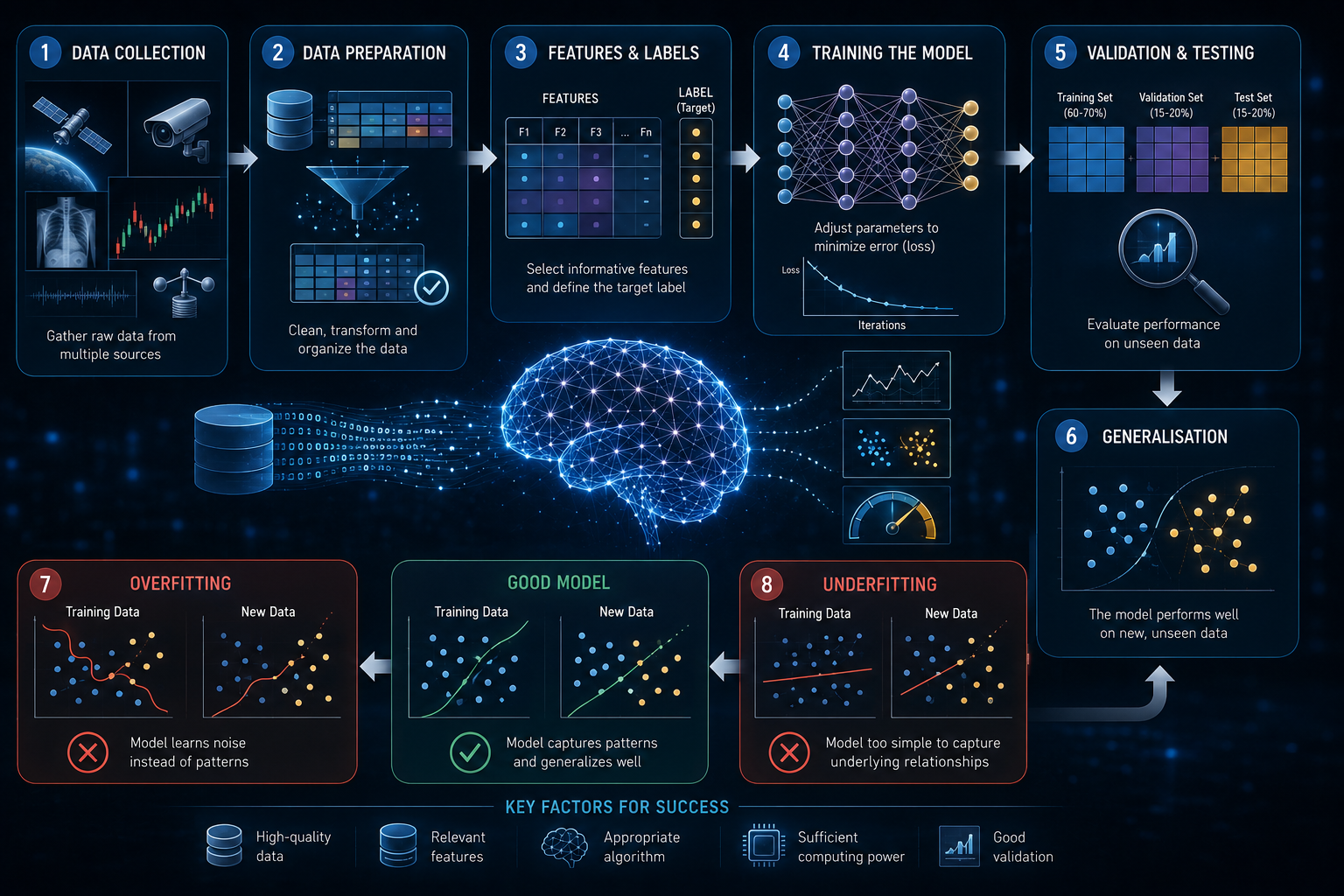
At its core, machine learning is a process through which computers construct mathematical models capable of recognising patterns within data and using those patterns to make predictions or decisions.
Unlike traditional software, which executes explicit instructions written by programmers, machine learning systems derive their behaviour from examples. Rather than being told exactly how to solve every problem, they gradually improve by analysing observations and adjusting their internal parameters according to the results they produce.
Although individual algorithms differ considerably, most machine learning systems follow a common workflow consisting of several interconnected stages.
Data Collection
Every machine learning model begins with data.
The quality, diversity, and quantity of available data often determine the overall success of a learning system more than the choice of algorithm itself. For this reason, data is frequently described as the fundamental resource of modern artificial intelligence.
Training datasets may originate from numerous sources, including:
- Medical records
- Financial transactions
- Satellite imagery
- Scientific experiments
- Internet activity
- Industrial sensors
- Cameras
- Audio recordings
- Weather observations
- Laboratory measurements
Modern organisations generate enormous quantities of digital information every day, allowing machine learning systems to identify increasingly subtle statistical relationships.
However, larger datasets do not automatically produce better models.
Poor-quality information, incomplete records or biased sampling may introduce systematic errors that affect predictions long after deployment.
For this reason, preparing high-quality datasets has become one of the most important stages of machine learning.
Data Preparation
Raw data rarely arrives in a form suitable for immediate analysis.
Before training begins, researchers typically perform extensive preprocessing to improve data quality and consistency.
This stage may involve:
- Removing duplicate records
- Correcting errors
- Filling missing values
- Eliminating irrelevant information
- Normalising numerical values
- Standardising formats
- Encoding categorical variables
Images may be resized.
Audio recordings may undergo noise reduction.
Text documents may be cleaned by removing punctuation or irrelevant words.
These seemingly routine operations often have a significant influence on the accuracy of the final model.
Many data scientists estimate that preparing data consumes considerably more time than training the machine learning model itself.
Features and Labels
Machine learning algorithms learn by analysing characteristics known as features.
A feature represents any measurable property that may help distinguish one observation from another.
For example, when predicting house prices, relevant features may include:
- Floor area
- Number of bedrooms
- Age of the building
- Geographic location
- Distance from schools
- Local crime rate
If the objective is to predict the selling price, the known price becomes the label, or desired output.
The algorithm attempts to discover the mathematical relationship connecting the features with the label.
Once this relationship has been learned, the model can estimate prices for houses it has never previously encountered.
Selecting informative features is one of the most important aspects of machine learning.
Poorly chosen variables may limit model performance regardless of how sophisticated the underlying algorithm may be.
Training the Model
Training represents the stage during which the algorithm learns from data.
Initially, the model possesses no useful knowledge regarding the problem it must solve.
It begins by making predictions that are often little better than random guesses.
Each prediction is compared with the known correct answer.
The difference between the prediction and reality is measured through a mathematical quantity known as the loss function.
The objective of training is to reduce this loss as much as possible.
Algorithms repeatedly adjust internal mathematical parameters, sometimes millions or even billions of times, gradually improving predictive accuracy.
This optimisation process continues until further improvements become minimal or additional training begins to reduce the model’s ability to generalise.
The resulting mathematical representation becomes the trained machine learning model.
Validation and Testing
Training alone cannot determine whether a model has genuinely learned.
A system may simply memorise its training examples without understanding the broader statistical relationships.
To evaluate performance objectively, datasets are normally divided into three independent subsets.
Training Set
Used to teach the model.
Validation Set
Used during development to adjust parameters and compare alternative model designs.
Test Set
Reserved until training is complete.
Because the model has never encountered these examples before, the test set provides the most reliable estimate of real-world performance.
This separation helps ensure that the system is capable of making accurate predictions beyond the information used during learning.
Generalisation
Generalisation is one of the most important concepts in machine learning.
The objective is not to remember individual examples but to identify the underlying principles connecting them.
A successful model performs well not only on familiar data but also when confronted with entirely new situations.
For example, an image recognition system trained to identify thousands of cats should also recognise cats it has never previously seen, regardless of lighting conditions, colour or background.
This ability to apply learned knowledge beyond previous experience distinguishes effective learning from simple memorisation.
Generalisation therefore, represents the ultimate objective of virtually every machine learning algorithm.
Overfitting
One of the greatest challenges in machine learning is overfitting.
Overfitting occurs when a model becomes excessively specialised to its training data.
Instead of learning general patterns, it begins memorising random variations, noise and accidental details.
As a result, the model performs extremely well during training but poorly when presented with new information.
An overfitted model resembles a student who memorises examination questions without understanding the underlying subject.
Preventing overfitting requires careful model design, high-quality data and appropriate validation techniques.
Common strategies include:
- Regularisation
- Cross-validation
- Early stopping
- Data augmentation
- Simplifying the model
Underfitting
The opposite problem is underfitting.
An underfitted model remains too simple to capture meaningful relationships within the data.
Its predictions perform poorly both during training and when evaluating new observations.
This situation may arise because:
- The model lacks sufficient complexity.
- Important features are missing.
- Too little training has occurred.
- The dataset is too small.
Balancing overfitting and underfitting represents one of the central challenges of machine learning research.
Researchers seek models that are sufficiently complex to recognise meaningful patterns while remaining general enough to perform reliably in unfamiliar situations.
The Four Main Learning Paradigms
Although hundreds of specialised algorithms exist, nearly all machine learning systems belong to one of four fundamental learning paradigms.
Each addresses different types of problems and employs different methods for acquiring knowledge from data.
Supervised Learning
Supervised learning is the most widely used form of machine learning.
In supervised learning, every training example includes both the input information and the correct output.
The algorithm therefore learns by comparing its predictions with known answers and gradually reducing its errors.
Common applications include:
- Medical diagnosis
- Email spam detection
- Credit risk assessment
- Image classification
- Speech recognition
- Weather forecasting
For example, a medical AI may analyse thousands of X-ray images already classified by radiologists.
Over time, it learns the statistical characteristics associated with healthy tissue and disease, enabling it to evaluate new scans with increasing accuracy.
Because correct answers are available during training, supervised learning often achieves very high predictive performance when sufficient labelled data exists.
Unsupervised Learning
Unlike supervised learning, unsupervised learning receives no predefined answers.
The algorithm must independently identify patterns, structures, and relationships hidden within the data.
Rather than predicting known outcomes, it explores similarities between observations.
Common applications include:
- Customer segmentation
- Market analysis
- Fraud detection
- Scientific discovery
- Document clustering
- Recommendation systems
For example, an online retailer may analyse millions of purchasing records without any predefined customer categories.
The algorithm automatically groups customers according to shared purchasing behaviour, allowing businesses to develop more targeted marketing strategies.
Unsupervised learning often reveals relationships that human analysts might never have considered.
Semi-supervised Learning
In many real-world situations, obtaining labelled data is expensive or time-consuming.
Medical images require expert diagnosis.
Legal documents require specialist review.
Scientific observations may require years of laboratory work.
Semi-supervised learning addresses this challenge by combining a relatively small quantity of labelled data with much larger collections of unlabelled information.
The labelled examples provide initial guidance, while the unlabelled data helps refine the model’s understanding of broader statistical relationships.
This approach has become increasingly important in modern artificial intelligence because vast quantities of unlabelled digital information already exist.
Reinforcement Learning
Reinforcement learning differs fundamentally from the previous approaches.
Instead of learning from examples, an intelligent agent learns through interaction with its environment.
The system performs actions, observes the consequences and receives rewards or penalties based upon its performance.
Its objective is to maximise long-term reward through repeated experience.
Applications include:
- Robotics
- Autonomous vehicles
- Industrial automation
- Resource management
- Video game AI
- Strategic planning
One of the best-known demonstrations occurred when reinforcement learning systems mastered complex games such as chess, Go and StarCraft by playing millions of simulated matches against themselves.
Rather than following human strategies, these systems discovered entirely new approaches through experimentation.
Today, reinforcement learning remains one of the most promising areas of artificial intelligence research, particularly for autonomous systems capable of operating within dynamic and unpredictable environments.
Machine Learning Algorithms
Machine learning is not built upon a single method but rather a diverse collection of mathematical techniques designed to solve different classes of problems. Over the past several decades, researchers have developed hundreds of algorithms, each with particular strengths, limitations, and areas of application.
Some algorithms excel at making predictions from structured data, while others are designed to discover hidden patterns, classify images, recognise speech or optimise complex decisions. Selecting an appropriate algorithm depends upon the nature of the available data, the computational resources required, and the objective of the task itself.
Although recent advances in deep learning have attracted considerable public attention, many classical machine learning algorithms remain indispensable across science, engineering, and industry due to their efficiency, interpretability, and reliability.
Decision Trees
Decision Trees are among the most intuitive machine learning algorithms.
Their structure resembles a flowchart in which a sequence of questions gradually narrows possible outcomes until a final prediction is reached.
Each internal node represents a decision based upon one feature, while each branch corresponds to one possible answer. The process continues until the algorithm reaches a terminal node representing the final classification or prediction.
For example, a medical diagnosis system might begin by asking whether a patient has a fever.
If the answer is yes, the next decision may concern the presence of respiratory symptoms.
Further questions progressively reduce uncertainty until the algorithm recommends the most probable diagnosis.
One of the greatest strengths of decision trees lies in their transparency.
Unlike many modern neural networks, their reasoning process can usually be followed step by step, making them particularly valuable in fields where explainability is essential, including healthcare, finance, and legal decision support.
However, individual decision trees are also susceptible to overfitting, especially when allowed to grow without constraints.
To overcome this limitation, researchers developed ensemble methods capable of combining numerous trees into a single predictive system.
Random Forests
Random Forests build upon the concept of decision trees by creating large collections of independently trained trees whose predictions are combined.
Instead of relying upon one model, the algorithm generates many slightly different trees using randomly selected subsets of the available data and features.
Each tree produces an independent prediction.
The final decision is determined through voting for classification problems or averaging for numerical predictions.
This collective approach significantly reduces the influence of individual errors and improves the model’s ability to generalise.
Random Forests have become widely adopted because they combine high predictive accuracy with relatively straightforward implementation.
They are particularly effective for:
- Medical diagnosis
- Financial risk assessment
- Customer behaviour analysis
- Environmental modelling
- Industrial quality control
Although newer deep learning techniques dominate image and language processing, Random Forests remain among the most trusted algorithms for structured datasets.
Support Vector Machines
Support Vector Machines, commonly abbreviated as SVMs, represent another important family of machine learning algorithms.
Their objective is to separate different categories by identifying the optimal mathematical boundary between them.
Imagine plotting thousands of observations on a graph.
Rather than simply drawing any dividing line, an SVM searches for the boundary that maximises the distance between opposing categories.
This margin-based approach often improves predictive performance when analysing complex datasets.
Support Vector Machines proved particularly successful during the 1990s and early 2000s, achieving outstanding results in applications including:
- Image classification
- Text categorisation
- Handwriting recognition
- Bioinformatics
- Medical diagnosis
Although deep learning has replaced SVMs for many large-scale image recognition tasks, they continue to perform exceptionally well when working with relatively limited datasets.
Bayesian Learning
Bayesian machine learning incorporates principles from probability theory to reason under uncertainty.
Rather than producing absolute answers, Bayesian models estimate the probability that different outcomes may occur based upon available evidence.
As new information becomes available, these probabilities are continuously updated.
This approach closely resembles human reasoning.
For example, physicians rarely diagnose disease with complete certainty.
Instead, they gradually revise diagnostic probabilities as laboratory tests and clinical observations accumulate.
Bayesian algorithms operate similarly.
Because they explicitly represent uncertainty, Bayesian methods are widely employed in:
- Medical diagnosis
- Weather forecasting
- Financial modelling
- Robotics
- Scientific research
- Risk analysis
Their ability to quantify confidence makes them especially valuable when decisions involve incomplete or uncertain information.
Clustering Algorithms
Not all machine learning problems involve prediction.
Many applications require discovering previously unknown structures hidden within data.
Clustering algorithms address this challenge by automatically grouping observations that share similar characteristics.
Unlike supervised learning, no predefined labels exist.
The algorithm independently determines which observations appear naturally related.
Businesses frequently employ clustering to identify customer groups with similar purchasing behaviour.
Scientists use clustering to classify galaxies, analyse genetic information and identify previously unknown biological relationships.
Popular clustering techniques include:
- K-Means
- Hierarchical Clustering
- DBSCAN
- Gaussian Mixture Models
These methods have become indispensable tools within exploratory data analysis and scientific discovery.
Neural Networks
Artificial neural networks represent one of the most influential developments in modern machine learning.
Inspired loosely by biological nervous systems, neural networks consist of interconnected computational units known as artificial neurons.
Each neuron receives numerical inputs, performs mathematical calculations, and passes information to subsequent layers.
Individually, these operations appear remarkably simple.
Collectively, however, millions or even billions of interconnected neurons can learn extraordinarily complex relationships.
Neural networks differ fundamentally from many traditional algorithms because they automatically discover useful representations within data.
Rather than requiring human experts to define every relevant feature manually, the network gradually learns increasingly sophisticated representations during training.
This capability has made neural networks particularly effective for problems involving:
- Speech recognition
- Image classification
- Language translation
- Medical imaging
- Robotics
- Scientific simulation
Modern artificial intelligence owes much of its recent progress to advances in neural network research.
Deep Learning
Deep Learning represents a specialised branch of machine learning based upon neural networks containing many interconnected computational layers.
The term “deep” refers not to the complexity of individual calculations but to the number of processing layers through which information passes.
Earlier neural networks often contained only one or two hidden layers.
Modern deep learning systems may contain hundreds or even thousands of layers, enabling them to recognise highly abstract patterns impossible for earlier algorithms to identify.
Each successive layer extracts increasingly sophisticated information.
For example, an image recognition network may initially detect simple edges and colours.
Higher layers then combine these basic features into textures, shapes, objects, and eventually complete scenes.
This hierarchical learning process has dramatically improved machine perception.
Deep learning has become the dominant technology behind numerous breakthroughs, including:
- Facial recognition
- Medical image analysis
- Speech synthesis
- Language translation
- Autonomous driving
- Protein structure prediction
- Scientific modelling
Unlike traditional machine learning algorithms that often require carefully engineered features, deep learning systems frequently learn these representations automatically from raw data.
This capability has significantly reduced the amount of manual feature engineering previously required.
Convolutional Neural Networks
Convolutional Neural Networks (CNNs) were specifically developed for analysing images and visual information.
Rather than examining every pixel independently, CNNs identify local visual patterns that gradually combine into increasingly complex representations.
This architecture has revolutionised computer vision.
Applications include:
- Medical imaging
- Satellite analysis
- Facial recognition
- Industrial inspection
- Autonomous vehicles
- Security systems
Today, CNNs enable computers to interpret visual information with levels of accuracy approaching or exceeding human performance in specialised tasks.
Recurrent Neural Networks
While CNNs specialise in visual information, Recurrent Neural Networks (RNNs) were designed for sequential data.
Language, speech, and time series all possess an inherent order.
The meaning of one word often depends upon those preceding it.
Similarly, financial markets and weather observations evolve.
RNNs introduced internal memory mechanisms allowing previous information to influence future predictions.
Although newer architectures have largely replaced classical RNNs, they represented an important milestone in natural language processing and speech recognition.
Transformer Architectures
One of the most important breakthroughs in artificial intelligence occurred in 2017 with the introduction of the Transformer architecture.
Unlike earlier sequential models, Transformers analyse relationships between all elements of an input simultaneously using a mechanism known as attention.
Attention enables the model to determine which pieces of information deserve the greatest emphasis when generating predictions.
This innovation dramatically improved efficiency while enabling models to scale to unprecedented sizes.
Transformers rapidly became the foundation for:
- Large Language Models
- Image generation
- Speech recognition
- Scientific discovery
- Computer programming assistance
- Multimodal artificial intelligence
Today, nearly all state-of-the-art generative AI systems rely upon Transformer architectures.
Large Language Models
Large Language Models (LLMs) represent one of the most visible applications of modern machine learning.
These systems are trained on enormous collections of books, scientific literature, websites, and other textual information.
Rather than memorising specific answers, LLMs learn statistical relationships between words, phrases and concepts.
This enables them to generate coherent text, answer questions, summarise documents, translate languages, and assist with programming, education, and research.
Examples include conversational assistants, writing tools, and scientific research systems capable of interacting naturally with human users.
Although their capabilities often appear remarkably sophisticated, Large Language Models remain specialised machine learning systems.
They do not possess consciousness or human understanding.
Instead, they predict the most probable sequence of words based upon patterns learned during training.
Nevertheless, their emergence represents one of the most significant advances in artificial intelligence since the invention of digital computing.
Large Language Models have fundamentally changed how people interact with computers, transforming natural language into one of the primary interfaces between humans and intelligent machines.
Machine Learning and the New Generation of Artificial Intelligence
The convergence of deep learning, Transformer architectures, and Large Language Models has marked a turning point in the evolution of machine learning.
Algorithms that once specialised in narrowly defined tasks have become increasingly capable of performing multiple forms of reasoning across text, images, audio, video and computer code.
Modern machine learning systems no longer function solely as analytical tools.
They increasingly act as collaborative technologies that assist scientific discovery, accelerate industrial innovation, and augment human creativity.
As computational resources continue to expand and learning algorithms become more sophisticated, machine learning is expected to remain one of the principal driving forces behind the future evolution of artificial intelligence.
Machine Learning Across Society
Machine learning has evolved from an academic discipline into one of the most influential technologies of the twenty-first century. Although its theoretical foundations were established decades ago, recent advances in computing power, cloud infrastructure, and data availability have enabled learning algorithms to become deeply integrated into everyday life.
Today, billions of people interact with machine learning systems, often without realising it. Every online search, navigation route, personalised recommendation and digital assistant relies upon algorithms that continuously analyse information and improve their predictions over time.
Unlike earlier generations of software, which depended upon explicitly programmed rules, machine learning systems adapt to changing environments by learning directly from new data. This capacity has allowed organisations across nearly every sector to automate complex tasks, improve decision-making and uncover insights that would otherwise remain hidden.
As machine learning continues to mature, it is increasingly recognised not simply as another digital technology but as a general-purpose capability comparable in significance to electricity, the internet and the microprocessor.
Machine Learning in Healthcare
Healthcare has become one of the most transformative areas for machine learning applications.
Modern hospitals, research institutions and pharmaceutical companies generate extraordinary volumes of information through medical imaging, laboratory testing, genomic sequencing and electronic health records. Machine learning enables clinicians and researchers to analyse these datasets at scales that would be impossible using conventional methods.
Among its most significant applications are:
- Medical image interpretation
- Disease prediction
- Personalised medicine
- Drug discovery
- Clinical decision support
- Hospital resource optimisation
- Remote patient monitoring
Machine learning algorithms can identify subtle abnormalities within X-rays, CT scans, and MRI images, assisting radiologists in detecting diseases at earlier stages.
In oncology, learning systems analyse tumour characteristics to support treatment planning and improve diagnostic accuracy.
Genomic medicine has also benefited substantially from machine learning.
By analysing complex genetic information alongside clinical records, algorithms help researchers understand disease mechanisms and identify therapies tailored to individual patients.
During pharmaceutical research, machine learning significantly accelerates the identification of promising drug candidates by predicting molecular interactions before laboratory testing begins.
Despite these advances, medical professionals remain responsible for diagnosis and patient care. Machine learning functions primarily as a decision-support technology, augmenting clinical expertise rather than replacing it.
Machine Learning in Industry
Industrial manufacturing has undergone profound transformation through intelligent automation.
Earlier industrial robots performed repetitive tasks according to fixed instructions. Modern manufacturing systems increasingly employ machine learning to adapt production processes dynamically as operational conditions change.
Current industrial applications include:
- Predictive maintenance
- Automated quality inspection
- Supply chain optimisation
- Inventory forecasting
- Warehouse automation
- Energy management
- Industrial robotics
Sensors installed throughout factories continuously collect operational data regarding temperature, vibration, pressure and equipment performance.
Machine learning analyses these measurements to identify early signs of mechanical failure before breakdowns occur, reducing downtime and maintenance costs.
Computer vision systems also inspect manufactured products at extraordinary speed, detecting microscopic defects that may escape human observation.
Together, these technologies improve productivity while reducing waste, energy consumption and operational costs.
Machine Learning in Finance
The financial industry was among the earliest sectors to recognise the value of machine learning.
Banks, investment firms, and insurance companies process millions of transactions every day, generating ideal conditions for predictive analytics.
Machine learning supports:
- Fraud detection
- Credit scoring
- Algorithmic trading
- Portfolio management
- Anti-money laundering
- Risk assessment
- Customer analytics
Fraud detection systems continuously monitor transaction behaviour, identifying unusual spending patterns that may indicate criminal activity.
Unlike rule-based systems, machine learning adapts as fraudulent techniques evolve, improving its effectiveness over time.
Investment firms increasingly employ predictive models to evaluate financial markets, estimate economic trends and optimise investment strategies.
Although machine learning contributes significantly to financial decision-making, human judgement remains essential due to the inherent uncertainty and volatility of global markets.
Machine Learning in Education
Education has increasingly embraced machine learning to create more personalised learning experiences.
Traditional classrooms often present identical material to every student regardless of individual strengths or learning pace.
Machine learning enables educational platforms to adapt automatically according to each learner’s progress.
Applications include:
- Intelligent tutoring systems
- Personalised learning pathways
- Automated assessment
- Language learning
- Accessibility technologies
- Academic research support
Adaptive learning systems continuously evaluate student performance and adjust lesson difficulty accordingly.
Students struggling with particular concepts receive additional guidance, while advanced learners may progress more rapidly.
Machine learning also assists educators by automating administrative tasks, analysing classroom performance and identifying learners who may require additional academic support.
These technologies have expanded access to education while encouraging more individualised approaches to learning.
Machine Learning in Transportation
Transportation has become one of the most visible demonstrations of machine learning in everyday life.
Modern vehicles increasingly incorporate intelligent systems capable of interpreting complex environments and assisting drivers in real time.
Machine learning supports:
- Driver assistance systems
- Traffic prediction
- Route optimisation
- Fleet management
- Collision avoidance
- Autonomous navigation
Self-driving vehicles combine machine learning with computer vision, radar, lidar, and satellite navigation to interpret road conditions continuously.
Algorithms identify pedestrians, traffic signs, road markings, and surrounding vehicles while predicting potential hazards.
Machine learning also assists logistics companies by optimising delivery routes, reducing fuel consumption and improving operational efficiency across global transportation networks.
Machine Learning in Scientific Research
Scientific discovery increasingly depends upon analysing datasets whose complexity exceeds traditional analytical methods.
Machine learning has therefore become an indispensable research tool across numerous scientific disciplines.
Applications include:
- Astronomy
- Climate science
- Chemistry
- Materials science
- Particle physics
- Biology
- Genomics
- Environmental monitoring
Astronomers employ machine learning to identify distant galaxies, classify stellar objects, and detect exoplanets from telescope observations.
Climate researchers use predictive models to improve weather forecasting and analyse long-term environmental change.
Chemists apply learning algorithms to predict molecular behaviour before laboratory synthesis begins, accelerating the discovery of new materials and pharmaceuticals.
Rather than replacing scientific reasoning, machine learning enables researchers to process information at unprecedented speed, allowing scientists to focus on interpretation and discovery.
Machine Learning in Robotics
Modern robotics relies heavily upon machine learning to enable machines to operate within dynamic physical environments.
Unlike conventional industrial robots programmed for repetitive movements, intelligent robotic systems learn to adapt through experience.
Machine learning enables robots to:
- Recognise objects
- Navigate unfamiliar environments
- Manipulate tools
- Collaborate safely with humans
- Learn new tasks
- Plan complex actions
Applications extend across manufacturing, healthcare, agriculture, disaster response, and scientific exploration.
Warehouse robots optimise logistics operations.
Agricultural robots identify crops and weeds.
Medical robots assist surgeons during highly precise procedures.
As sensing technologies continue improving, intelligent robotics is expected to become increasingly important throughout modern economies.
Machine Learning in Space Exploration
Space exploration presents unique challenges because communication delays often prevent direct human control.
Machine learning enables spacecraft to make autonomous decisions while operating millions of kilometres from Earth.
Current applications include:
- Autonomous navigation
- Planetary exploration
- Satellite operations
- Scientific data analysis
- Mission planning
- Spacecraft diagnostics
Planetary rovers employ machine learning to identify hazards, analyse geological formations and select safe routes across unfamiliar terrain.
Earth observation satellites use learning algorithms to process enormous quantities of imagery supporting disaster response, environmental monitoring, and climate research.
Future missions to the Moon, Mars and beyond are expected to rely increasingly upon intelligent autonomous systems capable of operating independently for extended periods.
Machine Learning in Defence and Security
Machine learning has become a strategic capability for defence organisations worldwide.
Modern military operations generate enormous volumes of intelligence collected from satellites, reconnaissance aircraft, sensors, and cyber networks.
Learning algorithms assist analysts by processing this information rapidly and identifying patterns that may otherwise remain unnoticed.
Applications include:
- Intelligence analysis
- Cybersecurity
- Satellite imagery interpretation
- Logistics planning
- Predictive maintenance
- Autonomous reconnaissance
- Simulation and training
- Battlefield decision support
Computer vision systems identify military equipment from satellite imagery, while cybersecurity platforms continuously monitor networks for suspicious behaviour indicating cyberattacks.
Autonomous aerial and maritime systems increasingly perform reconnaissance missions within environments considered hazardous for human personnel.
Although machine learning offers significant operational advantages, most defence organisations emphasise maintaining meaningful human oversight over decisions involving the use of force.
Machine Learning in Everyday Life
For many people, machine learning is no longer a specialised scientific concept but an invisible component of daily life.
Search engines organise billions of webpages according to relevance.
Streaming platforms recommend films, music, and television programmes.
Navigation applications optimise travel routes in real time.
Email services identify unwanted messages.
Digital assistants interpret spoken language.
Online retailers personalise shopping recommendations.
Translation systems enable communication across languages.
Social media platforms curate content according to individual interests.
These services continuously improve because machine learning algorithms analyse new information every second.
Rather than remaining confined to research laboratories, machine learning has become deeply embedded within the digital infrastructure of modern society.
Its influence now extends across communication, commerce, education, healthcare, scientific discovery, and public administration.
As increasingly intelligent systems become integrated into everyday technologies, machine learning will continue shaping how individuals interact with information, make decisions, and solve complex problems.
Advantages of Machine Learning
Machine learning has fundamentally changed the way organisations analyse information, solve complex problems and make decisions. Unlike conventional software, which follows predefined rules, learning algorithms improve their performance through experience, enabling computers to adapt to changing environments and increasingly complex data.
One of its greatest strengths is the ability to process information at a scale beyond human capability. Modern machine learning systems analyse millions or even billions of observations within seconds, identifying statistical relationships that might otherwise remain undiscovered.
Another major advantage is adaptability.
As new information becomes available, many machine learning models can be retrained to reflect changing conditions. This makes them particularly valuable in dynamic environments such as financial markets, cybersecurity, weather forecasting, and medical research, where patterns continually evolve.
Machine learning also enables automation of tasks that previously required significant human expertise. Image classification, language translation, speech recognition and anomaly detection can now be performed with remarkable speed and consistency.
Its principal advantages include:
- Processing vast quantities of data
- Identifying complex patterns
- Continuous improvement through training
- Supporting human decision-making
- Automating repetitive analytical tasks
- Enhancing predictive accuracy
- Accelerating scientific discovery
- Improving operational efficiency
- Reducing costs across numerous industries
Perhaps its most significant contribution lies in augmenting rather than replacing human expertise. By providing faster analysis and data-driven insights, machine learning allows specialists to focus on judgement, creativity and strategic decision-making.
Limitations and Challenges
Despite its remarkable capabilities, machine learning remains subject to important technical and practical limitations.
The performance of any learning system depends heavily upon the quality of its training data. Poor-quality, incomplete or biased datasets frequently produce inaccurate or unfair predictions regardless of the sophistication of the underlying algorithm.
Machine learning models also require considerable computational resources.
Training large neural networks often involves specialised hardware operating continuously for days or weeks while consuming substantial amounts of electrical energy.
Another challenge concerns generalisation.
Models trained successfully within one environment may perform poorly when confronted with conditions significantly different from those represented in their training data.
This issue becomes particularly important in applications involving autonomous vehicles, medical diagnosis, and financial forecasting.
Machine learning systems may also struggle to explain how specific decisions were reached.
While traditional software follows transparent logical rules, many modern neural networks operate through millions or billions of mathematical parameters whose interactions are difficult for humans to interpret.
This lack of transparency has become known as the black box problem.
Other significant challenges include:
- Data privacy
- Model bias
- Cybersecurity risks
- High computational costs
- Environmental impact
- Limited explainability
- Dataset quality
- Model robustness
- Adversarial attacks
These limitations demonstrate that machine learning should not be viewed as an infallible technology but rather as a powerful analytical tool requiring careful design, evaluation and human oversight.
Explainable Artificial Intelligence
As machine learning systems become increasingly influential, understanding how they reach their conclusions has become a major research priority.
Explainable Artificial Intelligence (XAI) seeks to develop techniques that make machine learning models more transparent, interpretable, and accountable.
Traditional statistical models often allow researchers to understand exactly why a particular prediction was made.
Many deep learning systems, however, consist of billions of interconnected parameters whose internal reasoning cannot easily be interpreted.
This lack of transparency presents important challenges in areas such as:
- Healthcare
- Banking
- Criminal justice
- Insurance
- Public administration
If an algorithm rejects a loan application or recommends a medical diagnosis, affected individuals increasingly expect an understandable explanation.
Researchers therefore continue developing techniques capable of identifying which variables most strongly influenced a model’s decision.
Explainability not only improves public trust but also assists developers in identifying hidden biases, correcting errors, and ensuring compliance with emerging regulatory frameworks.
Ethics and Responsible Machine Learning
As machine learning has become deeply integrated into modern society, ethical considerations have assumed increasing importance.
Algorithms now influence decisions affecting employment, healthcare, education, finance, policing, and national security. Ensuring that these systems operate fairly, transparently and responsibly has therefore become one of the defining challenges of contemporary artificial intelligence.
One major concern involves algorithmic bias.
Machine learning learns from historical data.
If those datasets contain social inequalities or systematic discrimination, the resulting models may unintentionally reproduce or even amplify existing biases.
Researchers therefore emphasise careful dataset design, fairness testing, and continuous evaluation throughout the development process.
Privacy represents another significant issue.
Many machine learning systems depend upon enormous quantities of personal information, including medical records, financial transactions, online behaviour and biometric data.
Governments increasingly require organisations to ensure compliance with privacy legislation while protecting fundamental human rights.
Other ethical challenges include:
- Human oversight
- Data ownership
- Intellectual property
- AI-generated misinformation
- Deepfakes
- Employment displacement
- Autonomous weapons
- Digital inequality
- Cybersecurity
Numerous international organisations have proposed principles intended to guide responsible machine learning development.
Among the most influential are:
- OECD Principles on Artificial Intelligence
- UNESCO Recommendation on the Ethics of Artificial Intelligence
- European Union AI Act
- National AI strategies adopted by governments worldwide
Although technological innovation remains important, the long-term success of machine learning will depend equally upon effective governance, transparency, and public trust.
The Future of Machine Learning
Machine learning continues to advance at an extraordinary pace.
Progress that once required decades now frequently occurs within only a few years, driven by improvements in computational power, algorithmic innovation, and global scientific collaboration.
Future developments are expected to influence nearly every aspect of society.
Healthcare may increasingly rely upon predictive medicine capable of identifying diseases before symptoms appear.
Scientific research is likely to accelerate through AI-assisted experimentation and automated hypothesis generation.
Industrial production will become more autonomous and sustainable through intelligent optimisation systems.
Transportation networks may coordinate themselves dynamically using real-time predictive analytics.
Education is expected to become increasingly personalised through adaptive learning environments tailored to individual students.
At the same time, future machine learning research is likely to focus on improving:
- Energy efficiency
- Explainability
- Safety
- Robustness
- Generalisation
- Multimodal learning
- Human-AI collaboration
Researchers are also exploring systems capable of learning from far smaller quantities of data, reducing one of the principal limitations of current machine learning approaches.
As artificial intelligence continues evolving toward increasingly capable general-purpose systems, machine learning will remain one of the principal scientific foundations supporting that progress.
Open Chronicle Perspective
Machine learning represents far more than a collection of computational techniques. It marks a fundamental transformation in the relationship between humans, information and technology.
For centuries, machines have extended human physical capabilities.
Machine learning extends intellectual capability by enabling computers to recognise patterns, analyse complexity and generate insights at scales impossible for unaided human cognition.
Its influence now reaches almost every scientific discipline and economic sector, from healthcare and climate science to finance, manufacturing and national security.
At the same time, the rapid expansion of machine learning raises profound questions regarding transparency, accountability, employment, privacy and democratic governance.
Its future will therefore depend not solely upon advances in mathematics or computing but upon humanity’s ability to deploy these technologies responsibly.
Like electricity, the internet, and the microprocessor before it, machine learning has become a foundational technology whose impact will continue to shape the twenty-first century.
Timeline
1763 – Thomas Bayes develops Bayesian probability theory.
1854 – George Boole publishes An Investigation of the Laws of Thought.
1936 – Alan Turing introduces the theoretical foundations of computation.
1943 – Warren McCulloch and Walter Pitts propose one of the first mathematical models of artificial neurons.
1949 – Donald Hebb publishes The Organization of Behavior, inspiring artificial neural networks.
1957 – Frank Rosenblatt develops the Perceptron.
1959 – Arthur Samuel introduces the term Machine Learning.
1986 – Backpropagation becomes widely adopted for neural network training.
1997 – IBM Deep Blue defeats Garry Kasparov.
2006 – Geoffrey Hinton helps popularise modern deep learning.
2012 – AlexNet demonstrates the power of deep neural networks in computer vision.
2017 – The Transformer architecture revolutionises natural language processing.
2020s – Large Language Models and Generative AI become widely adopted across industry, research, and education.
Why Machine Learning Matters
Machine learning has transformed computers from passive tools into adaptive systems capable of learning from experience and improving continuously through data.
Its influence extends far beyond artificial intelligence itself, shaping scientific discovery, healthcare, industry, finance, transportation, education, and public administration.
As societies generate ever larger quantities of digital information, machine learning has become one of the principal methods through which that information is converted into knowledge.
Understanding machine learning is therefore essential for understanding the technological transformation defining the twenty-first century.
See Also
- Artificial Intelligence
- Deep Learning
- Neural Networks
- Large Language Models
- Computer Vision
- Natural Language Processing
- Reinforcement Learning
- Robotics
- Alan Turing
- Data Science
- Artificial General Intelligence
References
Arthur Samuel. Some Studies in Machine Learning Using the Game of Checkers. IBM Journal of Research and Development, 1959.
Bishop, Christopher M. Pattern Recognition and Machine Learning. Springer, 2006.
Goodfellow, Ian, Bengio, Yoshua & Courville, Aaron. Deep Learning. MIT Press, 2016.
Mitchell, Tom M. Machine Learning. McGraw-Hill, 1997.
Murphy, Kevin P. Machine Learning: A Probabilistic Perspective. MIT Press, 2012.
Russell, Stuart & Norvig, Peter. Artificial Intelligence: A Modern Approach. Pearson, 2021.
Further Reading
Christopher Bishop, Pattern Recognition and Machine Learning.
Geoffrey Hinton, Machine Learning and Neural Computation.
Ian Goodfellow, Yoshua Bengio & Aaron Courville, Deep Learning.
Tom M. Mitchell, Machine Learning.
OECD, Principles on Artificial Intelligence.
UNESCO, Recommendation on the Ethics of Artificial Intelligence.
Explore this subject
Continue exploring related Open Chronicle Encyclopedia entries through the categories associated with this article.

Staff Writers at Open Chronicle produce trusted journalism, strategic analysis and authoritative reference content across global affairs, geopolitics, defense, science, history, technology, business, culture and sport. Their work combines accurate reporting with historical perspective and analytical depth, helping readers understand not only what is happening, but why it matters. Beyond daily news coverage, Staff Writers contribute to the Open Chronicle Encyclopedia, investigative features, original research projects and long-form reports, building a comprehensive knowledge platform designed to inform, educate and preserve reliable information for a global audience.