
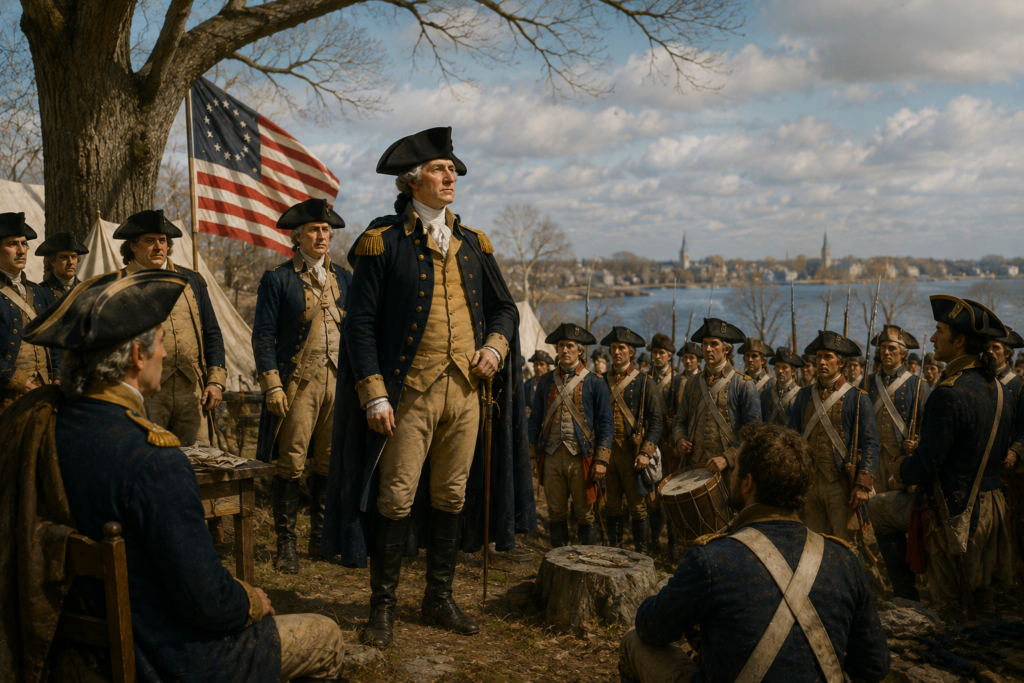
Image Credentials: Image Title: Today in History, July 3: George Washington Takes Command of the Continental Army. Source: (chatgpt.com) Date: June 2026. Attribution: This image was created using AI-generated imagery (chatgpt.com) by Open Chronicle and does not depict a real-world scene.
By Open Chronicle
July 3, 1775
On this day in 1775, George Washington formally took command of the Continental Army at Cambridge, Massachusetts, assuming leadership of the military force that would fight for American independence during the Revolutionary War. His appointment marked a defining moment in the struggle against British rule and established Washington as one of the central figures in the founding of the United States.
The American Revolutionary War had begun only a few months earlier with the Battles of Lexington and Concord in April 1775. Colonial militia forces had successfully surrounded British troops in Boston, but the growing rebellion lacked a unified command structure. Recognizing the need for coordinated military leadership, the Second Continental Congress appointed George Washington as Commander in Chief on June 15, 1775.
Washington was chosen for several reasons. A veteran of the French and Indian War, he possessed valuable military experience and had earned a reputation for courage, discipline, and integrity. As a respected Virginian, his appointment also helped unite the southern colonies behind a conflict that had initially been concentrated in New England.
On July 3, Washington arrived at Cambridge, where approximately 16,000 colonial soldiers were encamped outside British occupied Boston. Standing beneath a large elm tree, according to long standing tradition, he ceremonially assumed command of the Continental Army and immediately began inspecting the troops.
Washington quickly realized the enormous challenges before him. The army consisted largely of volunteer militia units from different colonies, many lacking proper training, standardized equipment, adequate supplies, or military discipline. Ammunition was scarce, enlistments were short, and the command structure required significant reorganization.
Over the following months, Washington transformed the Continental Army into a more disciplined fighting force. He improved training, strengthened military organization, secured additional supplies, and worked closely with the Continental Congress to build a national army capable of confronting one of the world’s most powerful military forces.
His leadership would prove decisive throughout the Revolutionary War. Despite numerous setbacks, defeats, and harsh winters, Washington maintained the army’s cohesion and morale. His victories at Trenton, Princeton, and later Yorktown ultimately helped secure American independence.
Following the war, Washington voluntarily resigned his military commission in 1783, reinforcing the principle of civilian control over the military. Six years later, he was unanimously elected the first President of the United States, becoming one of the most influential figures in American history.
Today, Washington’s assumption of command at Cambridge is remembered as the beginning of his remarkable leadership of the Continental Army, a role that shaped both the outcome of the American Revolution and the future of the United States.