
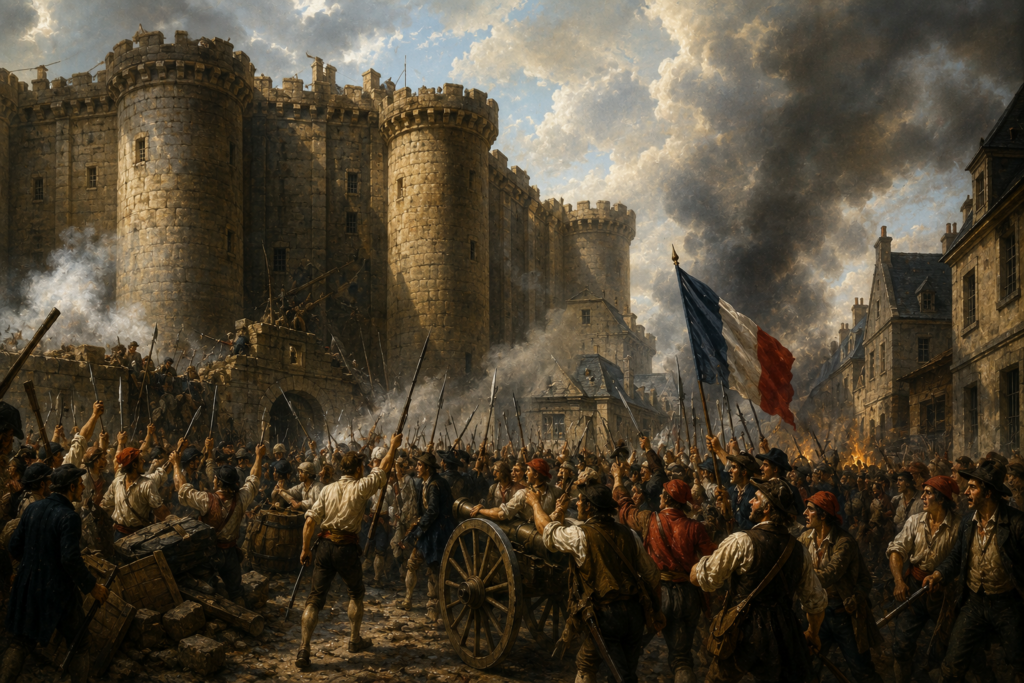
Image Credentials: Image Title: Today in History, July 14: 1789 The Storming of the Bastille Marks the Beginning of the French Revolution. Source: (chatgpt.com) Date: July 2026. Attribution: This image was created using AI-generated imagery (chatgpt.com) by Open Chronicle and does not depict a real-world scene.
By Open Chronicle
14 July 1789
On 14 July 1789, an armed crowd in Paris stormed the Bastille, a medieval fortress and state prison that had become a powerful symbol of royal authority and absolute monarchy. Although only seven prisoners were held within its walls at the time, the fall of the Bastille became the defining moment that marked the beginning of the French Revolution and one of the most influential events in modern history.
In the late eighteenth century, France was facing a severe political, social, and financial crisis. Years of costly wars, including support for the American Revolution, had left the kingdom heavily in debt. Poor harvests and rising bread prices caused widespread hardship, while the privileges enjoyed by the clergy and nobility created growing resentment among the Third Estate, which represented the vast majority of the population.
King Louis XVI attempted to address the crisis by convening the Estates General in May 1789, the first meeting of the representative assembly in more than 170 years. However, disagreements over voting procedures quickly escalated into a constitutional conflict. The representatives of the Third Estate declared themselves the National Assembly, claiming the authority to govern on behalf of the French people.
Tensions continued to rise as the king concentrated troops around Paris and dismissed his popular finance minister, Jacques Necker, on 11 July. Many Parisians feared that the monarchy intended to dissolve the National Assembly by force. Citizens began organising militias and searching for weapons to defend themselves.
On the morning of 14 July, crowds first seized thousands of muskets from the Hôtel des Invalides before marching toward the Bastille in search of gunpowder and ammunition. Negotiations with Governor Bernard René de Launay broke down, and fighting erupted between the defenders and the attackers. After several hours of intense combat, the fortress surrendered.
Governor de Launay was captured and killed by the crowd, while the Bastille’s commander and several defenders also lost their lives during the violence. News of the fortress’s fall spread rapidly throughout France, becoming a powerful symbol of resistance against tyranny and inspiring revolutionary movements across the country.
The storming of the Bastille had consequences far beyond the capture of a prison. It demonstrated that royal authority could be challenged by ordinary citizens and encouraged communities throughout France to establish local governments and citizen militias. Within weeks, revolutionary reforms accelerated, leading to the abolition of feudal privileges and the adoption of the Declaration of the Rights of Man and of the Citizen, one of the foundational documents of modern democracy.
Over the following years, the French Revolution transformed France’s political system, abolished the absolute monarchy, established republican ideals, and profoundly influenced movements for liberty, equality, and constitutional government around the world. While the Revolution also entered periods of violence and political upheaval, its principles reshaped the course of European and global history.
Today, 14 July, is celebrated annually as Bastille Day, the national day of France. Military parades, public celebrations and commemorative events honour not only the storming of the Bastille but also the enduring ideals of liberty, citizenship and national unity that emerged from the French Revolution.
More than two centuries later, the fall of the Bastille remains one of history’s most enduring symbols of popular revolution, representing the moment when a determined people challenged absolute power and helped redefine the modern relationship between governments and their citizens.