
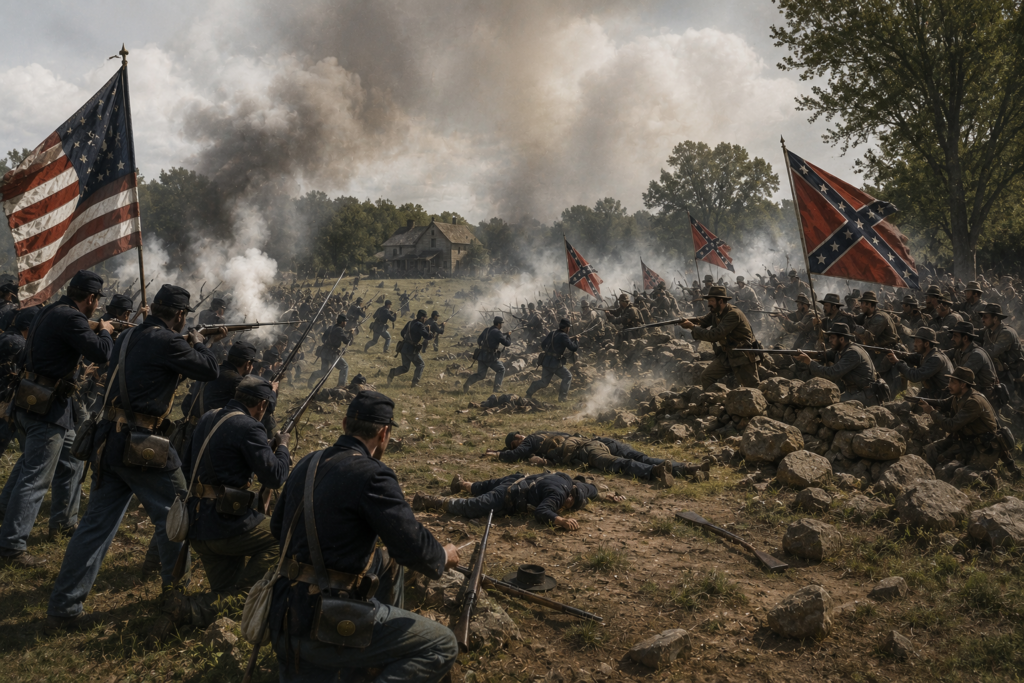
Image Credentials: Image Title: The First Battle of Bull Run Ends in a Confederate Victory. Source: (chatgpt.com) Date: July 2026. Attribution: This image was created using AI-generated imagery (chatgpt.com) by Open Chronicle and does not depict a real-world scene.
By Open Chronicle
21 July 1861
On 21 July 1861, Union and Confederate forces clashed near Manassas, Virginia, in the First Battle of Bull Run, the first major land battle of the American Civil War. The fighting ended in a Confederate victory and shattered widespread expectations that the conflict would be short and easily decided.
The battle took place only a few months after the Civil War began with the Confederate attack on Fort Sumter in April 1861. Following the secession of several Southern states, both the Union and the Confederacy rapidly assembled armies made up largely of inexperienced volunteers. Political leaders and much of the public believed that a decisive early victory might bring the war to a swift conclusion.
Union forces commanded by Brigadier General Irvin McDowell advanced from Washington toward the important railway junction at Manassas. Their objective was to defeat the Confederate army gathered there, capture the junction, and open the way toward Richmond, the Confederate capital.
McDowell commanded approximately 35,000 troops, many of whom had received only limited training. Facing him were Confederate forces under Brigadier General P. G. T. Beauregard, supported by reinforcements commanded by General Joseph E. Johnston. The Confederates benefited from the Manassas Gap Railroad, which allowed Johnston’s soldiers to travel rapidly from the Shenandoah Valley to the battlefield.
The Union attack began early on 21 July with an attempt to outflank the Confederate left. Initial progress was encouraging. Union troops crossed Bull Run and forced several Confederate units to retreat toward Henry House Hill.
As the Confederate position came under pressure, troops commanded by Brigadier General Thomas J. Jackson formed a defensive line on the hill. According to a famous account, General Barnard Bee urged his men to rally by declaring that Jackson stood like a stone wall. Whether intended as praise or criticism, the remark gave Jackson the nickname Stonewall, which remained associated with him for the rest of his life.
Fighting around Henry House Hill became intense and confused. Units repeatedly advanced and retreated, while smoke, noise, and similar uniforms made it difficult to distinguish friend from enemy. Both armies suffered from poor communication, limited battlefield experience and uncertain command structures.
Confederate reinforcements gradually strengthened the defensive line. Late in the afternoon, Confederate forces launched a counterattack that broke the Union position. What began as an organised withdrawal soon turned into a chaotic retreat toward Washington.
Civilian spectators, including politicians and members of Washington society, had travelled to the area expecting to watch a dramatic but brief Union victory. As defeated troops fled the battlefield, military wagons and civilian carriages crowded the roads, adding to the confusion.
The battle resulted in approximately 4,700 killed, wounded, captured, or missing across both armies. Although these losses were modest compared with later battles, they shocked a public that had not yet understood the scale of the conflict ahead.
The Confederate victory produced celebrations throughout the South and strengthened confidence in the new Confederacy. However, Confederate commanders lacked the organisation and resources needed to pursue the retreating Union army and threaten Washington directly.
For the Union, the defeat exposed serious weaknesses in training, leadership and military planning. President Abraham Lincoln responded by expanding the army and appointing Major General George B. McClellan to organise and command the Army of the Potomac.
The First Battle of Bull Run demonstrated that the American Civil War would not be resolved by a single campaign. Both sides began preparing for a prolonged struggle that would require mass mobilisation, industrial resources and increasingly sophisticated military organisation.
A second major battle would be fought over much of the same ground in August 1862, again ending in a Confederate victory. By then, the war had already become far larger and more destructive than most Americans had imagined in the summer of 1861.
Today, the First Battle of Bull Run is remembered as the moment when the realities of the Civil War became unmistakable. The battle ended illusions of a quick victory and marked the beginning of four years of conflict that would transform the United States and claim hundreds of thousands of lives.