
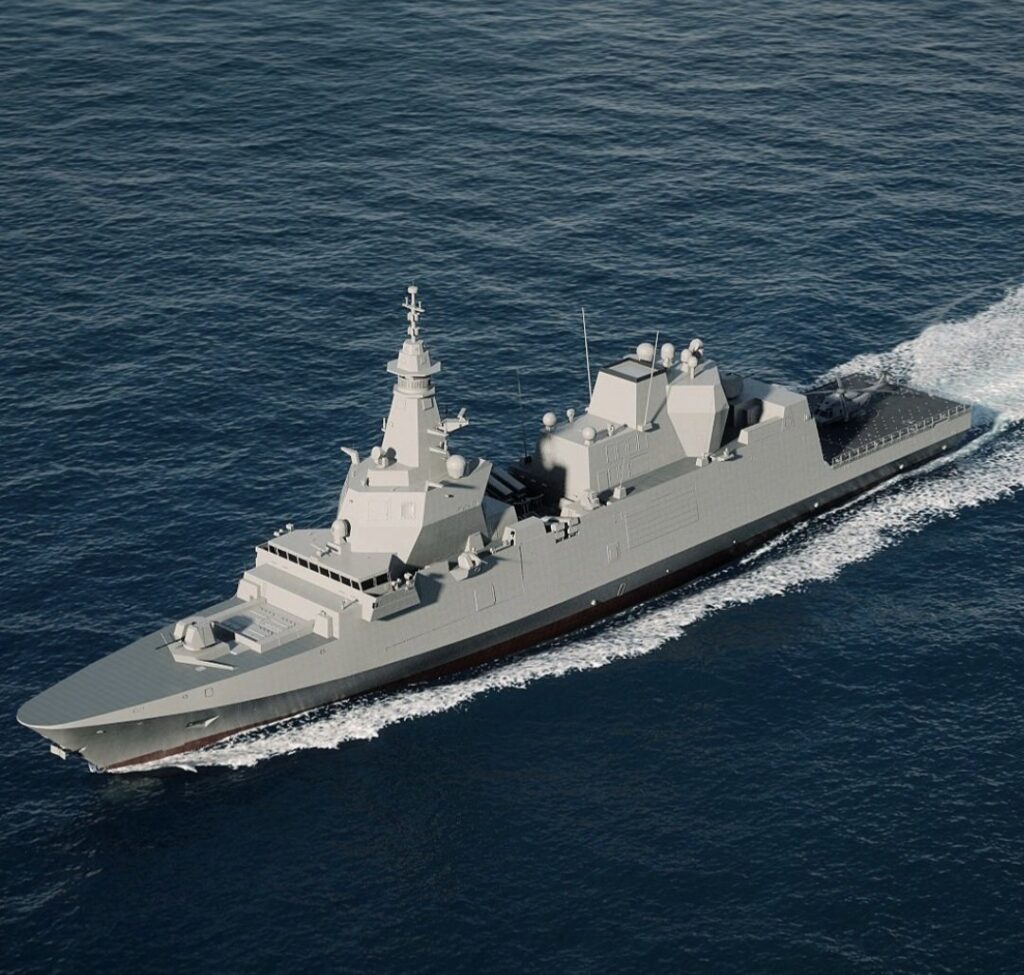
Image: from Portugal Defense X @PortugalDefense
By Open Chronicle News Desk with Agencies
Portugal has announced the acquisition of three FREMM EVO multi-mission frigates from Italian shipbuilder Fincantieri in a defence contract valued at approximately €3.9 billion, marking the largest naval procurement undertaken by the Portuguese Navy in decades.
The agreement was unveiled in Rome by Portuguese Prime Minister Luís Montenegro and Italian Prime Minister Giorgia Meloni following talks at the Palazzo Chigi, during the first official visit by a Portuguese head of government to Italy in 12 years.
The new warships are expected to be delivered between 2029 and 2030, beginning the long-term renewal of Portugal’s principal surface combat fleet.
A major investment in Portugal’s naval future
Prime Minister Luís Montenegro described the programme as a strategic investment aimed at strengthening Portugal’s defence capabilities while supporting Europe’s growing defence industrial base.
According to the Portuguese government, the new frigates will significantly improve the country’s ability to protect its maritime resources, secure strategic national interests and contribute to the safety of international shipping routes across the Atlantic.
The €3.9 billion figure represents the overall programme cost, although the government has not yet released a detailed breakdown covering ship construction, combat systems, weapons, logistics, training, infrastructure or long-term maintenance.
Officials also indicated that the programme could generate opportunities for Portuguese research institutions, technology companies and defence industries, although no formal industrial participation or technology-transfer arrangements have yet been announced.
Italy celebrates a strategic victory
Italian Prime Minister Giorgia Meloni welcomed Portugal’s decision, describing it as recognition of the excellence of Italy’s naval industry.
She said the contract demonstrated Europe’s ability to strengthen its strategic autonomy by investing in its own industrial and technological capabilities.
“I’m very pleased with the decision of the Portuguese authorities to acquire three EVO frigates built by Fincantieri,” Meloni said during the joint press conference.
Portugal’s decision concludes a competition in which the Italian proposal prevailed over rival designs offered by France’s Naval Group.
The most advanced version of the FREMM family
The FREMM EVO (European Multi-Mission Frigate Evolution) represents the latest generation of the highly successful FREMM programme jointly developed by Italy and France.
The Italian version is managed by Orizzonte Sistemi Navali, a joint venture owned by Fincantieri (51%) and Leonardo (49%).
Designed for the Italian Navy, the FREMM EVO incorporates substantial technological improvements over previous variants.
Among its key features are:
- A cyber-resilient platform management system.
- The SADOC 4 combat management system.
- Advanced electronic warfare equipment.
- Fixed-face AESA radars operating in both X and C bands.
- Enhanced air-defence capabilities, including improved tracking of tactical ballistic missile threats.
- Upgraded sonar, communications and secure data-link systems.
- Counter-drone technologies.
- The ability to command and coordinate unmanned aerial, surface and underwater vehicles.
Portugal has not yet disclosed the exact configuration of its ships, including radar systems, sonar suites, missile armament, naval guns or electronic warfare equipment.
Backed by the European Union’s SAFE programme
The acquisition will be financed through the European Union’s SAFE (Security Action for Europe) initiative.
SAFE was created to accelerate joint European defence procurement by providing up to €150 billion in long-term loans under favourable financing conditions for member states purchasing equipment produced within Europe’s defence industrial base.
Portugal’s application under SAFE extends beyond the frigate programme and includes investments in the Arsenal do Alfeite naval shipyard, armoured vehicles, satellites, drones and additional defence capabilities.
The initiative reflects the European Union’s broader effort to reinforce defence readiness and reduce dependence on non-European suppliers.
Replacing an ageing fleet
The Portuguese Navy currently operates five frigates.
Three belong to the Vasco da Gama class:
- NRP Vasco da Gama
- NRP Álvares Cabral
- NRP Corte-Real
These ships entered service between 1991 and 1992.
The remaining two vessels belong to the Bartolomeu Dias class:
- NRP Bartolomeu Dias
- NRP D. Francisco de Almeida
Originally built for the Royal Netherlands Navy in the early 1990s, both ships were acquired second-hand by Portugal and entered Portuguese service in 2009.
The arrival of three FREMM EVO frigates will begin replacing the oldest ships in the fleet but will not, by itself, maintain Portugal’s current force of five ocean-going escorts.
Additional acquisitions or service-life extensions for existing vessels will likely be required if Portugal intends to preserve its present fleet size.
A technological leap for the Portuguese Navy
The introduction of the FREMM EVO class is expected to transform Portugal’s naval capabilities across multiple mission areas.
The new ships will significantly enhance:
- Area air defence.
- Anti-submarine warfare.
- Missile and drone defence.
- Electronic warfare.
- NATO interoperability.
- Maritime surveillance.
- Protection of critical underwater infrastructure.
- Atlantic security operations.
They will also strengthen Portugal’s contribution to multinational naval task groups operating under NATO and European Union frameworks.
Ambitious delivery schedule
The announced delivery timeline is considered particularly ambitious.
The first FREMM EVO currently being built for the Italian Navy is itself scheduled for delivery in 2029, with the second expected in 2030.
If Portugal’s schedule is maintained, the three frigates will enter service almost simultaneously with Italy’s own newest surface combatants, placing the Portuguese Navy among the first operators of the most advanced FREMM variant.
The programme represents one of the most important defence investments in modern Portuguese history and signals Lisbon’s commitment to modernising its armed forces while strengthening European defence cooperation in an increasingly challenging international security environment.