
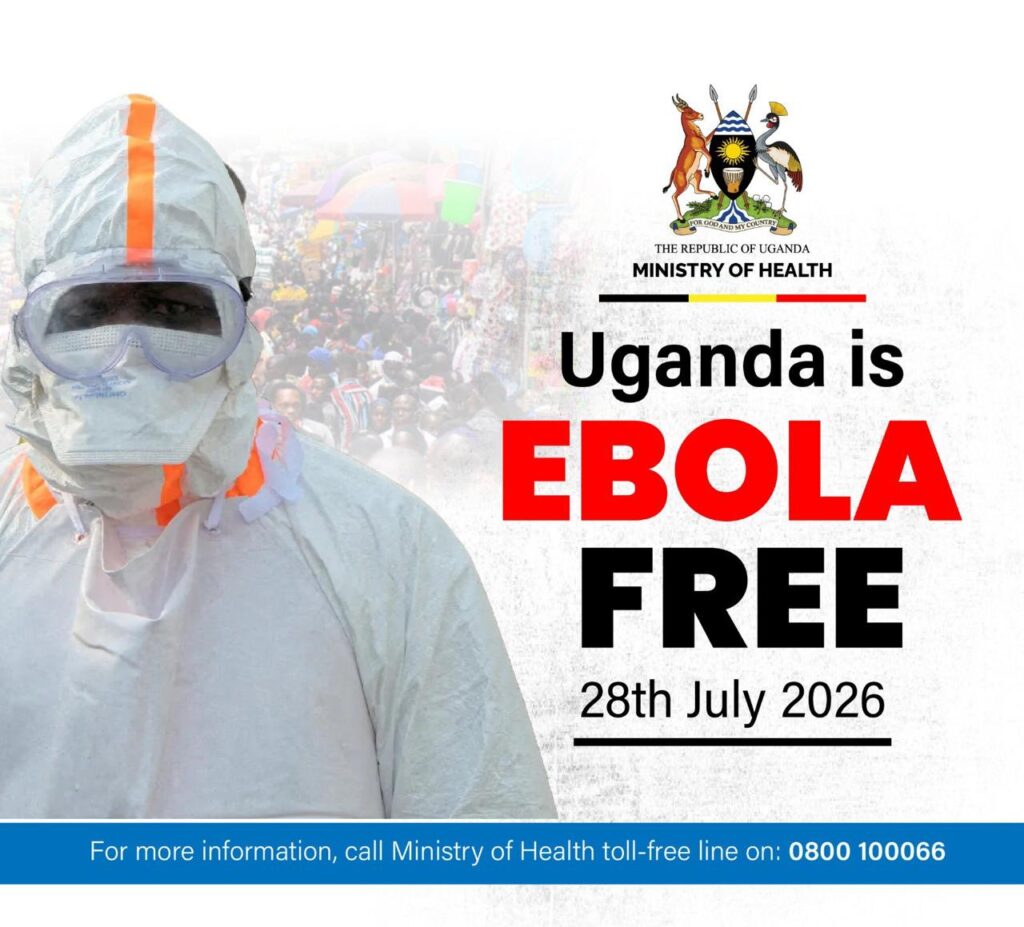
Image: from Krishna Prasad K S X @KpXhandle
By Open Chronicle News Desk with Agencies
Uganda has officially declared itself Ebola-free, successfully containing an imported outbreak that originated in neighbouring Democratic Republic of Congo (DRC). The announcement marks a significant public health achievement, even as eastern Congo continues to battle one of the fastest-growing Ebola epidemics ever recorded.
The declaration follows the discharge of Uganda’s last Ebola patient in mid-June and the completion of mandatory monitoring for all identified contacts without any evidence of further community transmission.
Health officials said the country’s rapid response prevented the virus from spreading beyond the initial imported cases.
Uganda declares itself free of Ebola after last patient discharged.
First cases in Uganda's outbreak were Congolese people who crossed the border to seek treatment for an unknown illness before it was known they had Ebola.
Congo declared its outbreak on May 15, the same day… pic.twitter.com/4yaBfVgIJQ
— News Arena India (@NewsArenaIndia) July 28, 2026
Imported Cases Quickly Contained
According to Uganda’s Ministry of Health, the outbreak began when infected individuals crossed the border from Congo seeking medical treatment before Ebola had been officially diagnosed.
Congo declared its outbreak on 15 May, the same day Uganda confirmed two Ebola infections, including one patient who had already died.
In a statement announcing the end of the outbreak, Uganda’s Ministry of Health said the situation differed from previous Ebola emergencies.
“Unlike previous Ebola outbreaks that informed the current 42-day declaration policy, Uganda’s 2026 Ebola outbreak arose from a fully documented importation event.”
Officials said every identified contact was placed under institutional quarantine and completed the required 21-day monitoring period without developing the disease.
Enhanced surveillance also detected no unexplained community transmission, allowing authorities to formally declare the outbreak over.
.@MinofHealthUG is pleased to announce that Uganda has officially declared the end of the 2026 Ebola Disease outbreak. Today, Uganda is Ebola-free. -Dr @CHRISBARYOMUNS1 #NBSUpdates pic.twitter.com/kXKysbsJqA
— NBS Television (@nbstv) July 28, 2026
Bundibugyo Strain Poses Additional Challenge
The outbreak involved the Bundibugyo strain of the Ebola virus, a rare variant for which there is currently no approved vaccine or specific treatment.
Despite the absence of targeted medical therapies, Uganda’s extensive experience in responding to Ebola outbreaks enabled health authorities to implement swift containment measures.
The regional outbreak has been classified as a global health emergency, reflecting concerns over its rapid spread across eastern Congo.
Uganda’s Rapid Response
Following confirmation of the first cases, Ugandan authorities introduced a series of emergency measures aimed at preventing wider transmission.
President Yoweri Museveni urged citizens to stop shaking hands, a common form of greeting that can facilitate disease transmission through physical contact.
The government also postponed a major annual religious pilgrimage near Kampala that normally attracts thousands of worshippers from Congo and other neighbouring countries.
Additional precautions included:
- Institutional quarantine for all identified contacts.
- Enhanced surveillance in border communities.
- Suspension of public transport links between Uganda and Congo.
- Temporary suspension of flights connecting the two countries.
These interventions helped interrupt transmission before the virus became established within Ugandan communities.
Congo’s Outbreak Continues to Worsen
While Uganda has successfully ended its outbreak, neighbouring Congo continues to face a rapidly deteriorating public health crisis.
According to Congo’s Ministry of Health, the country has now recorded:
- 3,262 confirmed Ebola cases
- 1,437 deaths
Health officials have described the epidemic as the fastest-growing Ebola outbreak on record.
At just 10 weeks old, the current outbreak is already approaching the total number of cases recorded during Congo’s previous largest Ebola epidemic, which lasted two years.
Only the devastating West African Ebola epidemic between 2014 and 2016 remains larger globally, having infected approximately 28,000 people and claimed more than 11,000 lives.
Security Challenges Hamper Response
Containing the outbreak in eastern Congo has proven increasingly difficult because of ongoing insecurity in the affected provinces.
Health workers have faced attacks from armed groups and angry local residents, leaving some communities temporarily inaccessible.
Public health experts warn that tracing and isolating contacts remains the most effective strategy for stopping Ebola transmission.
Any interruption to those operations increases the risk of further spread.
Understanding Ebola
Ebola is a severe viral disease that often causes haemorrhagic fever and can be fatal if not rapidly identified and treated with supportive care.
According to the World Health Organization (WHO), fruit bats are believed to be the virus’s natural reservoir.
The disease spreads through direct contact with:
- Bodily fluids of infected individuals.
- Contaminated medical equipment.
- Objects or materials exposed to infected bodily fluids.
Early detection, rapid isolation of patients and careful monitoring of contacts remain the cornerstone of outbreak control.
A Public Health Success Amid Regional Concern
Uganda’s successful containment demonstrates the importance of rapid surveillance, coordinated border controls and strict quarantine procedures in preventing imported infectious diseases from becoming larger outbreaks.
However, health authorities caution that the threat has not disappeared.
With the epidemic continuing to accelerate across eastern Congo, Uganda and neighbouring countries remain on high alert to detect and contain any new imported cases before they can spread.
The contrasting situations on either side of the border illustrate both the effectiveness of strong public health systems and the ongoing regional challenge posed by one of the world’s deadliest infectious diseases.