
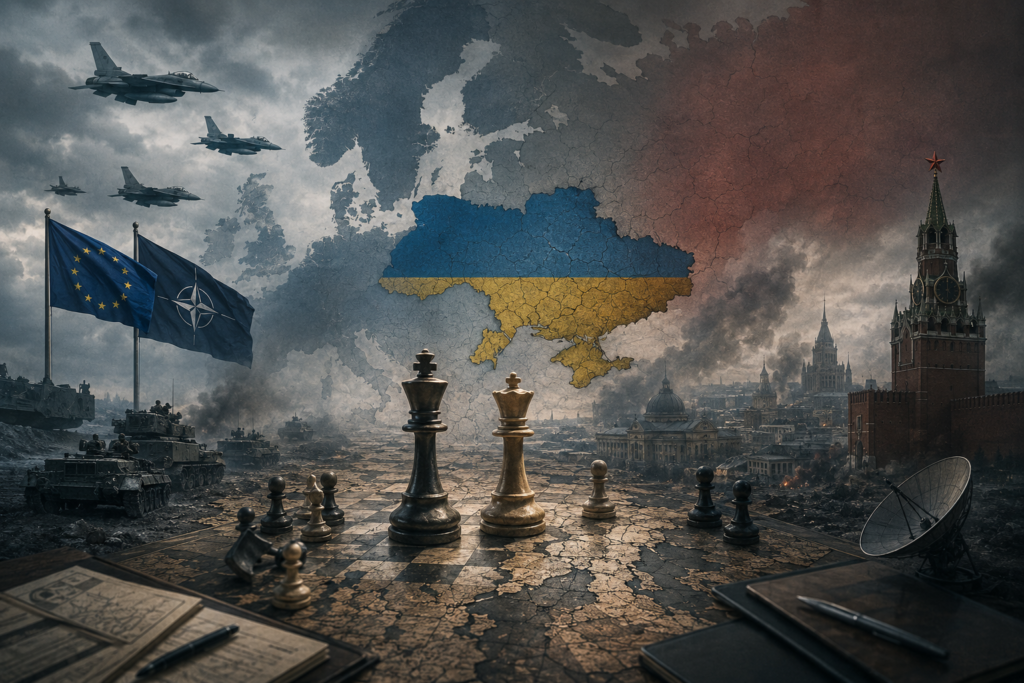
THE GRAND STRATEGY INSTITUTE
Research Division
Strategic Assessment Series
Strategic Assessment No. 001
The Russia–Ukraine War
A War Reshaping Europe’s Security Architecture
How Europe’s Largest Conflict Since 1945 Is Transforming Military Strategy, European Security and the International Order
Published by
The Grand Strategy Institute
Research Division
Open Chronicle
July 2026
About this Publication
The Strategic Assessment Series is the flagship research publication of the Research Division at The Grand Strategy Institute.
Each assessment provides an extensive, evidence based examination of the geopolitical, military, economic and technological developments shaping the international system. Unlike daily news reporting, these publications are designed to provide enduring analytical value through historical context, strategic assessment and multidisciplinary research.
Every study combines historical analysis, military doctrine, international relations, economics, defence policy, technological innovation and geopolitical forecasting to explain not only what has happened, but why it happened, how it continues to evolve and what its long term implications may be.
The objective of the Strategic Assessment Series is to produce accessible yet academically rigorous studies capable of supporting policymakers, researchers, students, journalists and readers seeking a comprehensive understanding of major international developments.
Methodology
This assessment is based upon publicly available information collected from official government publications, international organisations, defence ministries, military doctrine, academic literature, historical archives, satellite imagery, verified open source intelligence, economic data and independent strategic research.
Every effort has been made to ensure analytical balance and factual accuracy. Because the Russia–Ukraine War remains an active conflict, future editions may incorporate updated information, revised assessments and newly available evidence.
Executive Summary
The Russia–Ukraine War is the most consequential armed conflict in Europe since the end of the Second World War. While the full scale invasion began on 24 February 2022, the origins of the conflict stretch back decades, reflecting unresolved questions surrounding the collapse of the Soviet Union, the enlargement of NATO, competing visions of European security and Russia’s determination to reassert itself as a major geopolitical power.
The consequences of the war extend far beyond the battlefield. Military operations inside Ukraine have reshaped European defence policy, transformed the strategic posture of the North Atlantic Treaty Organization, accelerated defence spending across the continent and triggered the largest rearmament effort witnessed in Europe for a generation.
The conflict has also revolutionised modern warfare. Unmanned aerial systems, precision guided munitions, electronic warfare, commercial satellite imagery, cyber operations and artificial intelligence have become central elements of military operations, providing a glimpse of how future conflicts may be fought.
Beyond military affairs, the war has fundamentally altered global energy markets, international trade routes, food security, sanctions policy and diplomatic alignments. It has strengthened some alliances, weakened others and accelerated the transition towards a more competitive and fragmented international order characterised by renewed great power rivalry.
For Europe, the conflict represents the definitive end of the optimistic assumptions that characterised the decades immediately following the Cold War. Large scale interstate warfare has returned to the continent, compelling governments to reconsider deterrence, defence planning, industrial resilience and national preparedness.
This Strategic Assessment argues that the Russia–Ukraine War should not be understood solely as a conflict over territory. It represents a broader struggle concerning the future architecture of European security, the interpretation of sovereignty under international law, the credibility of military deterrence and the balance of power within the evolving international system.
Understanding these wider dynamics requires examining the historical developments that shaped Europe after 1991, the gradual deterioration of relations between Russia and the West and the strategic choices made by all principal actors over more than three decades.
PART I
FOUNDATIONS OF THE CONFLICT
Chapter 1
The Post-Cold War Security Order
From the End of the Soviet Union to the Return of Great Power Competition
Introduction
Few wars emerge without deep historical roots. Although the full scale Russian invasion of Ukraine commenced in February 2022, its origins lie within the profound transformation of Europe’s political and strategic landscape following the collapse of the Soviet Union in 1991.
The end of the Cold War was widely celebrated as the beginning of a new international era. For almost half a century, Europe had been divided by ideological confrontation, military blocs and the constant possibility of nuclear conflict. With the dissolution of the Soviet Union and the disappearance of the Warsaw Pact, many believed that a cooperative European security order had finally become possible.
The following decades appeared to support this optimism. Democratic institutions expanded throughout Central and Eastern Europe, the European Union experienced its largest period of enlargement and NATO gradually transformed from an alliance primarily focused on territorial defence into an organisation increasingly engaged in crisis management, peacekeeping and international security operations.
Yet beneath these developments, important strategic disagreements remained unresolved.
For the United States and most European governments, the post Cold War order represented the expansion of a stable international system based upon sovereign equality, democratic governance, economic integration and collective security.
For Russia, however, the same period was frequently perceived as one of geopolitical retreat, economic dislocation and diminishing international influence. The loss of the Soviet Union represented not only the disappearance of a political system but also the collapse of an empire that had defined Russian strategic thinking for centuries.
These contrasting interpretations gradually produced fundamentally different understandings of European security.
Countries emerging from Soviet influence increasingly sought integration with Western institutions in order to guarantee their independence and protect themselves against future coercion.
Russian policymakers increasingly interpreted this process as the steady expansion of Western political and military influence towards Russia’s borders.
Neither interpretation emerged in isolation.
Each reflected historical experience, national identity, security concerns and differing assessments of the international environment.
Ukraine would ultimately become the geographical, political and strategic intersection of these competing visions.
The conflict that erupted in 2022 therefore cannot be understood solely through the military events of the invasion itself.
It must instead be viewed as the culmination of more than thirty years of evolving strategic competition, institutional transformation and unresolved questions regarding the future security architecture of Europe.
1.1 Europe at the End of the Cold War
When the Berlin Wall fell on 9 November 1989, few observers anticipated the speed with which the European strategic landscape would change. For over four decades the continent had been defined by a rigid bipolar order in which NATO and the Warsaw Pact faced each other across the Iron Curtain. Millions of troops, thousands of tanks and vast nuclear arsenals underpinned a precarious balance based upon deterrence and the doctrine of mutually assured destruction.
Despite numerous crises, including Berlin, Cuba and Afghanistan, direct military confrontation between the two superpowers had been avoided. Instead, the Cold War was characterised by ideological rivalry, proxy conflicts and an unprecedented accumulation of military capabilities.
By the late 1980s, however, the Soviet Union faced mounting structural challenges. Economic stagnation, declining industrial productivity, technological shortcomings and the financial burden of sustaining military parity with the United States increasingly constrained Moscow’s ability to compete. The costly intervention in Afghanistan further exposed weaknesses within the Soviet political and military system, while growing demands for political reform emerged across Eastern Europe and within the Soviet republics themselves.
The reforms introduced by Mikhail Gorbachev through Perestroika and Glasnost were intended to revitalise socialism and modernise the Soviet state. Instead, they accelerated political liberalisation, encouraged nationalist movements and weakened the authority of the Communist Party.
During 1989, communist governments across Central and Eastern Europe collapsed in rapid succession. Poland, Hungary, East Germany, Czechoslovakia, Bulgaria and Romania each underwent profound political transformation, signalling the end of Soviet dominance over Eastern Europe.
The symbolic destruction of the Berlin Wall represented far more than German reunification. It marked the beginning of a new European order whose long term implications would continue to shape international politics decades later.
Continue the Strategic Assessment
Current
Chapter 1
The Post-Cold-War Security Order
Next Chapter
Ukraine Between East and West
State Building, National Identity and Strategic Geography
This chapter explores how Ukraine emerged as an independent state following the collapse of the Soviet Union, how its national identity gradually developed and why its geography transformed the country into one of Europe’s most important strategic frontiers.
Strategic Assessment No. 001
The Russia–Ukraine War
Return to the complete assessment, explore the table of contents and follow the publication of future chapters.
The Grand Strategy Institute
Continue Exploring Strategic Analysis
Return to The Grand Strategy Institute for strategic assessments, long-form analysis and research examining geopolitics, military affairs, international security, emerging technologies and the changing international order.
← Back to The Grand Strategy Institute