
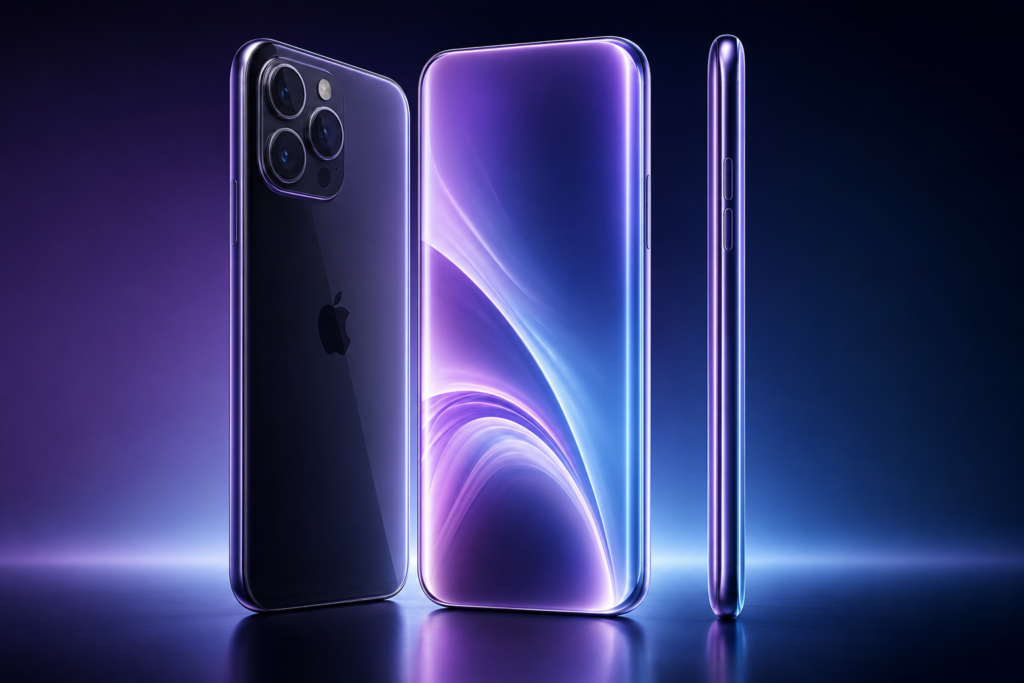
Image Credits: Apple’s 20th anniversary iPhone could deliver the biggest redesign since the iPhone X. AI-generated illustration created by Open Chronicle using ChatGPT (OpenAI). July 2026. This image is illustrative and does not depict a real-world scene.
By Open Chronicle News Desk
Apple is reportedly preparing its most ambitious iPhone redesign in a decade, with the company’s 20th anniversary model expected to debut in the autumn of 2027 featuring an all-new design, cutting-edge display technology and major advances in artificial intelligence, cameras and battery life.
Although the original iPhone was introduced in January 2007 and released in June of that year, Apple is widely expected to unveil the anniversary model during its traditional September launch event in 2027, following the approach it took with the iPhone X, which celebrated the device’s tenth anniversary.
Industry analysts believe the anniversary handset could become the company’s most significant design milestone since the iPhone X fundamentally changed the look and direction of the iPhone lineup in 2017.
A radically new design
According to multiple reports, Apple is working on an almost entirely glass construction featuring an edge-to-edge display that curves seamlessly around all four sides of the device.
Rather than adopting the dramatic “waterfall” displays seen on some competing smartphones, Apple is reportedly pursuing a more subtle quad-curved design with shallow micro-curves intended to improve gesture navigation while minimizing image distortion.
The display is also expected to feature dramatically thinner bezels measuring approximately 1.1 millimetres, creating what could be Apple’s closest approach yet to a truly borderless smartphone.
More advanced display technology
The anniversary iPhone is expected to introduce Samsung’s latest OLED technology using Color Filter on Encapsulation (CoE).
This approach removes the traditional polarising layer, allowing more light to pass through the display while simultaneously reducing power consumption and improving brightness.
Reports also suggest Apple will pair the panel with next-generation 16-nanometre display driver chips and a specially designed light diffusion layer to maintain uniform brightness across the entire curved screen.
Face ID hidden beneath the display
Apple is continuing its long-term effort to eliminate visible display cut-outs.
The 2027 model is expected to move much of the Face ID system beneath the display using a transparent section of specially engineered glass that allows infrared sensors to operate without being visible.
Some analysts caution that the technology may not be fully mature by 2027, meaning a smaller version of the Dynamic Island could remain for another generation.
Two premium models
Unlike the single-sized iPhone X, Apple is expected to release two anniversary models.
Current reports suggest display sizes of approximately 6.3 inches and 6.9 inches, although the larger version could be marketed as a seven-inch device thanks to its nearly bezel-free design.
Apple’s own camera sensor
For the first time, Apple may replace Sony image sensors with a sensor designed entirely in-house.
The new stacked sensor reportedly incorporates LOFIC (Lateral Overflow Integration Capacitor) technology, allowing each pixel to capture different light levels and dramatically increasing dynamic range.
If successful, the camera system could deliver images with up to 20 stops of dynamic range, approaching professional cinema camera performance.
Solid-state buttons return
Apple is also believed to be reviving its previously shelved “Project Bongo,” replacing all mechanical buttons with solid-state haptic controls integrated directly into the frame.
The pressure-sensitive buttons would simulate physical clicks using haptic feedback while remaining functional even when the phone is powered off or the battery is depleted, thanks to an ultra-low-power controller.
Faster processor and AI memory
Powering the device is expected to be Apple’s second-generation 2-nanometre A21 processor.
The anniversary iPhone may also become the first Apple smartphone to feature High Bandwidth Memory (HBM), a technology more commonly found in AI accelerators and high-performance graphics processors.
HBM could significantly improve on-device artificial intelligence by dramatically increasing memory bandwidth while maintaining energy efficiency.
Apple’s modem arrives in flagship models
After gradually replacing Qualcomm components over several product generations, Apple is expected to introduce its own high-end modem across flagship iPhones in the United States.
The custom modem is expected to improve battery life, wireless efficiency and AI-assisted connectivity while further reducing Apple’s dependence on third-party suppliers.
Pure silicon battery technology
Battery life may also receive one of its biggest upgrades in years.
Reports suggest Apple is developing pure silicon battery technology with significantly higher energy density than conventional lithium-ion batteries.
The technology could allow substantially larger battery capacity without increasing the size of the device, with some reports suggesting capacities approaching 6,000mAh.
More innovations on the horizon
Additional rumours point to reverse wireless charging, under-display audio that removes the traditional earpiece opening and a next-generation Ceramic Shield for improved durability.
However, these features remain less certain than the broader design changes and have yet to be independently confirmed.
A new era for the iPhone
Although Apple has not officially announced any details, industry observers expect the 20th anniversary iPhone to become the company’s next defining flagship, much as the iPhone X reshaped smartphone design a decade earlier.
The device is also expected to launch alongside Apple’s second-generation foldable iPhone, signalling what could be the beginning of a new chapter for the company’s smartphone lineup as it places greater emphasis on artificial intelligence, custom silicon and advanced hardware integration.