
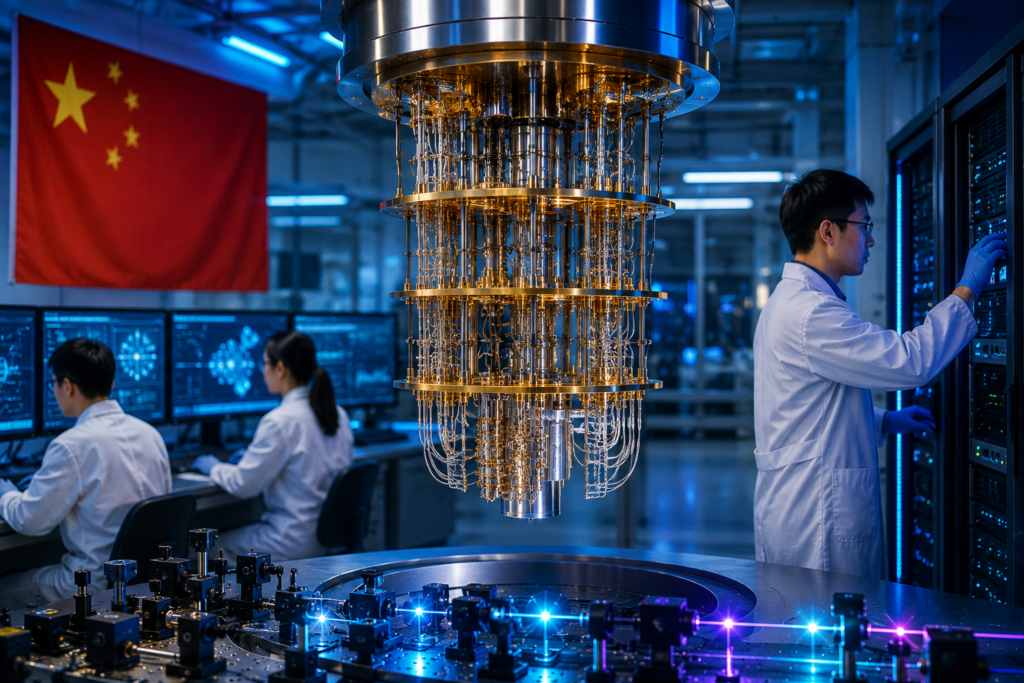
Image Credits: China creates national committee to accelerate quantum technology standards. AI-generated illustration created by Open Chronicle using ChatGPT (OpenAI). July 2026. This image is illustrative and does not depict a real-world scene.
By Open Chronicle News Desk with Agencies
China has taken another significant step in its drive to become a global leader in quantum technology by establishing a national technical committee dedicated to developing industry standards for quantum information.
The new committee, created under the Ministry of Industry and Information Technology (MIIT), was formally established during a meeting in Beijing and will oversee the creation and revision of technical standards across China’s rapidly expanding quantum sector.
Officials said the committee will play a central role in standardising key areas including quantum computing, quantum communication, quantum precision measurement and other foundational quantum information technologies.
Its secretariat will be hosted by the China Academy of Information and Communications Technology (CAICT), one of the country’s leading research institutions in digital technologies.
Supporting China’s future industries
The creation of the committee forms part of Beijing’s broader strategy to strengthen emerging industries considered critical to China’s long-term technological competitiveness.
The Chinese government has identified quantum technology as one of its priority “future industries” for 2026, alongside artificial intelligence, brain-computer interfaces, future energy technologies and sixth-generation (6G) telecommunications.
Authorities believe internationally recognised technical standards will be essential for supporting innovation, encouraging industrial growth and expanding global cooperation in quantum technologies.
According to the Ministry of Industry and Information Technology, the committee will help establish a unified technical framework for China’s quantum industry while increasing the country’s participation in developing international standards.
Accelerating quantum innovation
China has continued to report major advances in quantum computing throughout the year.
In February, developers released Origin Pilot, China’s domestically developed quantum computer operating system, making it available for public download.
Researchers said the software is designed to reduce technical barriers for developers and accelerate the growth of China’s quantum computing ecosystem by making quantum programming more accessible.
The launch was viewed as an important milestone in China’s efforts to build an independent quantum technology infrastructure.
Record-breaking achievements
Chinese researchers have also announced significant scientific breakthroughs.
In May, scientists unveiled Jiuzhang 4.0, a programmable quantum computing prototype that reportedly established a new world record in optical quantum information technology.
The achievement further strengthened China’s position among the world’s leading nations in quantum research, an area increasingly viewed as strategically important for scientific discovery, cybersecurity, advanced computing and national security.
Global race intensifies
Quantum technologies are expected to transform computing by enabling certain calculations that are currently impossible or impractical for conventional supercomputers.
Governments and technology companies around the world are investing billions of dollars in quantum research, viewing the field as a key driver of future economic competitiveness and technological leadership.
By creating a dedicated standards committee, China is signalling that it intends not only to advance quantum research but also to shape the technical rules and industrial frameworks that could govern the next generation of quantum technologies worldwide.
The move highlights Beijing’s broader ambition to strengthen its influence in emerging technologies while promoting closer international cooperation on the development of global quantum standards.