
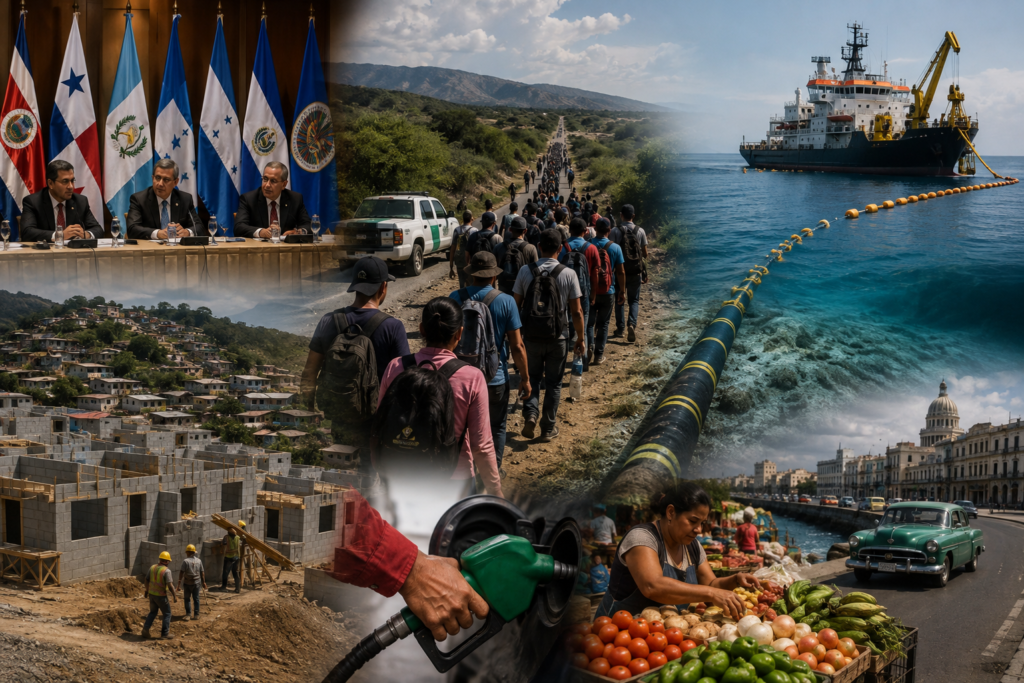
Image Credits: Central America & Caribbean News Brief: Top Stories Across the Region, August 3, 2026. AI-generated illustration created by Open Chronicle using ChatGPT (OpenAI). August 2026. This image is illustrative and does not depict a real-world scene.
By Open Chronicle with agencies
Political tensions, regional security concerns and growing geopolitical competition are shaping the news agenda across Central America and the Caribbean. Governments are responding to democratic challenges, migration pressures and economic uncertainty while major powers increase their strategic engagement in the region.
Regional leaders condemn Nicaragua’s abolition of elections
The strongest political reaction across Central America continues to focus on Nicaragua after President Daniel Ortega’s government moved to abolish national elections.
Costa Rica, Panama and Guatemala have condemned the decision, describing it as a serious setback for democratic governance. Regional and international organizations have also expressed concern, warning that the move could further isolate Nicaragua and weaken democratic institutions across the region.
Migration and organized crime remain top priorities
Migration, border security and the fight against transnational organized crime continue to dominate discussions among Central American governments.
Regional leaders are working with international partners to strengthen border management, improve intelligence sharing and address the economic and social factors driving migration while combating criminal networks involved in drug trafficking and human smuggling.
United States plans major regional investment
The Trump administration is considering a significant investment package for Central America and the Caribbean aimed at strengthening regional infrastructure and reducing China’s growing influence.
The proposal includes funding for telecommunications, cybersecurity and strategic infrastructure, reflecting Washington’s increasing focus on the region as part of its broader geopolitical strategy.
Caribbean telecommunications become strategic battleground
One of the flagship initiatives under consideration is a US$175.8 million project to replace undersea telecommunications cables linking Caribbean and Central American nations.
U.S. officials view the project as an important step toward improving digital resilience while reducing dependence on Chinese technology providers for critical communications infrastructure.
Cuba continues to face economic challenges
Cuba remains under considerable economic pressure as fuel shortages, energy supply problems and continued U.S. sanctions affect businesses and households across the island.
Although no major policy changes have been announced, the country’s economic difficulties continue to be closely monitored throughout the Caribbean.
Honduras launches affordable housing initiative
The Honduran government has unveiled a US$400 million housing programme designed to expand access to affordable homes while improving infrastructure and supporting economic development.
Officials say the initiative is expected to create jobs and improve living conditions in rapidly growing urban areas.
Guatemala seeks relief from fuel costs
Guatemala’s government is advancing measures aimed at easing the burden of high fuel prices through temporary subsidies.
The proposal comes as households and businesses continue to face higher transportation and energy costs driven by global market volatility.
Food prices continue to rise in El Salvador
New economic data indicate that the cost of the basic food basket continues to increase in El Salvador, placing additional pressure on household budgets despite broader efforts to stabilise inflation.
Economists say rising food costs remain one of the country’s most significant domestic economic challenges.
Nicaragua strengthens ties with China
Nicaragua continues to deepen its economic relationship with China through new mining concessions and expanded commercial cooperation.
The growing partnership reflects Managua’s broader foreign policy shift toward Beijing and is being closely watched by governments across the region.
As Central America and the Caribbean confront political uncertainty, economic pressures and increasing geopolitical competition, regional leaders continue seeking solutions that balance security, development and democratic governance.