
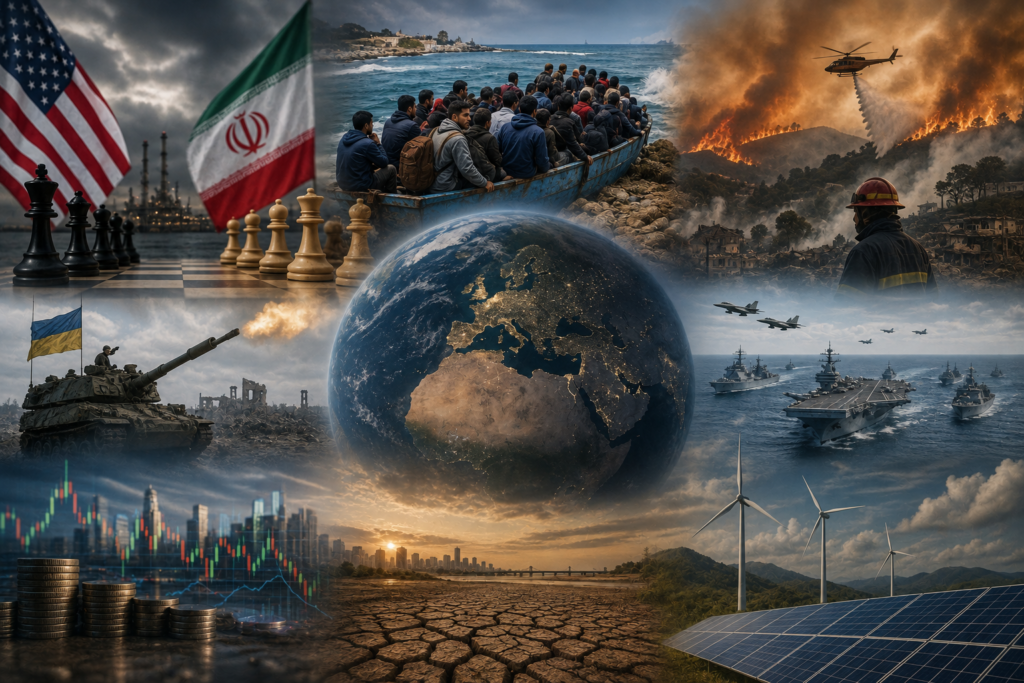
Image Credits: Global News Brief: Key Developments Around the World, August 3, 2026. AI-generated illustration created by Open Chronicle using ChatGPT (OpenAI). August 2026. This image is illustrative and does not depict a real-world scene.
World In Depth: The Strategic Forces Reshaping Global Affairs
By Open Chronicle with agencies
The international landscape is being shaped by a convergence of geopolitical confrontation, migration pressures, climate disruption and economic uncertainty. While several crises dominate daily headlines, they also reflect broader structural changes that are redefining global security, international trade and the balance of power.
From the Middle East and Europe to the Indo-Pacific, today’s developments illustrate how regional events increasingly carry worldwide consequences.
U.S. and Iran enter a fragile diplomatic phase
The confrontation between the United States and Iran remains the defining geopolitical issue of the moment.
President Donald Trump has announced a pause in planned military strikes, arguing that diplomacy deserves another opportunity before further escalation. Tehran, however, has publicly rejected suggestions that negotiations are currently underway, maintaining its firm stance while continuing to exert pressure over the Strait of Hormuz.
The dispute extends far beyond bilateral relations. The strategic waterway remains one of the world’s most important energy corridors, carrying a significant share of global oil exports. Any prolonged disruption could affect energy prices, inflation and economic growth across multiple continents.
Diplomatic efforts continue behind the scenes, but uncertainty remains high as military forces remain deployed throughout the region.
Europe confronts its most serious migration challenge in years
The mass crossings into Spain’s North African enclave of Ceuta have evolved into one of Europe’s most significant political crises.
The events have exposed deep divisions within the European Union over migration policy, external border protection and the future of the Schengen Area.
Several member states have strengthened border controls while European institutions prepare emergency discussions aimed at coordinating a common response. The crisis has reignited debates over asylum policy, burden sharing and relations with neighbouring countries.
Migration has once again become one of the defining political issues across Europe, with implications extending well beyond Spain.
Climate extremes reshape Europe’s security landscape
Europe is simultaneously confronting another growing challenge as record temperatures, prolonged drought and destructive wildfires affect multiple countries.
Large-scale fires continue to threaten communities in Greece, while Romania has implemented emergency measures to protect cooling water supplies for its Cernavodă nuclear power plant. Other countries are facing increasing pressure on electricity generation, water resources and transportation infrastructure.
The combination of climate stress and energy security concerns is forcing governments to rethink resilience planning, emergency preparedness and long-term infrastructure investment.
Ukraine expands pressure deep inside Russia
The war in Ukraine continues to evolve beyond the traditional battlefield.
Kyiv has intensified long-range drone operations against strategic targets inside Russian territory, striking logistics centres, industrial facilities and infrastructure that Ukrainian officials say contribute to Moscow’s military capabilities.
These operations demonstrate how modern warfare increasingly combines conventional military operations with long-range precision strikes and economic disruption.
The conflict continues to reshape European defence policy, accelerate military investment and strengthen security cooperation among NATO members.
Markets recover, but uncertainty remains
Global financial markets have responded positively to hopes that a wider conflict in the Middle East may be avoided.
Stock markets have recovered while oil prices have retreated from recent highs, providing temporary relief to investors and policymakers.
Despite the improved market sentiment, economists caution that the global outlook remains closely tied to geopolitical developments. Any renewed instability around the Strait of Hormuz or other strategic regions could quickly reverse recent gains.
Central banks also remain cautious as inflation risks continue to be influenced by geopolitical events and energy markets.
Strategic rivalry intensifies across the Indo-Pacific
Competition between major powers continues to expand in the Indo-Pacific.
China has increased joint naval and air patrols around disputed areas of the South China Sea, reinforcing its presence in one of the world’s most strategically important maritime regions.
Neighbouring countries continue strengthening defence cooperation with regional and Western partners, reflecting growing concern over freedom of navigation, territorial disputes and regional stability.
The Indo-Pacific remains one of the principal theatres of long-term geopolitical competition.
Climate change becomes a strategic security issue
Extreme weather is no longer viewed solely as an environmental concern.
Governments across the world are increasingly treating climate-related disasters as national security challenges capable of disrupting infrastructure, agriculture, energy production and economic stability.
Wildfires, floods, prolonged drought and water shortages are placing additional pressure on governments already managing geopolitical tensions and economic uncertainty.
The growing intersection between climate resilience, national security and global economic stability is likely to become one of the defining strategic issues of the coming decade.
A rapidly changing global landscape
Today’s international developments illustrate that the world’s major challenges are becoming increasingly interconnected.
Geopolitical rivalry influences energy markets, migration affects political stability, climate change reshapes security planning and economic performance increasingly depends on developments far beyond national borders.
Rather than isolated crises, these events form part of a broader transformation of the international system, one in which diplomacy, military strategy, economic resilience and climate adaptation are becoming inseparable components of global policy.