
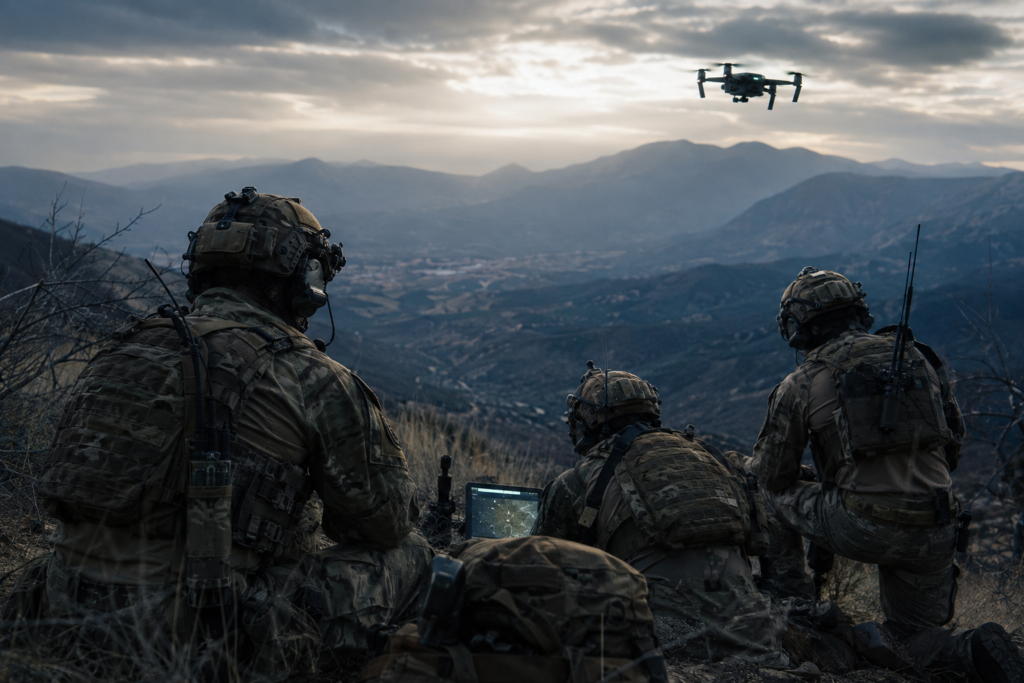
Image Credits: How Special Operations Forces Are Adapting to the Drone Battlefield. AI-generated illustration created by Open Chronicle using ChatGPT (OpenAI). August 2026. This image is illustrative and does not depict a real-world scene.
By Open Chronicle Military Desk
For decades, one of the defining advantages of Special Operations Forces was their ability to disappear.
A small team could infiltrate hostile territory, observe an objective, communicate discreetly with headquarters and remain concealed long enough to conduct reconnaissance, direct an air strike, capture a target, or prepare a larger military operation.
The war in Ukraine is challenging that model.
Cheap reconnaissance drones can remain above the battlefield searching for movement. First person view drones can pursue individual soldiers or vehicles. Thermal sensors can reveal positions at night. Electronic warfare systems can detect or disrupt communications. Loitering munitions can remain airborne waiting for a target to appear.
The battlefield is becoming increasingly transparent.
For Special Operations Forces, whose survival has traditionally depended on remaining difficult to find, that transformation poses a fundamental question.
Are drones turning the traditional Special Forces operator into a reconnaissance, targeting, robotics and electronic warfare specialist?
Evidence emerging from Ukraine, NATO exercises and recent changes within U.S. Army Special Operations suggests the answer may increasingly be yes.
Ukraine has changed the battlefield
The Russia Ukraine war has become the world’s most important laboratory for modern drone warfare.
Small unmanned aircraft that once represented a specialised military capability are now present throughout the battlespace.
Reconnaissance drones search for troops and vehicles.
FPV systems attack individual targets.
Larger unmanned aircraft conduct surveillance and strikes deeper behind enemy lines.
Electronic warfare units attempt to detect, jam or manipulate the radio frequencies connecting drones with their operators.
The result is an environment in which simply moving across open terrain can reveal a unit’s location.
For conventional forces, this creates enormous tactical problems.
For Special Operations Forces, it challenges some of the fundamental assumptions behind clandestine military operations.
The disappearing battlefield sanctuary
Traditional special operations frequently depend on operating inside spaces where an adversary has limited awareness.
A team might infiltrate at night, establish an observation position and remain concealed while monitoring a target.
Persistent aerial surveillance changes that equation.
A relatively inexpensive commercial quadcopter equipped with a thermal camera can search terrain that previously required aircraft, helicopters or dedicated reconnaissance teams.
Several drones operating sequentially can create near persistent observation.
Once something suspicious is detected, another drone can investigate.
If the target is confirmed, strike assets may follow.
The process compresses what military planners sometimes describe as the sensor to shooter chain.
Detection and attack can increasingly occur within minutes.
For a Special Forces team deep behind enemy lines, those minutes can determine whether the mission continues or ends.
Every electronic signal can become a clue
Physical concealment is only part of the problem.
Modern military units produce electronic signatures.
Radios transmit.
Drones communicate with controllers.
Satellite terminals exchange data.
Navigation systems interact with satellites.
Electronic equipment generates emissions.
An adversary equipped with sufficient electronic intelligence capabilities can potentially detect or analyse some of those signals.
This means camouflage is no longer simply about hiding soldiers from human observers.
Units increasingly need to manage their electromagnetic signature.
Special Operations Forces therefore require a sophisticated understanding of when to transmit, how to communicate securely and how enemy electronic warfare systems may attempt to locate or disrupt them.
The ability to remain electronically quiet can become as important as remaining physically invisible.
U.S. Special Forces are already training for the threat
The transformation is no longer theoretical.
In May 2026, personnel from the U.S. Army’s 1st Special Forces Command, the Army Marksmanship Unit and the 82nd Airborne Division participated in counter drone training near Fort Bragg, North Carolina.
The exercise focused on engaging both surveillance and weaponised FPV drones.
Soldiers tested conventional Army weapons and different ammunition against small drones moving at more than 40 miles per hour.
The objective was partly economic.
Using an expensive missile to destroy a drone costing only hundreds or thousands of dollars creates an unsustainable exchange.
Military forces therefore need inexpensive defensive systems that can be distributed widely.
For Special Operations Forces operating with limited logistical support, that requirement is particularly important.
A small team cannot carry an unlimited supply of specialised counter drone missiles.
It needs layered protection that is portable, reliable and relatively inexpensive.
Special Operations creates a new kind of specialist
Perhaps the clearest indication of how rapidly the profession is changing came from the U.S. Army Special Operations community itself.
On May 29, the U.S. Army John F. Kennedy Special Warfare Center and School completed the first Robotics and Technology Integrators Course, or RTIC.
The first class included personnel from across the Army Special Operations Command enterprise.
Their task was not simply to learn how to fly a drone.
The course was designed to create specialists capable of integrating robotic and autonomous systems into Special Operations units.
That distinction matters.
Future SOF teams may require personnel who understand friendly drones, enemy unmanned systems, autonomous platforms, communications networks and the constantly changing commercial technology behind them.
Army Special Operations officials have described this technological transformation as part of a broader renaissance within the force.
The traditional Special Forces skill set is expanding.
The drone operator becomes an intelligence collector
One of the most important changes involves reconnaissance.
Historically, Special Operations teams were themselves sensors.
They infiltrated areas that satellites, aircraft or conventional reconnaissance units could not adequately observe.
That role remains important.
But the operator now increasingly controls additional sensors.
A small drone can look over a ridge without exposing a soldier.
It can inspect a road before a team crosses it.
It can observe an objective from several kilometres away.
It can identify movement around a potential landing zone.
It can provide imagery to commanders far from the battlefield.
This allows a very small team to observe considerably more territory than previous generations of operators could physically monitor.
The operator is no longer simply conducting reconnaissance.
He or she is managing a miniature intelligence network.
From reconnaissance to targeting
The next step is even more consequential.
Once a drone detects a target, the information can potentially be passed to another military system.
That might be artillery.
It might be an aircraft.
It might be another drone.
It could be a long range precision weapon.
Special Operations Forces have long performed this type of targeting mission.
What drones change is the speed, range and persistence with which it can occur.
A team equipped with multiple unmanned systems can potentially observe several areas simultaneously while remaining physically separated from the objective.
This strengthens one of the traditional roles of SOF: providing high quality intelligence and targeting information to a much larger conventional force.
The Special Forces operator increasingly becomes part of a distributed sensor network.
FPV drones create a new close combat threat
But drones are not only sensors.
Ukraine has demonstrated the effectiveness of inexpensive FPV drones as precision attack systems.
Operators wearing video goggles can guide small aircraft directly toward vehicles, firing positions and individual soldiers.
The implications for Special Operations teams are serious.
Traditional elite units often depend on mobility and small numbers rather than heavy protection.
That can make them particularly vulnerable to persistent drone observation followed by FPV attack.
A concealed vehicle may no longer remain concealed once spotted from above.
A temporary observation post can become a target.
Even withdrawing from an operation can become dangerous if hostile drones begin tracking the team.
Counter drone awareness therefore has to become part of routine tactical behaviour.
Electronic warfare becomes a survival skill
The natural response to drone proliferation is electronic warfare.
Many small drones depend on radio frequency links between aircraft and operator.
Disrupting those links can prevent or complicate attacks.
NATO forces training in Latvia during 2026 practised detecting, tracking and neutralising drones using both electronic warfare and conventional weapons.
The concept is increasingly layered.
One system detects the drone.
Another identifies it.
Electronic warfare may attempt to jam it.
A kinetic system may destroy it if jamming fails.
For Special Operations teams, the challenge is making this architecture portable.
Large conventional formations can deploy dedicated counter UAS vehicles and radar systems.
A six or twelve person team operating far from friendly forces cannot.
SOF therefore needs smaller sensors, portable electronic warfare equipment and operators capable of understanding the electromagnetic environment around them.
NATO is treating drones as a strategic transformation
The scale of NATO’s response demonstrates how seriously the Alliance views the issue.
At the NATO Summit Defence Industry Forum in July 2026, Allies announced plans to invest more than $40 billion in counter drone capabilities over five years.
They also committed to training five times as many military drone operators by the end of 2027.
NATO Secretary General Mark Rutte described drones as having fundamentally altered the character of modern warfare.
The Alliance is developing systems not simply to destroy drones but to connect sensors, command networks and defensive weapons into integrated counter UAS architectures.
For Special Operations Forces, interoperability will be particularly important.
NATO SOF frequently operate in multinational environments where intelligence collected by one country’s team may need to move immediately through another country’s command network.
Ukraine is teaching NATO directly
NATO is not learning about the drone battlefield only through reports.
Ukrainian operators are directly participating in Allied exercises.
During Sweden’s Aurora 26 exercise, experienced Ukrainian drone operators were used to test NATO forces.
More than 18,000 troops from 13 countries participated in the wider exercise.
Ukrainian and Swedish operators employed reconnaissance and attack drones against Allied formations, exposing troops to battlefield conditions shaped by lessons from the war.
The objective was deliberately uncomfortable.
Military planners wanted NATO units to experience what happens when soldiers, vehicles and command posts operate under persistent unmanned observation.
Ukraine is therefore becoming not only a recipient of NATO assistance but also a source of battlefield knowledge for the Alliance.
Project Flytrap brings the drone war to NATO’s eastern flank
Another important experiment took place in Lithuania.
During Project Flytrap, American and Allied troops tested reconnaissance drones, FPV strike systems, electronic jammers, artificial intelligence enabled command systems and live tactical data networks.
The exercise was conducted at the Pabradė Training Area, roughly 30 kilometres from the Belarusian border.
The location was symbolically important.
This was not experimentation taking place inside a distant research laboratory.
It was happening along NATO’s eastern flank.
Systems that only recently might have been treated as experimental technology were being mounted on vehicles, carried by soldiers and tested in realistic battlefield conditions.
The message is clear.
Drone warfare is moving from innovation programmes into normal military operations.
Communications become even more important
Special Operations Forces cannot exploit drones and distributed sensors without resilient communications.
In July, the NATO Communications and Information Agency signed a contract with a consortium formed by Thales and Leonardo for a new generation of deployable communications systems supporting NATO Special Operations Forces.
The objective is to provide secure and resilient communications for SOF operating across dispersed and rapidly changing areas.
This is another part of the same transformation.
A distributed Special Forces team may operate drones, receive intelligence from other sensors, pass targeting information to aircraft and coordinate with multinational forces.
All of that depends on communications.
But transmitting also creates potential vulnerabilities.
The future SOF communications architecture therefore has to accomplish two apparently contradictory objectives.
It must move enormous amounts of information quickly while making the unit increasingly difficult for the enemy to detect.
Smaller teams, larger digital footprints
This creates one of the paradoxes of modern Special Operations.
Technology allows fewer people to accomplish more.
A small team equipped with drones, satellite communications, advanced optics and precision targeting systems can potentially observe and influence an enormous area.
But every additional device can also create another signature.
More sensors mean more data.
More data requires more communications.
More communications create more opportunities for interception or electronic attack.
The challenge is therefore not simply acquiring technology.
It is learning when not to use it.
Future Special Forces operators may need exceptional discipline in controlling their digital and electromagnetic footprint.
Counter UAS becomes part of basic force protection
There is another important change.
Counter drone capability cannot remain confined to specialised air defence units.
If small drones are everywhere, every military formation needs some ability to respond.
That includes SOF.
NATO’s current approach increasingly combines multiple defensive layers.
Electronic warfare can disrupt control links.
Small arms or specialised weapons can engage low flying systems.
Interceptor drones can attack hostile drones.
Sensors can provide early warning.
Command systems can determine which threat requires which response.
No single technology provides complete protection.
This is particularly relevant for Special Operations Forces because they may operate outside the protective umbrella available to conventional formations.
Artificial intelligence enters the kill chain
Artificial intelligence is also beginning to influence this environment.
Project Flytrap included AI enabled command and control platforms designed to process battlefield information more rapidly.
As the number of drones and sensors increases, the amount of information available to military units can exceed what humans can comfortably analyse in real time.
AI systems may help classify objects, prioritise threats and connect information from multiple sensors.
For SOF, this could significantly increase situational awareness.
A small team might receive information from its own drones, higher altitude surveillance, electronic intelligence sensors and other units simultaneously.
The challenge becomes determining what matters.
AI can potentially assist with that filtering.
But it also introduces questions involving reliability, human judgment and the appropriate role of automation in lethal military decisions.
The return of camouflage, deception and discipline
Paradoxically, the drone revolution may also revive some very old military skills.
Camouflage becomes essential again.
So does deception.
Decoy positions can attract drones.
False electronic signatures can confuse sensors.
Movement discipline becomes critical.
Units may need to remain underground or beneath cover for long periods.
Night movement is no longer automatically safe because thermal sensors can see in darkness.
The future Special Forces operator therefore combines extremely modern technological skills with some of the oldest principles of irregular warfare.
Hide.
Observe.
Deceive.
Move unpredictably.
Control signatures.
Strike only when necessary.
Special Forces may become the battlefield’s network specialists
This leads back to the central question.
Are drones transforming Special Forces operators into reconnaissance, targeting and electronic warfare specialists?
Increasingly, yes, but not by replacing traditional Special Operations skills.
Instead, those skills are being layered on top of them.
A future operator may still need exceptional physical conditioning, weapons proficiency, navigation, medical knowledge, language skills and the ability to work with partner forces.
But that same operator may also need to understand drones, autonomous systems, digital mapping, electronic signatures, data networks and counter UAS techniques.
The Special Forces team becomes less like an isolated patrol and more like a highly mobile node inside a much larger military network.
The operator remains the decisive element
Technology does not eliminate the human role.
It arguably makes judgment even more important.
Drones can provide imagery.
Artificial intelligence can classify information.
Electronic warfare can detect signals.
Precision weapons can strike coordinates.
But someone still has to understand the situation.
Special Operations Forces operate precisely in environments where information is incomplete, politics matters and the consequences of mistakes can extend far beyond the immediate battlefield.
Technology can expand what a small team can see and do.
It cannot automatically determine what should be done.
That remains a human decision.
A Special Operations revolution is already underway
The transformation visible in Ukraine is unlikely to disappear when that war eventually ends.
Cheap drones will proliferate.
Electronic warfare will spread.
Autonomous systems will become more capable.
Artificial intelligence will increasingly connect sensors and weapons.
Military forces around the world are already adapting.
The U.S. Army’s new Robotics and Technology Integrators Course, counter drone training within 1st Special Forces Command, NATO’s multibillion dollar investment and the direct incorporation of Ukrainian battlefield lessons into Allied exercises all point in the same direction.
The Special Forces operator of the future will still need to move quietly through hostile territory.
The difference is that the hostile territory itself will be watching.
Above the team may be drones.
Across the electromagnetic spectrum may be sensors searching for transmissions.
Behind the operator may be a digital network connecting intelligence, aircraft, artillery and autonomous systems.
Survival will depend not simply on being difficult to see.
It will depend on being difficult to detect in every domain.
The age of the invisible commando is not necessarily ending.
But invisibility now means something very different.
References
U.S. Army, Learning Lessons from Ukraine: Cost Effective Solutions to Counter Drone Operations, May 17, 2026.
U.S. Army Special Operations Center of Excellence, Forging Overmatch: Army SOF Unleashes First Swarm of Robotics and Technology Integrators, July 2, 2026.
NATO, NATO Allies Invest $40 Billion in Counter Drone Capabilities and Drone Training, July 7, 2026.
NATO Communications and Information Agency, NATO Strengthens Special Operation Forces with Next Generation Deployable Communications, July 6, 2026.
NATO Allied Command Transformation, Layered Counter UAS Initiative Is Building NATO’s Approach to a Fast Moving Threat, May 18, 2026.
U.S. Army, Counter Drone Crucible: Project Flytrap Applies Lessons to Inform the Future of Warfare, May 7, 2026.
NATO, NATO Allies Train Together in Swedish Led Exercise Aurora 2026, May 7, 2026.