
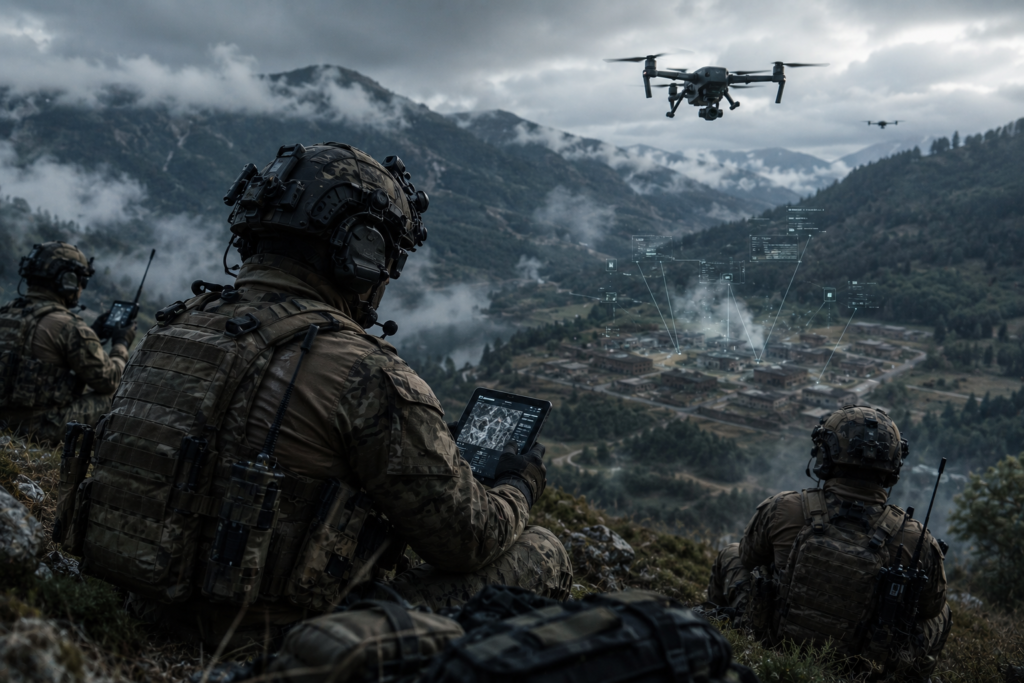
Image Credits: Are drones transforming the traditional Special Forces operator into a reconnaissance, targeting and electronic warfare specialist?. AI-generated illustration created by Open Chronicle using ChatGPT (OpenAI). August 2026. This image is illustrative and does not depict a real-world scene.
By Open Chronicle Military Desk
For generations, Special Operations Forces have depended on a simple but powerful advantage: the ability to operate where the enemy does not know they are.
Small teams could infiltrate hostile territory, observe targets, gather intelligence and direct attacks while remaining concealed. Darkness, terrain, camouflage, communications discipline and superior training allowed elite units to operate deep behind enemy lines with relatively small footprints.
The modern drone battlefield is challenging that assumption.
Persistent aerial surveillance, thermal cameras, first-person-view drones, loitering munitions, electronic intelligence and increasingly sophisticated battlefield sensors are making it harder for soldiers to disappear.
At the same time, those same technologies are giving Special Operations Forces capabilities that previous generations could barely have imagined.
A small team can now launch its own reconnaissance aircraft, observe terrain kilometres away, identify potential targets, transmit information across digital networks and help coordinate precision strikes without physically approaching an objective.
The result is a profound transformation of the Special Forces operator.
The commando is not disappearing.
But increasingly, the commando is also becoming a sensor operator, intelligence collector, targeting specialist and participant in the electromagnetic battle.
The battlefield is becoming transparent
The war in Ukraine has provided perhaps the clearest demonstration yet of what persistent surveillance means for ground forces.
Thousands of unmanned aircraft operate across different parts of the battlespace.
Some are inexpensive commercial quadcopters adapted for military reconnaissance. Others are purpose built surveillance aircraft capable of remaining airborne for extended periods.
FPV drones can pursue vehicles and individual soldiers. Larger unmanned systems can search areas considerably farther behind the front.
Thermal sensors allow observation at night.
Electronic warfare systems search for radio transmissions and other emissions.
Satellite imagery and other intelligence sources add additional layers of observation.
Together, these technologies are creating something military planners have feared for decades: a battlefield where hiding becomes progressively more difficult.
For Special Operations Forces, this matters enormously.
Their effectiveness has historically depended partly on being able to operate inside the gaps of an adversary’s surveillance network.
Those gaps are becoming smaller.
Invisibility no longer means camouflage
A Special Forces team hidden inside a forest may be invisible to the human eye.
That does not necessarily mean it is undetectable.
A thermal sensor might identify body heat.
A reconnaissance drone could notice disturbed vegetation or unusual movement.
Electronic intelligence equipment could potentially detect transmissions.
A drone control signal might reveal activity in an area.
Even vehicles, generators and other equipment can contribute to a unit’s overall signature.
This changes the definition of concealment.
The operator must increasingly think about several forms of visibility simultaneously.
There is visual visibility.
There is thermal visibility.
There is acoustic visibility.
And increasingly important, there is electromagnetic visibility.
The modern SOF operator must therefore understand not simply how to hide from an enemy soldier, but how to hide from an entire network of sensors.
Electronic warfare becomes fieldcraft
This is why electronic warfare is moving closer to the individual operator.
Traditionally, electronic warfare could be regarded as the responsibility of specialised military formations equipped with sophisticated systems.
That distinction is becoming less useful.
When drones, radios, sensors and communications networks are present throughout the battlefield, understanding the electromagnetic environment becomes part of basic survival.
A Special Operations team must know that transmitting information can create risk.
It must understand that hostile forces may attempt to locate electronic emissions.
It needs communications that remain useful in heavily contested environments.
It may also require portable counter-drone systems capable of disrupting hostile unmanned aircraft.
Electronic warfare therefore begins to resemble another form of fieldcraft.
Previous generations learned how to hide tracks, minimise noise and camouflage positions.
Future operators may have to apply the same discipline to electronic signatures.
The Special Forces team becomes its own reconnaissance network
There is another side to this transformation.
Drones make Special Operations Forces considerably more capable.
Traditionally, reconnaissance behind enemy lines often required physically placing operators where they could observe an objective.
That could involve considerable risk.
A drone changes the geometry of the mission.
Instead of moving onto a ridge to see what lies beyond it, a team can potentially send an unmanned aircraft.
Instead of approaching a road intersection, operators can observe it remotely.
Potential landing zones can be examined before helicopters arrive.
Routes can be checked for hostile activity.
An objective can potentially be monitored without placing a soldier directly beside it.
One team can also operate more than one sensor.
That means a handful of Special Forces operators can potentially observe an area that would previously have required several reconnaissance positions.
The team effectively becomes its own miniature intelligence network.
From reconnaissance to targeting
Finding something is only the beginning.
Modern military networks can increasingly move information rapidly between the sensor detecting a target and the system capable of attacking it.
Special Operations Forces have performed this function for decades.
Operators have identified targets and helped direct aircraft, artillery and other weapons against them.
Drones dramatically expand that capability.
A SOF team operating its own unmanned systems can potentially maintain observation of a target while passing information to other forces.
The team itself may never engage the target directly.
Instead, its most important contribution could be producing accurate information that allows another platform to act.
This changes how military power should be measured.
A small Special Forces patrol may contain only a handful of soldiers.
But if those soldiers can connect reconnaissance drones, intelligence networks, precision artillery and combat aircraft, their influence can extend far beyond the weapons they physically carry.
The operator becomes a node connecting sensors with decision makers and ultimately with strike systems.
The rifle remains, but the tablet matters too
The visual image of Special Forces has traditionally centred on weapons.
The future operator may be just as dependent on screens, antennas, sensors and software.
Digital maps can display friendly and hostile positions.
Drone feeds can provide live imagery.
Communications systems can connect dispersed units.
Artificial intelligence may increasingly assist with analysing information generated by numerous battlefield sensors.
The amount of data available to a small unit is becoming enormous.
The challenge is no longer simply obtaining information.
It is deciding which information matters.
That places greater emphasis on judgment.
A Special Forces operator must understand what a drone is showing, determine whether the information is reliable and decide whether it is tactically significant.
Technology does not remove the human from reconnaissance.
It changes what the human must understand.
FPV drones threaten the traditional SOF advantage
The same technology providing extraordinary reconnaissance capabilities also creates one of the most serious threats to small teams.
FPV drones have demonstrated that relatively inexpensive aircraft can become precision attack weapons.
Their speed and manoeuvrability allow operators to pursue vehicles, enter structures and attack exposed personnel.
For a Special Operations team, this presents a particularly difficult problem.
SOF frequently operate without the heavy protection available to larger conventional formations.
They depend instead on concealment, mobility and surprise.
Once detected by a hostile drone network, those advantages can deteriorate quickly.
An observation position can become a target.
A vehicle concealed away from a road can be followed.
A team withdrawing after completing a mission can potentially be pursued.
Counter UAS capability consequently becomes part of force protection.
Counter drone warfare must become portable
Large conventional formations can deploy sophisticated counter-drone equipment.
Radar systems can detect aircraft.
Electronic warfare vehicles can disrupt control links.
Air defence systems can destroy larger threats.
Special Operations Forces cannot always carry that infrastructure.
A small team operating deep inside contested territory requires considerably lighter solutions.
Detection systems need to be portable.
Electronic countermeasures need to operate with limited power.
Defensive weapons need to be sufficiently compact to accompany operators.
Most importantly, the team must understand how the different defensive layers interact.
Sometimes concealment will remain the best defence.
Sometimes electronic warfare may be appropriate.
Sometimes moving immediately will be more important than attempting to engage a drone.
The essential requirement is awareness that the threat exists continuously.
Drones could make SOF teams smaller
Technology may also influence the size and organisation of Special Operations teams.
If one operator can control several sensors, and if those sensors can observe territory that previously required multiple soldiers, certain missions could potentially be conducted by smaller distributed elements.
Instead of concentrating a team around one observation position, operators might disperse.
One element could manage reconnaissance systems.
Another could maintain communications.
Another could coordinate targeting.
The physical distance between operators could increase while digital networks keep them connected.
This offers advantages.
A dispersed team is more difficult to destroy with a single attack.
It can observe a larger area.
It can create uncertainty about its true location.
But dispersion creates another dependency.
Communications become absolutely critical.
The communications paradox
This produces one of the central contradictions of future Special Operations.
SOF need connectivity more than ever.
They also need to transmit less predictably than ever.
Drones generate data.
Intelligence networks distribute information.
Commanders need updates.
Targeting information may need to reach another platform quickly.
All of this requires communications.
But communications can create electronic signatures.
The more connected a team becomes, the greater the danger that connectivity itself becomes a vulnerability.
Future Special Operations communications must therefore be secure, resilient and capable of operating in environments where an adversary is actively searching for transmissions.
The operator must also know when silence is more valuable than connectivity.
That is as much a question of discipline as technology.
Artificial intelligence adds another layer
Artificial intelligence could make this network considerably more powerful.
A Special Forces team operating several drones might receive more imagery than its members can analyse continuously.
Additional information could arrive from aircraft, satellites, electronic sensors and other units.
AI systems could help organise that information.
They may assist in detecting unusual movement, identifying objects or prioritising information for human review.
This could allow a small team to manage a much larger sensor network.
But automation also creates risk.
Machines can misidentify objects.
Algorithms can operate with incomplete information.
An apparently obvious pattern may have an innocent explanation.
For Special Operations Forces, which frequently operate in politically sensitive environments, a mistake can have strategic consequences.
Human judgment therefore remains essential.
Special Forces as multi-domain operators
The emerging operator increasingly works across several domains simultaneously.
On the ground, the team must manoeuvre and survive.
In the air, it may control unmanned aircraft.
Across the electromagnetic spectrum, it must protect communications while understanding hostile electronic activity.
Through digital networks, it exchanges intelligence with other units.
It may also help connect targets to effects originating hundreds of kilometres away.
This is very different from the popular image of Special Forces as simply exceptionally capable infantry.
The modern SOF team increasingly acts as an interface between the physical battlefield and the larger technological architecture surrounding it.
Its greatest weapon may sometimes be the ability to connect systems that would otherwise remain separate.
Old skills become important again
Yet the technological revolution is producing a curious effect.
Some of the oldest Special Forces skills may become more valuable rather than less.
Camouflage matters because drones are watching.
Deception matters because sensors can be fooled.
Movement discipline matters because persistent surveillance punishes predictable behaviour.
Fieldcraft matters because electronic systems cannot always be trusted.
Navigation without constant electronic assistance may become important when satellite signals are jammed.
Communications discipline becomes critical when transmissions can expose a position.
Operators may sometimes deliberately abandon sophisticated technology because using it creates more risk than benefit.
The future commando therefore combines extremely modern capabilities with very traditional soldiering.
The end of easy sanctuary
For decades, military forces often assumed that territory sufficiently far behind the front line offered some degree of protection.
Long range drones and precision weapons are eroding that assumption.
Command posts, logistics centres, airfields and military infrastructure deep inside supposedly secure territory can increasingly be observed and attacked.
Special Operations Forces face the same reality.
Being behind enemy lines no longer necessarily means operating beyond the enemy’s principal surveillance and strike systems.
In some situations, the rear may be filled with drones precisely because important targets are located there.
This makes infiltration more complicated.
It also makes Special Operations Forces more valuable.
SOF teams capable of operating inside such environments can provide intelligence that conventional forces may struggle to obtain.
Training must change
The Special Forces operator of the future therefore requires an expanding skill set.
Weapons, demolitions, medicine, communications, languages, survival and partner force training remain important.
But additional competencies are emerging.
Operators increasingly need familiarity with unmanned systems.
They need counter UAS awareness.
They need an understanding of electronic warfare.
They need to interpret digital intelligence.
They need to manage electromagnetic signatures.
They may need to work alongside autonomous systems and AI enabled analytical tools.
No individual can become an expert in everything.
The challenge for Special Operations organisations will be deciding which capabilities belong with every operator and which require specialists embedded within teams.
That organisational question could shape SOF structures for decades.
The human advantage
There is a danger in assuming that technology itself defines the future of Special Operations.
It does not.
A drone can observe a village.
It cannot automatically understand the relationships among the people living there.
A sensor can detect a radio transmission.
It may not understand why someone transmitted.
Artificial intelligence can recognise patterns.
It cannot necessarily understand the political consequences of acting on them.
Special Operations Forces have historically been valuable precisely because they combine military capability with human judgment.
Operators work with foreign militaries, resistance movements, local communities and political authorities.
They frequently operate in ambiguous situations where understanding context matters as much as identifying targets.
Technology amplifies that human capability.
It does not replace it.
A different kind of Special Forces operator
So, are drones transforming the traditional Special Forces operator into a reconnaissance, targeting and electronic warfare specialist?
The answer is increasingly yes.
But that transformation should not be understood as the disappearance of the traditional commando.
It is an expansion of the profession.
The future operator still needs to infiltrate.
Still needs to navigate.
Still needs to survive independently.
Still needs to fight when necessary.
But the operator must increasingly understand the invisible architecture surrounding the battlefield.
Drones overhead.
Electronic emissions across the spectrum.
Digital networks connecting sensors and weapons.
Artificial intelligence filtering information.
Precision systems capable of striking from enormous distances.
The Special Forces operator increasingly sits at the centre of those systems.
The new meaning of invisibility
Perhaps the greatest change is conceptual.
For previous generations, remaining invisible largely meant preventing the enemy from seeing you.
On the modern battlefield, invisibility has become multidimensional.
A team must minimise its visual signature.
Its thermal signature.
Its acoustic signature.
Its digital signature.
Its electromagnetic signature.
And potentially even the behavioural patterns that artificial intelligence systems could use to identify unusual activity.
That is a radically more demanding environment.
But Special Operations Forces have always existed partly to solve problems that conventional military formations cannot easily solve.
The drone battlefield is creating exactly that kind of problem.
The elite operator of the future may therefore look familiar from a distance: camouflage, weapons, helmet and equipment.
What has changed is everything surrounding that operator.
The battlefield is becoming a network of sensors.
And the Special Forces operator is becoming both one of its most sophisticated sensors and one of the most difficult targets within it.