
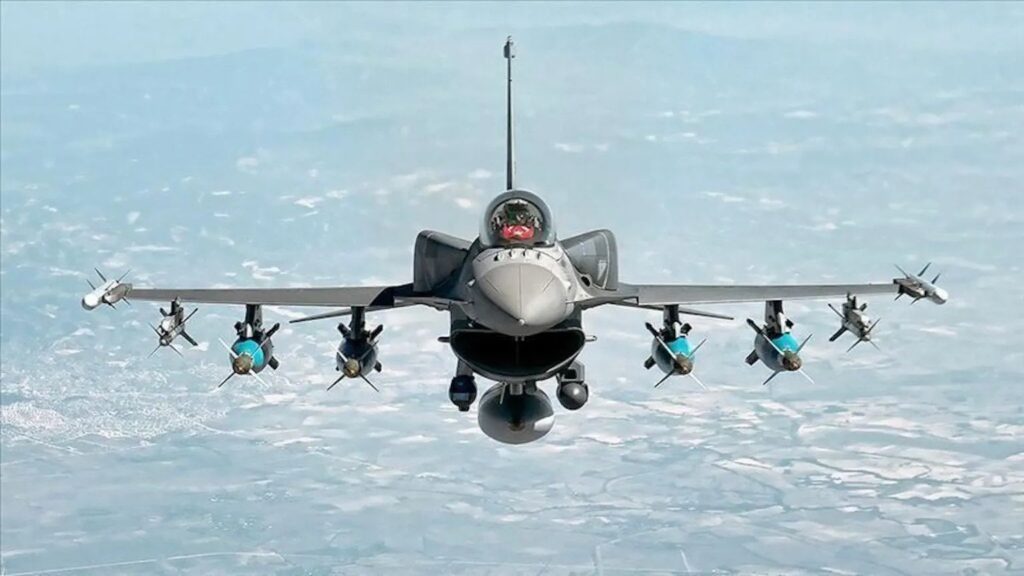
Image: from Tactical Tribune X @TacticalTribun
By Open Chronicle with agencies
A Turkish Air Force F-16 fighter jet crashed during a training flight in northwestern Turkey on Wednesday, August 12, with the pilot ejecting safely and no casualties reported on the ground, according to Turkish authorities.
The aircraft was conducting a training mission over Yalova Province when the accident occurred at approximately 15:00 local time. The Turkish Ministry of National Defense said the fighter belonged to a squadron operating from the 1st Main Jet Base at Eskişehir.
The pilot successfully activated the aircraft’s ejection system before the F-16 came down and was subsequently recovered unharmed.
Emergency services were immediately deployed to the crash site, while the Turkish Air Force opened an investigation to determine what caused the accident.
BREAKING: The Turkish Defense Ministry said a military F-16 jet crashed in Türkiye’s Yalova province during a training flight.
The pilot survived the crash. pic.twitter.com/mOKmf4jzJh
— Clash Report (@clashreport) August 12, 2026
The F-16 came down near a military installation
Yalova Governor Ahmet Hamdi Usta visited the crash site and said the fighter came down immediately next to the 18th Main Base Command, a Turkish Air Force installation in Yalova Province.
Despite the proximity of the crash to military facilities, there were no casualties among either civilian or military personnel on the ground.
Teams from Turkey’s Disaster and Emergency Management Presidency, AFAD, medical rescue units, and the fire service were dispatched following the accident.
Emergency personnel were able to reach the wreckage without encountering a major fire.
The absence of a post-crash fire potentially gives investigators an opportunity to recover important components from the aircraft as they attempt to establish what happened during the final moments of the flight.
Pilot taken to hospital
The pilot was recovered safely following the ejection.
Turkish media reported that the aviator was transported to Yalova Training and Research Hospital for medical assessment.
Authorities said the pilot was unharmed.
Modern fighter aircraft ejection systems are designed to allow aircrew to escape aircraft experiencing catastrophic technical failures or loss of control, although an ejection itself exposes pilots to significant physical forces.
The successful escape meant Wednesday’s accident ended without fatalities.
Officials rule out mid-air collision
One of the immediate questions surrounding the crash was whether another aircraft had been involved.
Usta rejected that possibility.
The governor said the incident involved only one aircraft and confirmed that there had been no mid-air collision.
He suggested that the F-16 may have suffered a technical problem, although he emphasised that this remained preliminary and that the official investigation would establish the cause.
The Turkish Ministry of National Defense similarly avoided speculating about what caused the accident.
A detailed technical investigation has now begun.
Aircraft had flown from Eskişehir
The F-16 had taken off from Eskişehir, one of the principal bases used by the Turkish Air Force.
According to the governor, fighter aircraft from Eskişehir and Bandırma periodically conduct flights around the Yalova facility, where Air Force Academy students and candidates undergo training.
The missions are partly intended to expose trainees to operational aviation activity and encourage future military aviators.
Wednesday’s aircraft was carrying out such a training flight when the accident occurred.
The circumstances leading to the pilot’s decision to eject have not yet been publicly established.
Investigation team begins work
An accident investigation team was sent to the site and began examining the wreckage.
Military aviation investigations typically examine numerous potential factors, including aircraft systems, engine performance, flight controls, maintenance records, weather conditions, and pilot actions.
Investigators will also seek to reconstruct the aircraft’s flight immediately before the crash.
The condition of the wreckage, together with available flight and maintenance data, could help establish whether a mechanical or technical malfunction occurred.
Until that investigation is completed, Turkish authorities have not identified an official cause.
Second Turkish F-16 lost in 2026
Wednesday’s accident represents the second reported Turkish Air Force F-16 loss this year.
On February 25, another F 16 assigned to the 9th Main Jet Base Command crashed shortly after departing Balıkesir during a night flight.
That accident had a very different outcome.
The pilot, Major İbrahim Bolat, was killed.
The two accidents occurring within several months of each other are likely to attract attention to the operational demands placed on Turkey’s large F-16 fleet, although there is currently no evidence indicating that the crashes were connected or resulted from the same type of problem.
Turkey operates one of the world’s largest F-16 fleets
The F-16 remains a central component of Turkish air power.
Turkey operates more than 230 aircraft of the type, giving it the largest F-16 fleet outside the United States Air Force.
The aircraft perform a wide range of missions, including air defence, training, strike operations and NATO responsibilities.
Turkey’s relationship with the F-16 also extends beyond operating the aircraft.
A substantial number of Turkish F-16s were assembled domestically under licence, helping Ankara develop an important aerospace industrial base and significant experience maintaining and upgrading combat aircraft.
But much of the fleet has now been operating for decades, making modernisation increasingly important.
Ankara is modernising its combat aviation fleet
Turkey is pursuing several programmes simultaneously as it prepares the Turkish Air Force for the coming decades.
One element is the acquisition of newer F-16 Block 70 aircraft and modernisation packages for parts of the existing fleet.
The Block 70 incorporates significant improvements over earlier F-16 variants, including advanced avionics and radar technology.
Modernising existing fighters is intended to preserve Turkey’s operational capabilities while newer aircraft enter service.
The programme is particularly important because the F-16 will remain a major part of Turkish air power for years even as Ankara develops and acquires other combat aircraft.
Eurofighter Typhoon adds another element
Turkey’s future fighter force is not being built around the F-16 alone.
Ankara also signed a contract with the United Kingdom in October 2025 involving the Eurofighter Typhoon.
The acquisition gives Turkey another advanced Western combat aircraft and could provide additional capability while the country’s indigenous fighter programme develops.
The Typhoon is operated by several NATO members and has evolved into a multirole platform capable of conducting both air-to-air and strike missions.
For Turkey, combining upgraded F-16s with Eurofighters could provide an important bridge toward the next generation of combat aviation.
KAAN represents Turkey’s long-term ambition
The most strategically significant element of Ankara’s plans is the domestically developed KAAN fighter.
Turkey is developing KAAN as an advanced combat aircraft intended eventually to become a central component of its air force.
The programme has reached another important stage in 2026.
The P1 prototype completed its first taxi test on July 31, marking another milestone in the development process.
KAAN also represents something larger than a replacement fighter programme.
It reflects Turkey’s broader strategy of reducing dependence on foreign defence suppliers while expanding the technological capabilities of its domestic aerospace industry.
The project will require years of development before reaching full operational maturity, meaning the existing F-16 fleet remains indispensable in the meantime.
Maintaining an ageing but essential fleet
That transition creates an important challenge for the Turkish Air Force.
Turkey must continue operating a large fleet of existing fighters while simultaneously introducing upgraded F-16s, acquiring Eurofighters and developing KAAN.
Maintaining operational readiness across an ageing combat aircraft fleet requires extensive maintenance, spare parts, pilot training and continuous technical monitoring.
Training flights are an unavoidable part of that process.
They allow pilots to maintain proficiency and prepare for operational missions, but military aviation inherently carries risk, particularly when aircraft operate at high speeds and under demanding flight conditions.
Wednesday’s accident demonstrates that risk.
The pilot’s survival prevents another fatal loss
The most important immediate outcome was the pilot’s successful ejection.
Unlike the fatal Balıkesir accident in February, the Yalova crash resulted in no reported deaths either in the aircraft or on the ground.
The fact that the fighter came down close to a military installation without causing additional casualties also prevented the accident from becoming significantly more serious.
Investigators must now determine why the aircraft was lost.
If a technical malfunction is confirmed, the investigation will seek to identify whether the problem was isolated or whether inspections or other measures are required across similar aircraft.
For the Turkish Air Force, the findings will matter beyond the loss of a single fighter.
The F-16 remains one of the foundations of Turkey’s air defence capability and will continue flying alongside newer aircraft as Ankara undertakes one of the most ambitious combat aviation modernisation programmes in its history.